NR-341 Week 6, in our teaching judgment, turns from the failing body to the people deciding about it: the goals-of-care conference write-up, a written analysis of a family meeting around a critically ill adult, examining the communication, the ethical structure and the nursing role inside it, and demonstrating that you can write about dying, uncertainty and surrogate decision making in a professional register. Most students will not witness such a conference during 48 clinical hours, which is precisely why the analysis happens on paper. Your section may print this as NR 341 or NR341; it is the same course. Chamberlain publishes no syllabi outside Canvas. The placement here is our teaching judgment from the course's catalog arc; your section's rubric decides what your week actually asks.
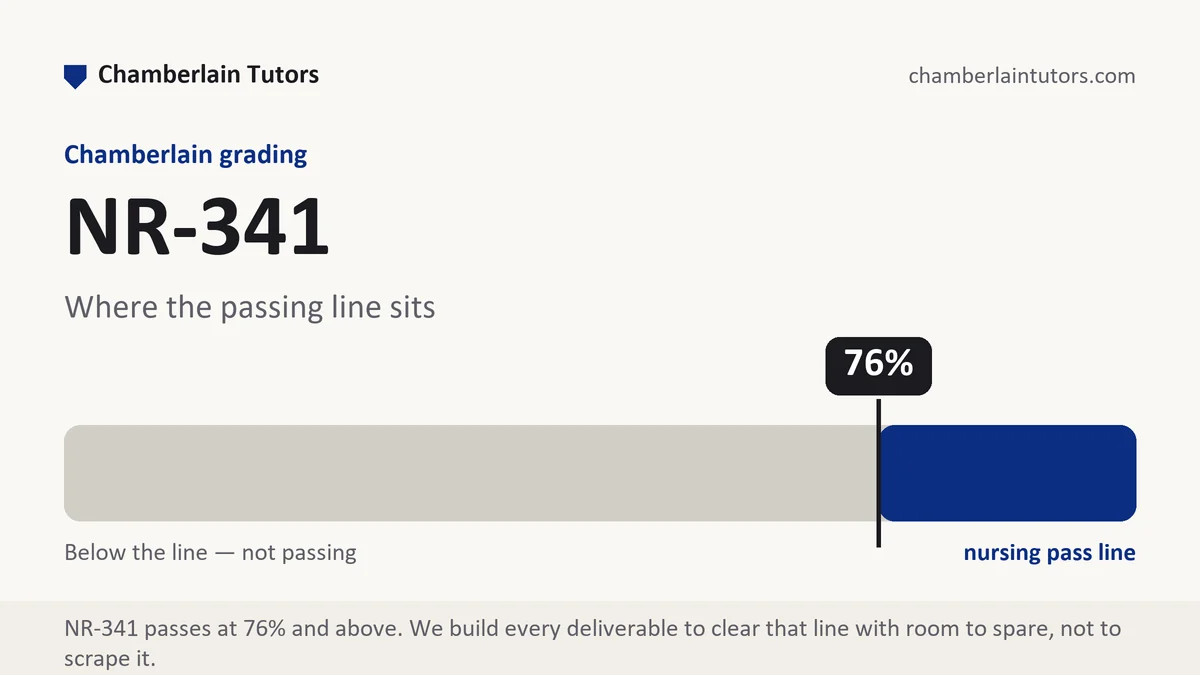
What NR-341 Week 6 asks for
Six days into a ventilator admission, the sons of a 79-year-old woman join a video call from two different time zones, and the meeting that follows will decide more than any infusion running upstairs. Their mother suffered a massive stroke; she is breathing on support, responding to little, and the team on the call, an intensivist, the bedside nurse, a palliative consultant, has asked the family to think about what she would want, a question the older son answers with everything possible and the younger with she never wanted this. The camera makes the distances visible: one son's grief runs ahead of the medicine, the other's runs behind it, and the nurse on the call is the person who has spent the most hours with the woman none of them can ask. Cases at this level put you in that meeting on purpose, because complex adult health is not only cascades and pressors; it is the moment the numbers stop being the point.
The written work at this stage, in our judgment, analyzes that meeting rather than scripting a fantasy version of it. The genre asks three things. First, communication analysis: what was said, how information moved or failed to move, where jargon blocked understanding, how conflict between surrogates was surfaced and held. Second, ethical structure: which principles are genuinely in tension, what surrogate decision making is supposed to weigh, the patient's own voice as prior statements and values, not the family's preferences, and where the case's documents, if any exist, bear on the question. Third, and graded hardest, the nursing role: what the bedside nurse uniquely contributes, the longitudinal observation, the translation of clinical language, the advocacy for the patient's previously expressed wishes, and the boundaries of that role, because the nurse neither decides the medical facts nor makes the family's decision for them.
Register is half of this assignment. Writing about dying invites two failures that rubrics punish from opposite directions: clinical detachment so complete the family becomes a logistics problem, and sentimentality so thick the analysis dissolves. The professional middle voice, precise about facts, plain about suffering, respectful without performance, is a learnable register, and this paper is where you practice it. That practice matters beyond the grade; the conference write-up is rehearsal for conversations your license will one day put you in, at whatever bedside, and the students who take the rehearsal seriously arrive at those conversations with sentences they have already built once.
The boundary, in this week's terms: real goals-of-care conversations belong to real teams and real families, and any you witness during clinical hours are confidential clinical experiences governed by your program's rules, your own to hold and never material a tutor touches. The case-based analysis is the written rehearsal layer, and it is all this manual serves.
The NR-341 Week 6 method, step by step
Six moves that hold a hard conversation still enough to examine.
-
Establish the clinical floor in three sentences
Summarize what is medically true and what is genuinely uncertain, with the uncertainty stated as ranges rather than evasions. Every later analysis stands on this floor, and a write-up that fudges the prognosis to soften the meeting has corrupted its own data.
-
Map the voices and what each carries
Identify every party in the conference and the distinct thing each brings: the intensivist's prognosis, the nurse's longitudinal observation, each surrogate's version of the patient's values, the palliative clinician's framing. Conflict analysis starts from an accurate map of who holds what.
-
Analyze the communication mechanics, not just the content
Trace how information actually moved: where jargon was translated or was not, where a question was answered with a statistic, where silence did work, how the video medium helped and hurt. Communication is the case's observable behavior, and analyzing it beats judging it.
-
Structure the ethical tension with named principles
Write the genuine tension, honoring the patient's expressed values against a surrogate's hope, benefit against burden, and anchor each side in the ethical framework your program teaches, cited. Name what surrogates are being asked to do, speak as the patient would, because most conference conflict is that standard misunderstood.
-
Define the nursing contribution and its edges
State what the nurse in the case did or should do: translate, witness, report the longitudinal picture, advocate for previously expressed wishes, support the family's process. Then draw the edges, no prognosis-making, no steering the decision, because the edges are as graded as the contribution.
-
Write the follow-through beyond the meeting
Close with what happens after the conference regardless of its outcome: what gets documented, what the bedside care plan does with the decisions or their absence, and what support the family and the staff need next. Conferences are events; care is continuous, and the write-up should know it.
A layout and word budget for a conference write-up
The frame below sizes a written product of roughly 1,000 to 1,250 words. It is our own outline rather than anything the university issues, and your section's rubric outranks it wherever the two disagree.
| Component | What belongs in it | Word target |
|---|---|---|
| Clinical floor | The medical situation and its honest uncertainties, de-identified, in plain declarative sentences. | 120 to 150 |
| Voice map | The conference parties and the distinct knowledge, authority or values each carries into the room. | 140 to 180 |
| Communication analysis | How information and emotion actually moved, including the effects of the medium, with moments quoted or closely described. | 200 to 250 |
| Ethical structure | The genuine tension in named, cited principles, and the surrogate standard applied accurately. | 200 to 240 |
| Nursing role and edges | The nurse's unique contributions and the boundaries that keep them nursing, both argued. | 170 to 210 |
| Follow-through | Documentation, care plan consequences and support needs after the meeting, whatever was decided. | 120 to 150 |
Evidence craft for goals-of-care writing
Cite the ethics at the principle level. Claims about autonomy, surrogate standards, benefit and burden come from the ethical framework and professional code your program teaches, and each principle is cited where it enters the argument, not gathered in a final paragraph. Ethics without sources reads as sentiment, and this genre is graded against that exact slide.
Keep prognostic claims inside the case's own data. The write-up inherits whatever the case's clinicians stated about likely outcomes, and your analysis works with those statements; inventing sharper numbers than the case provides, in either direction, is fabrication in the genre where fabrication does the most damage.
Quote the meeting precisely where analysis leans on it. When your communication analysis turns on a specific exchange, reproduce it exactly as the case gives it, briefly, and analyze the actual words. Paraphrase that shades what was said, softer or harsher, is the subtle dishonesty graders in this territory read for.
Hold the professional middle register throughout. Plain words for hard facts, dying rather than euphemism chains; no clinical slang for human events; no exclamation of feeling where description of behavior serves. The register is itself evidence, of exactly the professional formation this week exists to build, and it is assessed on every page whether the rubric names it or not.
Five mistakes that cost points in this week's territory
- Scripting a fantasy conference. Rewriting the meeting so everyone communicates perfectly analyzes nothing; the assignment is the meeting that happened, frictions included.
- Ethics as vocabulary. Dropping principle names without applying them to the actual tension converts the paper's spine into decoration.
- The nurse as hero or as furniture. Overwriting the nursing role into decision maker, or underwriting it into silent presence, both misstate the profession; the graded answer is the specific contribution with its edges.
- Surrogate standard confusion. Treating the family's preferences as the question, rather than the patient's values spoken through them, misses the exact distinction the conference exists to hold.
- Register failure in either direction. Detachment that turns grief into logistics, or sentimentality that abandons analysis, each forfeits the professionalism this genre is really grading.
Before you submit
- The clinical floor states facts and uncertainties without fudging
- Every conference voice is mapped with what it uniquely carries
- Communication analysis works from actual exchanges, quoted precisely
- The ethical tension is structured in named, cited principles
- The nursing role appears with both its contributions and its edges
- The register holds the professional middle on every page
Writing the conference analysis for NR-341?
Send the case and the rubric out of Canvas. A premium original draft comes back in 24 to 48 hours with the ethics structured, the nursing role edged and the register held, and revisions run until the grade lands. Real conversations, real families and your clinical hours stay yours alone.