NR-302 Health Assessment I is part one of Chamberlain's two-part assessment sequence, carrying 1.5 theory credits and a half credit of lab across 16 lab hours. What it grades in writing is not whether you can auscultate. It grades whether your written record of a history and an examination reads the way a nurse's record has to read: sourced, ordered, specific, and free of the guesses students slip in when memory runs out. This page is the manual for that written half.
What NR-302 actually grades
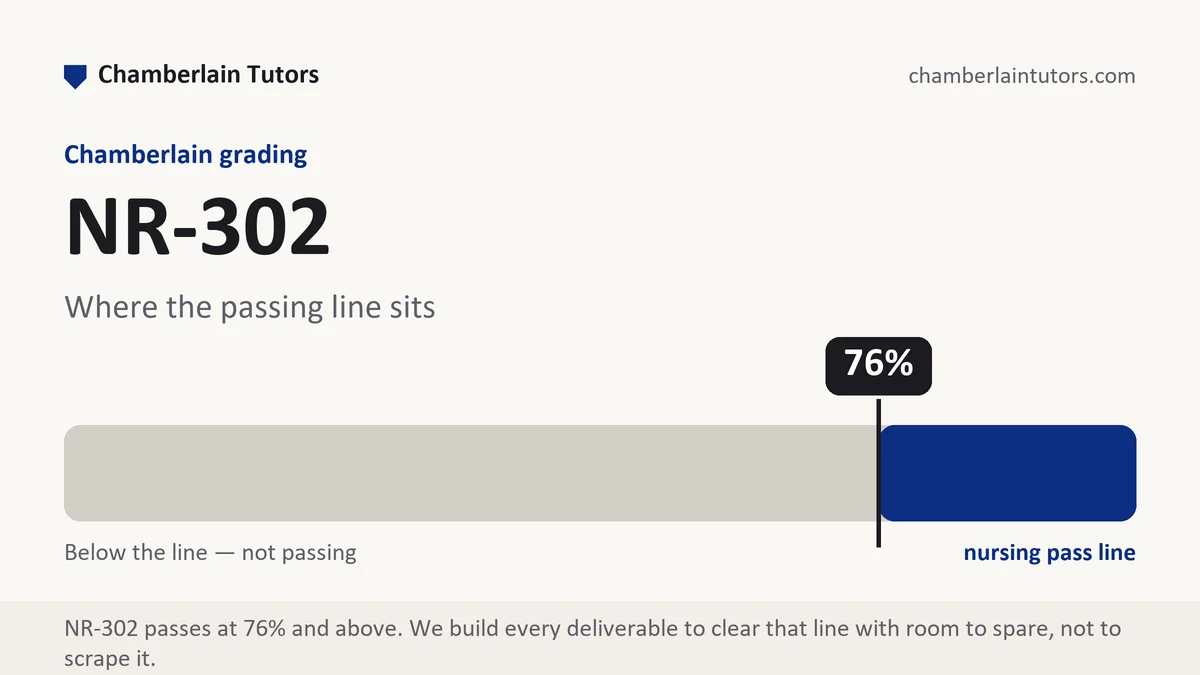
The catalog scope is patient history taking, interview and communication technique, and the four physical examination techniques of inspection, palpation, percussion and auscultation. Those four verbs are performed in lab. They are graded in prose. A written assessment record has to show that you asked in a defensible order, that you heard the answer rather than the answer you expected, and that what you observed is written as observation instead of as conclusion. The 76 percent floor that governs core nursing courses applies here, and the arithmetic behind it is unforgiving in a two-credit course, because a two-credit course has few graded pieces and each one carries more of the average than students assume.
The habit that separates a scoring record from a losing one is the boundary between what the patient reported and what you found. A grader can spot a blurred boundary in a single line. "Patient appears anxious about the procedure" is a conclusion wearing an observation's clothes; "patient reports feeling nervous, sits forward, answers in short phrases" is the same paragraph rewritten so a reader can check it.
How we help in this course
We write the paper half. Interview write-ups, history records, communication analyses, discussion posts and the reflective pieces that ride alongside the lab hours all come back as full model drafts in your voice register, with the subjective and objective boundary held cleanly and every claim traced to something a patient said or a nurse saw. Your lab hours, your check-offs and any hands-on demonstration are yours alone; we do not sit them, film them, or sign anything about them, and no honest service would.
What the model draft gives you is a shape to imitate for the rest of the sequence. Health assessment writing is a form with rules, and once the form is in your hands the second course gets easier rather than harder.
In NR-302 right now?
Send the week and the rubric from Canvas. First premium sample free, floor-checked, back in 24 to 48 hours.
Read the rubric before you read the prompt
Open the scoring guide in Canvas first, every time. The prompt tells you the story of the assignment; the scoring guide tells you where the points live, and those are different documents written by the same person on different days. Copy the criterion rows into a blank file, one per line. Strip each row to its instruction verb: obtain, document, differentiate, communicate, reflect. Those verbs are your headings, kept in the order the guide lists them so that a grader working down the rows meets your sections in the same sequence.
Then convert weight into words, because weight is a depth instruction in disguise. Say the record is capped at 1,000 words and the guide carries four rows weighted 40, 30, 20 and 10 percent. Multiply straight through: the 40 percent row is worth about 400 words, the 30 percent row 300, the 20 percent row 200, and the 10 percent row 100. In an assessment course the heaviest row is almost always the subjective history rather than the physical findings, which surprises students who spent the week practicing percussion. If your history section runs 120 words and your findings section runs 600, you have inverted the guide and no amount of technical accuracy will win those points back. Headers, references and any appendix sit outside the count unless the guide says otherwise.
Keep the budget on screen while you draft. Put the target in brackets after each heading and delete it only when the section reaches its number. A section 150 words under its share is not concise; it is under-evidenced, and the guide is telling you so in advance.
The shape of a history and interview record
Nearly every written piece in this half of the sequence is a history record in some costume: a full write-up, a focused interview, or a short post carrying the same demands in fewer words. These parts recur, and each one has a job a grader can either find or fail to find.
| Part | What it has to prove | How a thin version looks |
|---|---|---|
| Identifying data and source | Who gave you the information and how reliable it is, said in one line before anything else. | Demographics with no note on who is speaking or how well. |
| Reason for the visit, in the patient's words | That you recorded the concern as stated rather than as translated into a diagnosis. | A clinical label the patient never used. |
| History of the present concern | Onset, location, duration, character, aggravating and relieving factors, timing and severity, each answered rather than listed. | Two sentences that skip straight to what you think it is. |
| Relevant history and medication review | Only the past history that bears on this concern, with the reason for including it visible. | An undigested list copied from an intake form. |
| Interview technique described | The open question you opened with, where you used silence, how you handled a difficult answer. | A claim that rapport was established, with no line of dialogue to prove it. |
| Objective findings by technique | What inspection, palpation, percussion and auscultation each produced, named as findings and not as impressions. | Normal written across a system that was never actually examined. |
| Summary and next step | What the record adds up to and what you would ask or examine next, at a first-course scope. | A diagnosis pronounced by a student who is not diagnosing yet. |
Evidence and citation craft at this level
Assessment writing cites less than a theory paper does, but what it cites has to be handled properly, and the same four habits carry the difference all the way through the program.
Current sources, checked and not assumed. Treat anything older than five years as needing a stated reason to appear. A classic description of an examination technique earns its place; a decade-old prevalence figure for a symptom does not, because the number has moved and your grader may know it has.
Design and sample before the finding. Never let a result land undressed. Say what kind of study produced it and how many people it studied before you say what it found. "In a cross-sectional study of 1,410 primary care patients" costs eight words and turns an assertion into evidence.
Verbs that match the design. Observational work supports "was associated with", "occurred more often among", "predicted". Only controlled experimental work supports "caused" or "produced". Attaching a causal verb to correlational evidence is a documentation error with a citation attached, and graders in assessment courses read for exactly that kind of overstatement.
Denominator and window before any rate. A percentage without a base and a time frame is decoration. Write "about one in six of the 900 adults screened reported the symptom in the preceding month" rather than "17 percent reported the symptom". The longer sentence is the one that earns the point, because it can be checked.
What separates a passing record from a strong one
A passing NR-302 record is complete. Every heading has content, the systems are covered, nothing is obviously wrong. It sits in the seventies and low eighties and its author cannot see why. The reason is almost always specificity: the passing record describes categories where the strong record reports instances. "Lung sounds clear" is a category. "Vesicular breath sounds in all lobes, no adventitious sounds on quiet inspiration" is an instance, and instances are what a grader can score.
A strong record differs in three visible ways. It quotes the patient at least once, so the interview is evidenced rather than claimed. It reports negatives that matter, because a documented absence tells a reader you looked. And it keeps its scope honest: it stops at what a first assessment course asks for and says what it would examine next, instead of reaching for a diagnosis it has no business making. Specificity, evidenced dialogue, honest scope. Those three lift a record out of the middle band without adding a single page.
Mistakes that cost points here
- Writing conclusions into the subjective section. The patient's words belong there. Your interpretation belongs in the summary, and mixing them costs points in the heaviest weighted row of the guide.
- Documenting a system you did not examine. Blanket normals across every system read as filler. Record what you assessed, say what you deferred, and the record gains credibility instead of losing it.
- Losing the technique names. This course grades inspection, palpation, percussion and auscultation as distinct acts. A findings paragraph that never names which technique produced which finding leaves the grader nothing to check.
- Drafting a board response inside the post box. A submitted post cannot be reopened at Chamberlain, so every response is a single attempt. Write it in a document, read it aloud once, then paste.
- Abbreviating in a graded record. Shift shorthand that works on a unit reads as sloppiness in an academic write-up. Spell terms out on first use and keep the register formal.
- Filling the word count instead of the weights. A 1,000 word record with the sections in the wrong proportion scores below an 850 word record built on the guide's arithmetic.
Questions NR-302 students ask
My write-ups are accurate but keep scoring in the seventies. What is missing?
How much of a health history should a two-credit course actually cover?
Can you do my lab check-off or the hands-on portion?
Where NR-302 sits in Chamberlain's programs
Open the exact program map for sequence, credit, and option context. The current student schedule and syllabus remain authoritative after transfer evaluation, electives, state rules, and approved plan changes.
The weeks, one by one
Week 1
A health assessment course almost always opens with the interview: therapeutic communication, question technique, and the discipline of recording what a person actually said rather than what the listener concluded. Read the full Week 1 manual.
Week 2
After the interview comes the instrument it feeds: the complete health history, with its fixed sections, its symptom analysis attributes, and the review of systems. Read the full Week 2 manual.
Week 3
With the history in hand, an assessment course usually crosses into objective territory: the general survey, vital sign measurement, and the writing discipline that goes with numbers, exact values with units and conditions, never summaries of them. Read the full Week 3 manual.
Week 4
Assessment sequences typically give the integumentary system its own stage because skin is where descriptive writing is learned: color, moisture, temperature, turgor, and the discipline of describing a finding by its observable properties, size, shape, color, borders, location, instead of by its suspected name. Read the full Week 4 manual.
Week 5
Midway through the examination sequence comes the densest documentation territory in the course: head, eyes, ears, nose and throat, a region with more named structures and abbreviation traps per square inch than any other. Read the full Week 5 manual.
Week 6
The respiratory and cardiac stage is where auscultation enters the course, and with it the hardest documentation lesson so far: a sound is only a finding when its location, timing and quality are written down, which makes anatomical landmark language the real curriculum of the week. Read the full Week 6 manual.
Week 7
The catalog promises assessment across the lifespan, and the late-session stage is where that promise usually lands: how interviewing, history-taking and examination technique bend for children, older adults and everyone between, and how documentation must record which developmental lens the assessment used. Read the full Week 7 manual.
Week 8
Eight-week assessment courses converge on the integrated performance: the complete head-to-toe, where every regional skill runs in one continuous sequence, and its written twin, the full documented assessment that proves the sequence happened in order and in the taught vocabulary. Read the full Week 8 manual.