NR-293 Pharmacology for Nursing Practice is a three credit hour lecture course. The catalog frames it as clinical drug therapy approached through the nursing process, covering the major drug classifications, life-span implications, and selected complementary and alternative products. Its written work is graded on class reasoning rather than recall, and this page is about writing that reasoning down.
What NR-293 actually grades
The phrase to hold on to is major drug classifications. This course is not asking you to memorize a thousand agents, and any study plan built on that assumption collapses somewhere around week three. It is asking you to reason at the level of the class: what the class does at its site of action, what therefore happens in the patient, what therefore can go wrong, and what you therefore watch. Learn one prototype properly and the class travels with it. Written work is where a grader checks whether the travelling actually happened.
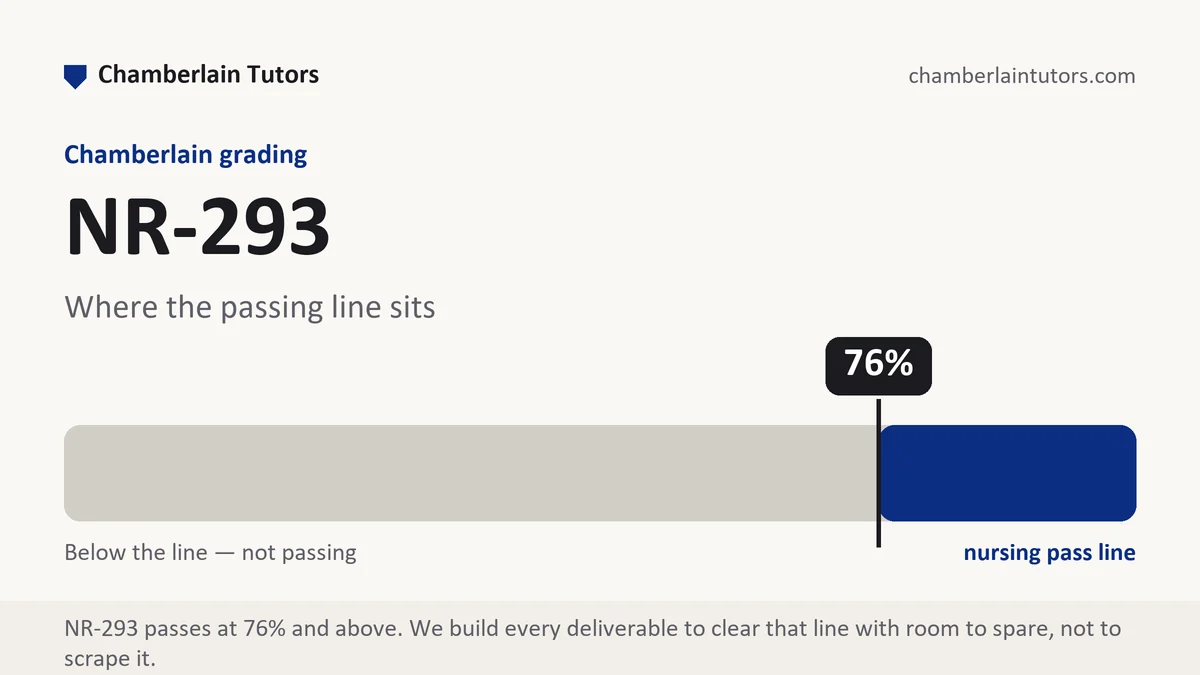
The nursing process framing in the catalog is a second instruction hiding in plain sight. Drug work here is expected to run assessment, analysis, planning, implementation and evaluation the same way patient work does, which is why an answer that stops at what the drug does has skipped three quarters of the sequence. Core coursework here answers to a 76 percent floor over an average that is weighted, which is why a quiet fortnight in a three credit course shows up in the final number harder than students expect, and why supplementary points do not undo it.
How we help in this course
Our half of this course is the writing: drug class analyses, medication teaching plans, case-based therapy write-ups, safety and interaction papers, and the discussion posts that carry weekly weight. Mechanisms get written with a direction of effect, adverse effects arrive with the monitoring attached, and every claim about a product is sourced to something that can be checked.
Deliverables run the standard promise: a premium original draft in 24 to 48 hours, targeted at the A band of your course's actual scale, through the eight-person pipeline with both QA passes and the floor check, revised free until it lands.
How to write this course's drug work
Nearly every graded document in NR-293 is a variation on one task: take a class or a prototype, put it in a patient, and account for it from first dose to evaluation. The container changes, the demands do not. What follows converts your week's criterion rows into a plan, gives you the shape of a complete drug analysis, and sets out the sourcing habits that keep a pharmacology claim defensible.
In NR-293 right now?
Send the week and the rubric from Canvas. First premium sample free, floor-checked, back in 24 to 48 hours.
Classification thinking, and why it is the whole course
Two students can submit the same list of facts and receive different grades, and the difference is usually whether the facts were organized by class or by alphabet. Class reasoning has a shape: the site of action explains the therapeutic effect, the same site explains most of the predictable adverse effects, and the adverse effects explain the monitoring. When you write in that order, each paragraph makes the next one nearly inevitable, and a grader can see that you derived the content rather than collected it.
The practical version is a habit. Every time you write an adverse effect, ask yourself which part of the mechanism produced it, and if you cannot answer, that is the sentence to research next. Most of the deductions on returned pharmacology papers land on adverse effect and monitoring sections that arrived as bullet lists with no parentage.
Turning the criterion rows into a drug paper plan
Copy the rows into a blank document as headings in the guide's own order, then price them before you write anything, because pharmacology guides are unusually lopsided and the lopsided part is not where students spend their evening.
Work an example. Say a drug class analysis is capped at 1,400 words and the guide reads: classification and prototype 10 points, mechanism of action 20, therapeutic use and expected effect 15, adverse effects and monitoring 25, life-span variations 10, patient teaching and evaluation 10, scholarly writing 10. Writing mechanics is judged across the whole paper, so lift it out and 90 points remain. Reserve about 120 words for the opening and closing and roughly 1,280 words are left across those 90 points, which is a shade over 14 words per point. Classification gets about 140 words, mechanism 280, therapeutic use 210, adverse effects and monitoring 350, life-span 140, teaching and evaluation 140.
Read the largest number again. Adverse effects and monitoring is the heaviest section in the paper, larger than mechanism, and it is the one most drafts answer with a list copied out of a drug reference in under a hundred words. Substitute your section's real point split, run the same division, and put the target in brackets beside each heading.
What a drug class analysis has to contain
Whatever your section calls the pieces, a complete drug document moves through these parts, and each one answers a question the grader is holding.
| Part | What it has to prove | The version that loses points |
|---|---|---|
| Class and prototype | Which class, which prototype, and what makes that agent representative of the rest. | A drug name in a heading, with the class mentioned once and never used. |
| Mechanism at the site | The receptor, enzyme, channel or transporter involved, and which way the drug pushes it. | Works on the nervous system, which names a location rather than an action. |
| Expected therapeutic effect | What the patient should show if the therapy is working, stated as something observable or measurable. | Improves the condition, which cannot be assessed at a bedside. |
| Adverse effects, ranked | Which effects are common and manageable, which are rare and dangerous, and why the mechanism produces each. | An unsorted list where a dry mouth and a life-threatening reaction sit at the same weight. |
| Monitoring plan | What you check, what the baseline is, how often you recheck it, and what finding would stop the drug. | Monitor for side effects, which names nothing and schedules nothing. |
| Life-span variation | What changes for the pregnant patient, the infant, the child or the older adult, with the physiological reason for the change. | Use caution in the elderly, repeated for every class in the paper. |
| Interactions, including complementary products | Which combinations matter, by what route the interaction happens, and where the information came from. | A list of interacting drug names with no mechanism and no source. |
| Teaching and evaluation | What the patient does, what they report, when they call, and how you would know the teaching worked. | Educate the patient about the medication. |
Life-span and complementary products, written carefully
Both of these strands are named in the catalog description, and both are where undergraduate papers get vague. Fix the life-span row by writing the reason instead of the caution. What changes with age is the handling of the drug, absorption, distribution, metabolism and elimination, and body composition alongside them. A sentence that says which of those four changed, in which direction, and what that does to the amount of drug in the body, will score where use caution never does. The same rule covers the other end of the life span and pregnancy: name the physiological difference first, then the practice implication.
Complementary and alternative products need a different discipline, which is neutrality plus precision. Two phrases are worth memorizing because they are not interchangeable. No interaction has been reported means somebody looked and found nothing published. No interaction exists is a claim almost nobody is in a position to make. Write the first one when that is what your source supports, say where you looked, and note when a product is not subject to the same pre-market requirements as a prescription drug. That single distinction, stated plainly, reads as more sophisticated than either dismissing these products or defending them.
Where a drug claim's evidence comes from
Pharmacology has the clearest sourcing hierarchy in the pre-licensure curriculum, and using it correctly is most of the citation score.
Current sources, with the revision date visible. Safety information changes, which makes the version part of the fact. Name the reference and its revision year where you use it, and if something older than five years is carrying a claim, say what keeps it standing. Then match the source to the question. Approved labeling and drug monographs establish what a product is authorized to do; trials establish how well it did it; guidelines establish where it sits among the alternatives. Citing a trial where a guideline belongs is a mismatch graders notice.
Design and sample before findings. Say what produced the number and in whom before you report it. In a randomized trial of 1,100 adults over 24 weeks does work no adjective can do, and it also tells the reader honestly that nobody in that trial was 8 years old or pregnant, which is exactly the point your life-span section is about to make.
Association versus causal verbs. Spontaneous adverse event reports and observational data generate signals, not proof. Write that an event was reported in association with a drug, or occurred more often among users. Keep caused and produced for controlled designs. Getting this wrong in a pharmacology paper is a substantive error, not a stylistic one.
How many, out of how many, over how long. Give the count, the group it came from and the treatment period, instead of calling an effect common. Common means one thing to a prescriber, another to the patient hearing it and a third to the person marking your paper, and only the version carrying a denominator and a measurement window survives all three readings.
Passing drug paper versus strong drug paper
A passing NR-293 paper contains true statements about a real drug. The class is right, the effects are real, the citations exist. True and unassembled is a thin margin above a 76 floor, because a grader can see that the paper was collected rather than reasoned.
A strong paper differs in three visible ways. It is derived: the adverse effects follow from the mechanism you already described, so the reader watches the class explain itself. It is actionable: the monitoring section names a value, a baseline, a frequency and a stopping point, which is the difference between knowing about a drug and being safe to give it. And it is bounded: it says who the evidence covers and who it does not, which is what makes the life-span section feel earned instead of decorative. Derivation, action, boundaries.
Six mistakes that cost points here
- Submitting a drug reference in paragraph form. A monograph reorganized is not an analysis. The analysis is the connective tissue between the facts.
- Mechanism with no direction. Naming a receptor without saying whether the drug blocks it, stimulates it or slows something at it leaves the heaviest reasoning row half answered.
- Adverse effects with no monitoring attached. Every serious effect you list should have a check beside it: what you assess, how often, and what number ends the therapy.
- Use caution as the entire life-span section. Name what changed physiologically and what it does to the drug in the body, or the row stays empty in the grader's eyes.
- Treating natural as a safety claim. Origin says nothing about risk, and a paper that implies otherwise loses the row that the complementary strand exists to test.
- Posting a dose or a figure you have not verified. Chamberlain boards lock a post the moment it publishes, so an unchecked number stays in front of the section all week. Verify it in a current reference before you paste, every time.
Questions NR-293 students send
There are hundreds of drugs. How do I write about them without memorizing everything?
How do I write about herbal and over the counter products without sounding dismissive or promotional?
Should the paper include specific doses?
Where NR-293 sits in Chamberlain's programs
Open the exact program map for sequence, credit, and option context. The current student schedule and syllabus remain authoritative after transfer evaluation, electives, state rules, and approved plan changes.
The weeks, one by one
Week 1
The opening stage of a first pharmacology course installs the two vocabularies the rest of the session runs on. Read the full Week 1 manual.
Week 2
Safety is where the nursing half of a pharmacology course becomes explicit. Read the full Week 2 manual.
Week 3
Analgesic writing is graded on the ability to reason across two mechanisms at once. Read the full Week 3 manual.
Week 4
Anti-infective writing turns on selective toxicity: the drug has to damage the organism while leaving human cells largely intact, and every class achieves that differently. Read the full Week 4 manual.
Week 5
Cardiovascular agents are best written through the variable each class moves. Read the full Week 5 manual.
Week 6
Two families share this stage because both are dominated by timing. Read the full Week 6 manual.
Week 7
Agents acting on the nervous system are written through neurotransmitters and through time to effect. Read the full Week 7 manual.
Week 8
The closing stage pulls the session together around one patient with a long list. Read the full Week 8 manual.