For any quiz- or exam-bearing Chamberlain course we build the preparation, never the attempt: condensed study notes for the tested units, practice questions in the exam's own formats with the answer logic explained, and a study plan aimed at the score your gradebook actually needs, computed against the 76 floor and your program's stricter scales where they apply. Plans land within 24 hours of a gradebook screenshot, and exam weeks trigger the standing split: the week's uneditable discussions, papers, and care plans hand off to the assignment desk whole, so every study hour stays a study hour. Anyone offering to sit a Chamberlain exam for you is offering to end your license path; we are permanently the other kind of help.
The floor math, run standing
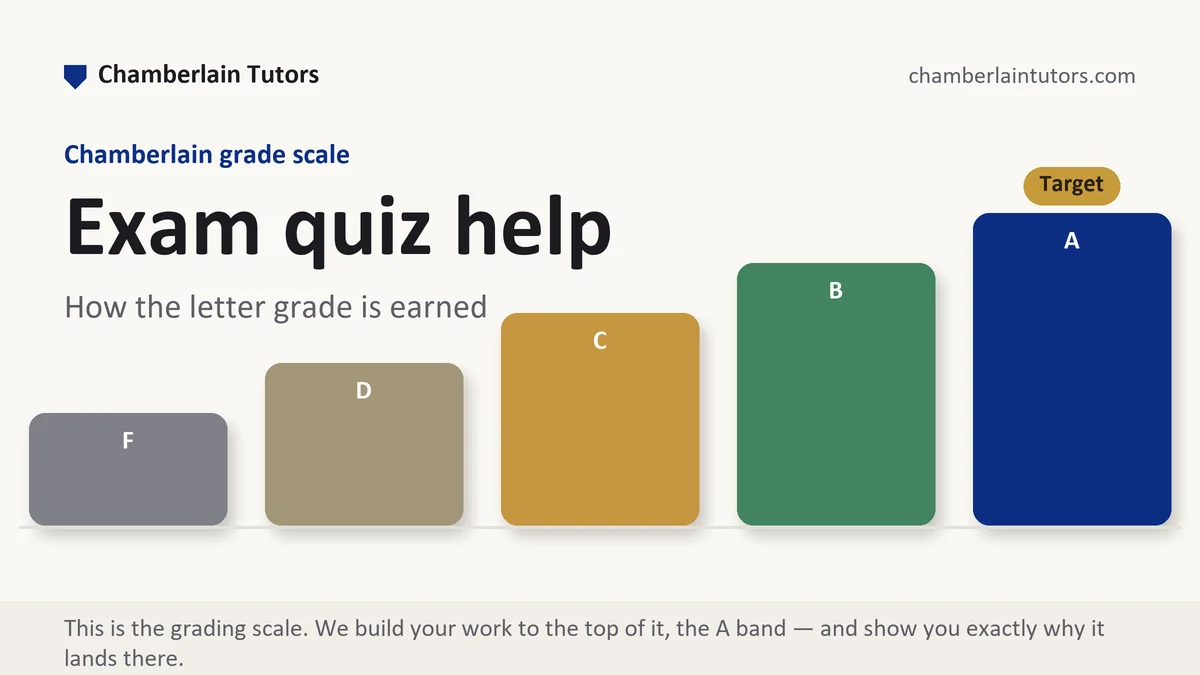
Chamberlain's grading rules make exam arithmetic the course's real syllabus: the 76 percent floor governs passing, NP-track courses run scales with no safe C, and dismissal math waits under repeated failures, the full map lives in the grading manual. So every exam engagement here starts with the number: your scores so far, the exams remaining, and what the next one must hit for the course to clear its floor with margin. Students who study to that number report the same thing every session, the dread shrinks to the size of the arithmetic.
What the prep kit includes
- Condensed notes for the tested units, organized by system logic the way nursing content actually memorizes
- Practice questions in the exam's formats with why-this-answer and why-not-the-others explained
- The target-score computation from your gradebook, refreshed after every exam
- A dated plan sized to shift work, twenty-minute blocks welcome
- Chat coaching for whatever refuses to click, any hour nights run
The exam-week split, Chamberlain edition
Exam weeks here still carry the week's full writing load, discussions that cannot be edited once posted, papers, care plans, and the collision is how strong students post weak scores. The split is the whole strategy: writable work handed off entirely, study hours protected entirely, the Deadline Shield standing behind the schedule if the week goes sideways anyway. Quizzes get the same treatment at lighter weight, banked early in the week so the big sits get the runway.
The line, held in writing
Exams and quizzes are sat by you, only you, every time, whatever monitoring your section runs; our exam work is preparation and coaching, full stop. It is also simply the better product at a licensure school: the content stays learned, and the boards waiting past graduation examine exactly what shortcut-takers skipped.
An exam is on the calendar
Send the course, the units covered, and a gradebook screenshot. The plan and floor math come back within 24 hours.
What the desk builds, and what it declines
Exam requests arrive in a few recognizable shapes and the answer differs for each. This is the whole map, including the rows where the answer is no.
| What you send | What comes back | Where the line sits |
|---|---|---|
| Unit review before a course exam | Condensed notes by system logic, practice items with a rationale for every option | You do the studying. Nothing in prep needs access to your courseroom. |
| A quiz opening tonight | Fast drills on the tested units, plus the target-score math | The attempt is opened by you and closed by you. |
| A proctored sit | A dated plan, drills, and the floor arithmetic | The identity check exists to confirm it is you, and it should. |
| The NR-509 check-off | Documentation frameworks and exam-sequence rehearsal, read aloud until the flow is automatic | The camera records you. No stand-in, at any price. |
| The week's writing while you study | Full handoff to the assignment desk, drafted to your rubric | You review it and you submit it. |
| A classmate has the actual questions | Nothing. Practice items here are written from the tested units | Circulated exam content is an integrity case with your name on it. |
The exam arithmetic, worked once
Every exam conversation here opens with a number, and the number is easy to compute once you have the weightings from your syllabus. Take a course that puts exams at half the grade, split across two sits at 25 percent each, with the rest of the gradebook running at 80. The first exam comes back 68.
Your course grade is 0.25 times 68, plus 0.25 times the second exam, plus 0.50 times 80. That is 17 plus 40, so 57 points are banked and the second exam supplies a quarter of whatever it scores. Clearing the 76 floor needs 19 more points, and 19 divided by 0.25 is 76. So exam two has to hit a 76. Not comfortable, but reachable, and now you know precisely what you are studying toward instead of studying toward a feeling.
Run the same start on the NP specialty scale, where there is no C and 84 is the pass line. You need 27 more points, and 27 divided by 0.25 is 108. No such score exists. A perfect second exam lands the course at 82, which means the course was decided by the first exam and the 80 sitting underneath it. That is why the arithmetic gets run standing rather than after the second sit. When the answer is that no score can save it, you want the answer while weeks remain to spend on your faculty, your advisor, and a plan.
Sitting early or sitting late, argued both ways
When a section opens an exam across a window rather than a single hour, when to sit becomes a real decision with a cost on both sides.
Sitting early costs study hours, plainly, and you take the exam with less review than you could have had. What it buys is the technical layer: a failed room scan, a locked browser that will not launch, a router that dies, an ID photo the system refuses. Early, those are inconveniences with hours left to fix them. It also pulls the exam away from the week's written deadline so the two never compete for the same night.
Sitting late buys the study hours and pays for them by stacking the exam on top of the week's uneditable discussion and its written deliverable, with no slack left if anything breaks. The last hour of a window is the worst possible first attempt, and it is also the hour when every support queue is longest. Either choice can be right. The rule that survives both is to leave enough window behind you that a technical failure is a retry rather than a zero.
NR-509, which is not a quiz
NR-509 pairs its written work with a video-recorded physical-exam check-off and an immersion component, and failing either one reverts the entire course grade to an F. That rule rewrites the strategy. The written side cannot bank enough points to survive a failed check-off, so both surfaces are pass-critical from week one and neither is an exam in the sense the rest of this page means.
Preparation for a check-off is rehearsal, not review. Documentation frameworks, the exam sequence drilled in order, scripts read aloud across weeks until your hands know where to go without your head narrating. Cramming does not work on a motor sequence. What preparation changes is who the camera meets: a student running this for the first time, or someone who has run it many times already. The course page sits here.
The mistakes that cost exam points
- Studying the reading list instead of the tested units. The two overlap without matching, and the gap is where lost points live.
- Doing practice questions and checking only the score. The rationale for each wrong option is the content. A question answered right for the wrong reason is a question you will miss next time.
- Learning the weighting after the exam. Five minutes with the syllabus beforehand tells you what the sit is worth and what it has to hit.
- Treating quizzes as free points. Low-weight items are exactly where a floor erodes quietly, because losing four points never feels like an event.
- Studying and writing in the same hours during exam week. Both tasks draw on the same attention, and the split exists so they stop competing.