NR-283 Pathophysiology runs on three theory credit hours and nothing else: no lab, no clinical. The catalog gives it four jobs: disease processes, their clinical manifestations, their complications, and the environmental and lifestyle influences acting on them. Written work here is graded on whether you can show a sequence rather than name a condition, and this page is about writing that sequence so a grader can follow it.
What NR-283 actually grades
The word doing the work in the catalog description is processes. A process has a direction and an order: something starts it, something changes, the body compensates, the compensation runs out, and the patient starts to show it. Undergraduate pathophysiology writing is graded on whether that arrow is visible on the page. Correct facts arranged in no particular order read as memorization, and memorization is what the lowest performance column describes.
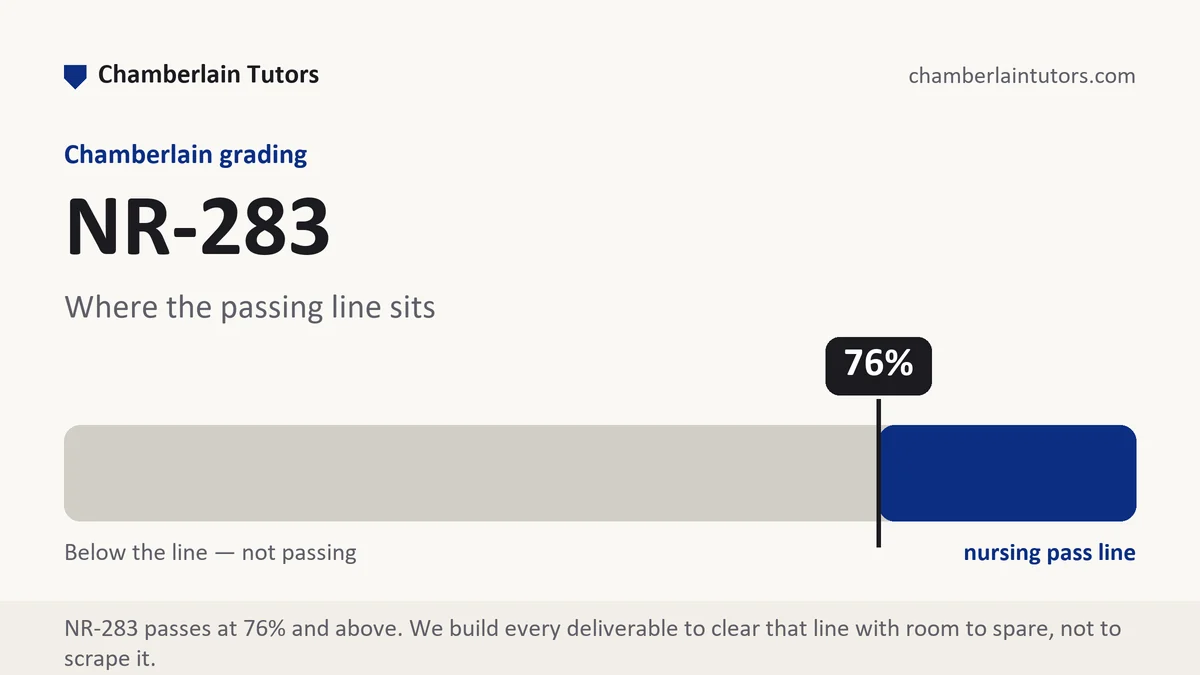
Two other strands sit in the description and get skipped constantly. Complications are not the same as manifestations, and a paper that treats them as one list has answered half a question. Environmental and lifestyle influences are not a closing paragraph of general advice, they are factors that act on specific steps in the sequence you just described. This is core nursing coursework, which puts a 76 percent floor underneath it.
How we help in this course
What we take on here is the writing: process explanations, case and scenario responses, concept-map write-ups, short-answer sets and the discussion posts that carry most of the weekly grade. The house rule is that no clinical statement appears without the mechanism sentence that earns it, in the same document, close enough that a reader can connect them.
Deliverables run the standard promise: a premium original draft in 24 to 48 hours, targeted at the A band of your course's actual scale, through the eight-person pipeline with both QA passes and the floor check, revised free until it lands.
How to write this course's pathophysiology work
Almost every graded piece in NR-283 is the same task in a different container: a paper, a case response, a short answer or a board post, each asking you to walk a process from its trigger to its consequences. The container changes the length, not the demands. Everything below turns your week's criterion rows into a plan, then gives you a shape for the explanation and the citation habits that keep it defensible.
In NR-283 right now?
Send the week and the rubric from Canvas. First premium sample free, floor-checked, back in 24 to 48 hours.
Where the floor bites in a content-heavy course
Pathophysiology is where pre-licensure students most often meet their first uncomfortable grade, and the reason is structural rather than intellectual. Three credit hours of dense content arrive on a weekly schedule, inside a semester that splits into two eight-week sessions, while other courses are running beside it. The volume is not the problem. The problem is that the volume tempts people into studying for recognition, which is enough for a multiple-choice question and nowhere near enough for a written explanation.
Written deliverables are the early-warning system for that gap. A grade in the 70s on a process explanation is telling you something about how you are studying, not only about how you wrote. Fix it while it is one assignment, because the floor leaves very little runway underneath a weighted average and supplementary points do not fill a hole the graded work opened.
Budgeting a short answer by its criterion rows
Copy the criterion rows into a blank document as headings, in the guide's order, before you choose your condition. Then price them, because the same three rows behave very differently at different lengths.
Take a guide with three rows: the process explained, 50 percent; manifestations linked to the process, 30 percent; nursing implications, 20 percent. On a 900 word paper that gives you 450 words for the mechanism, 270 for manifestations and 180 for implications. Now run the same weights on a 300 word discussion post and you get 150, 90 and 60. Those numbers are the useful part. One hundred and fifty words is about seven sentences, which means the mechanism in a board post has to arrive without any runway at all: no paragraph explaining why the topic matters, no restatement of the prompt, no definition of the disease everyone in the section already has open.
Substitute your section's real weights and lengths. What the arithmetic protects you from is the standard pathophysiology failure, which is spending the first third of a short answer on background and then compressing the actual process into two sentences at the end because the words ran out.
What a process explanation has to contain
Whether the container is a paper, a case response or a post, a complete explanation moves through these stages. Each one is a place a grader looks, and a missing stage is a visible hole rather than a small omission.
| Stage | What it has to prove | The version that loses points |
|---|---|---|
| The trigger, named | What starts the sequence: an exposure, an injury, an obstruction, a metabolic or genetic event. | The disease named again, as though a diagnosis were a cause. |
| The first change | What alters first, at the level this course teaches: cell, tissue, vessel, membrane, receptor. | Jumping straight from the trigger to a symptom with the middle missing. |
| The compensation | What the body does to stay stable in response, and what that response costs elsewhere. | Compensation skipped entirely, which removes the reason early disease is silent. |
| The point of decompensation | Where compensation stops working and why it stops working there. | The patient got worse, with no threshold and no mechanism. |
| The complication | The named downstream problem, attached to the specific step that produced it. | A list of complications with no line drawn back to anything above. |
| Manifestations placed | Each sign or symptom sitting beside the stage that generates it, so the list reads as consequences. | A symptom inventory copied from a reference, in alphabetical order. |
| Modifiable influences | Which environmental or lifestyle factor acts on which step, and in which direction. | A closing paragraph recommending diet and exercise for every condition. |
| The nurse's watch list | What you monitor, and what a change in it would mean the process has done next. | Advice general enough to fit any patient in any bed. |
Writing the lifestyle and environmental layer as mechanism
This is the strand that separates a graded explanation from a health poster, and it is worth its own habit. A modifiable influence belongs at the step it acts on, written with a direction. Not smoking is a risk factor for lung disease, which every reader already knows, but that a given exposure damages a specific structure, so that structure clears less effectively, so the next stage of the process arrives sooner. Same pattern for the environmental side: name the exposure, name the step it hits, name which way it pushes.
Doing this also fixes the most common vocabulary error in the course, which is treating a risk factor as a cause. A risk factor is an observed association in a population. A mechanism is the pathway by which something happens in a body. Undergraduate papers that keep those two apart and say which one they are talking about read as considerably more careful than the papers around them, and it costs nothing but attention.
Evidence and citation craft in a first pathophysiology course
Sourcing rules here are stricter than most students expect, and four habits carry the difference.
Current sources, with a reason for anything older. Five years is the default limit unless your guide sets another one, and crossing it needs a reason written into the sentence. A classic description of a mechanism can earn its place; a prevalence figure from a decade ago cannot. Reference the book you actually opened, not the one on the syllabus, and let its year show.
Design and sample before findings. Say what produced the number before you report it. In a case-control study of 214 adults, or in a series of 12 patients, changes how a reader weighs the sentence that follows, and a grader scanning for evidence quality is looking for exactly that clause.
Association versus causal verbs. Observational work supports was associated with, was more common among, and preceded. Only controlled experimental designs support caused, produced and prevented. This course is where the habit forms, and the students who build it here stop losing points for it permanently.
Denominator and measurement window before any rate. Write that a stated number of the 1,800 patients followed developed the complication within two years, rather than that a percentage developed it. A rate with no base and no window cannot be compared to anything, and comparison is the only thing a rate is for.
Passing explanation versus strong explanation
A passing NR-283 answer is accurate. It names the right condition, the right findings and real sources, and nothing in it is false. Accurate and unordered is a weak place to sit with a 76 floor underneath, because a run of merely correct pieces averages exactly where correctness alone deserves.
A strong answer differs in three visible ways. It commits: one process explained deeply beats four processes touched politely, and the word budget forces the choice anyway. It is continuous: a reader can start at the trigger and walk to the last manifestation without stepping over a gap, because every stage names what the previous one produced. And it is consequential: the implications section says what you would watch, what a change would mean, and what you would teach, in terms specific enough that another student could act on them. Commitment, continuity, consequence.
Six mistakes that cost points here
- Defining instead of explaining. An opening paragraph that defines the condition has spent the most expensive words in a short answer restating something the prompt already told you.
- Skipping compensation. Without it there is no way to explain why a patient looked fine last month, and the decompensation stage becomes an unexplained turn.
- Complications listed with no parent step. The complications row is asking which part of the process produced each one, not whether you can recall the list.
- Risk factor written as mechanism. Naming an association where a pathway belongs is the single most common accuracy deduction in this course.
- Patient education sites used as scholarly sources. They are written to reassure, not to be cited. Use the course reference, a professional source or a study, and check what your guide will accept.
- Posting an unfinished mechanism. Discussion boards do not reopen once you post at Chamberlain. Draft in a document, check the arrow runs end to end, then paste.
Questions NR-283 students send
How much normal physiology should I include before the disease part?
My discussion posts are correct and concise and still score in the middle. Why?
Can I use something I saw at work or in clinical as evidence?
Where NR-283 sits in Chamberlain's programs
Open the exact program map for sequence, credit, and option context. The current student schedule and syllabus remain authoritative after transfer evaluation, electives, state rules, and approved plan changes.
The weeks, one by one
Week 1
The opening stage of a first pathophysiology course is where the cell becomes the unit of explanation. Read the full Week 1 manual.
Week 2
Inflammation is the stage where students first meet a process that is simultaneously the body's repair system and the source of the patient's symptoms, and the written work is graded on holding both ideas at once. Read the full Week 2 manual.
Week 3
Immunity is the stage where the course stops being about tissue and starts being about recognition: what the body identifies as self, what it identifies as foreign, and what happens when either judgment goes wrong. Read the full Week 3 manual.
Week 4
Regulation is the theme of this stage: how the body holds volume, concentration and pH inside narrow limits, and what appears clinically when a control system is pushed past its range. Read the full Week 4 manual.
Week 5
Perfusion is where the course's central logic becomes unmistakable: a pump, a volume, a resistance, and a set of compensations that buy time at a price. Read the full Week 5 manual.
Week 6
Gas exchange separates into two questions that students routinely collapse into one: is air moving, and is gas crossing? Read the full Week 6 manual.
Week 7
This stage is about control loops: a signal, a target tissue, an effect, and a feedback line that tells the sender to stop. Read the full Week 7 manual.
Week 8
The closing stage of a first pathophysiology course usually asks for integration: one patient, several systems, and a written account of how a disturbance in one place propagated into the others. Read the full Week 8 manual.