NR-229 Fundamentals: Skills carries four credit hours, two theory and two clinical, with 96 clinical contact hours attached. It teaches the same fundamental nursing skills and physics-based body mechanics content as the lab-delivered version of the course, but it delivers them with a clinical component instead of a lab one. The written half asks you to justify a psychomotor skill in prose, and that is what this page is about.
What NR-229 actually grades
Skills courses look like they should be graded entirely by the hands, and then the transcript arrives and half the grade came from documents. The reason is simple: a demonstration proves you can perform a step, and only writing proves you know why the step exists, what it would look like going wrong, and what you would do next. So the graded writing here asks a specific question over and over. You did the thing correctly. Now explain it.
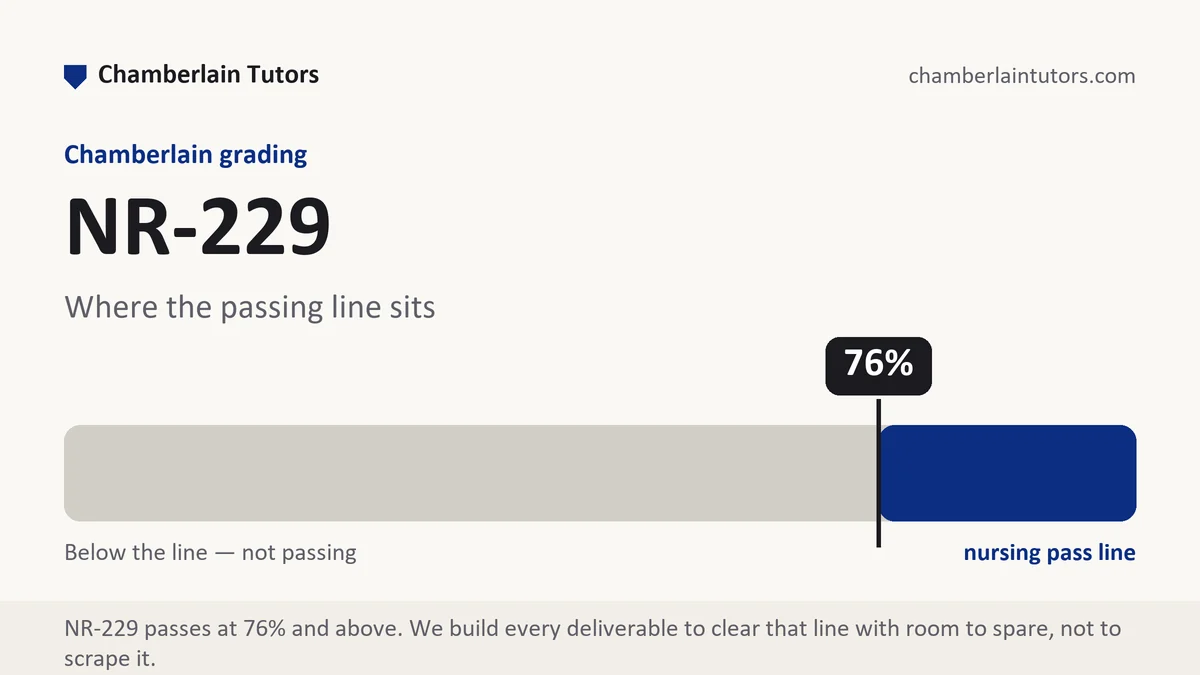
The other thing this course carries is unusual for a nursing course, and it is in the catalog description: an introductory physics unit for body mechanics. Levers, base of support, center of gravity, friction and force turn up as content you have to use rather than recite, and they turn up inside your rationale writing. Core nursing coursework sits above a 76 percent floor, and because the figure being tested is a weighted average, the written half is not a soft component you make up on the practical side.
How we help in this course
Our side of this course is the paper half: skill rationale write-ups, procedure and safety papers, body mechanics analyses, reflective pieces and the discussion posts around them. The house rule for this course is that every step in a draft carries a because, and that because is attached to a source rather than to habit.
Deliverables run the standard promise: a premium original draft in 24 to 48 hours, targeted at the A band of your course's actual scale, through the eight-person pipeline with both QA passes and the floor check, revised free until it lands.
How to write this course's skills work
The move that changes grades here is switching register from narrating to justifying. A narration says what happened next. A justification says why that had to happen next, and what would have followed if it had not. Everything below is about making that switch on paper: reading the guide first, giving the rationale column the space it is worth, and writing the physics so it reads like nursing.
In NR-229 right now?
Send the week and the rubric from Canvas. First premium sample free, floor-checked, back in 24 to 48 hours.
The demonstrations are yours, the writing is ours
NR-229 carries 96 clinical contact hours, and none of that side belongs to us. We do not sit skills demonstrations, check-offs, simulations or any assessment in your place, we do not attend clinicals, and we do not complete, sign or submit attendance records, hour logs or site paperwork. Anyone offering to do those things is offering you a problem, not a service.
What we do build is the written half and the preparation around it: the rationale documents that get graded, and rehearsal material that makes the sequence and its reasons automatic before you are standing in front of an evaluator. Keep patient identifiers out of anything you send us and anything you submit. Age band, presenting problem and relevant history describe a patient perfectly well for coursework.
Pricing the criterion rows before you write
Open the guide first. Give every row its own heading in a blank document, keep the guide's sequence, then turn points into words so you know what each heading is worth before you spend an evening on the wrong one.
Here is the arithmetic on an example guide. Say a skill write-up is capped at 900 words and the rows read: the procedure described in correct sequence, 15 points; rationale for each step, 15; safety and body mechanics, 12; documentation and evaluation, 8. That is 50 points across 900 words, which is 18 words per point. Sequence earns about 270 words, rationale another 270, safety and mechanics 216, documentation and evaluation 144.
Now look at what that says. Describing the sequence and justifying the sequence are worth the same, and describing is the half students can do from memory in twenty minutes. The rationale half takes sources, thought and a second draft, and it is routinely given three sentences. Substitute your section's real point split and run the same division, then write each target in brackets beside its heading and hold yourself to it. A section landing 100 words short of its share has not been efficient, it has been underexplained, and the row reads it that way.
What a skill rationale write-up has to contain
Whatever your section calls the pieces, a procedure or skill document keeps one shape. Each part answers a question the grader is holding.
| Part | What it has to prove | The version that loses points |
|---|---|---|
| Indication | Why this skill, for this patient, at this moment, rather than an alternative. | The procedure named, with no reason it was the right one. |
| Preparation and verification | Identity confirmed, order checked, equipment gathered and inspected, privacy and consent addressed before anything begins. | Gather supplies, listed as a single line as though nothing in it could go wrong. |
| Sequence | Steps in the order that makes each next step possible, with the dependency visible. | A numbered list that would read the same shuffled. |
| Rationale per step | The physiologic, mechanical or infection-control reason for that step, tied to a source. | The step written a second time with different verbs, or the words per policy standing alone. |
| Body mechanics and force | How base of support, load distance, leverage and friction were managed, and what that protected. | Used proper body mechanics, which names no principle and proves nothing. |
| Patient response and stop conditions | What you monitor during the skill and what specifically would make you stop. | Monitor the patient, with no finding named and no threshold. |
| Documentation | What a nurse who was not in the room would need to know from your entry. | Procedure completed, tolerated well. |
| Evaluation and next action | Whether the intended effect happened, measured against something, and what follows if it did not. | The write-up ending when the procedure ends. |
Writing the physics without writing a physics paper
The body mechanics content is the part students either skip or overdo. Skipping it leaves a scoring row empty. Overdoing it produces a paragraph of definitions that never touches a patient. The sentence pattern that scores does three things in order: name the principle, state the direction of the effect, then give the clinical action that follows.
So instead of writing that proper body mechanics were maintained, write that reaching across the bed lengthens the distance between the load and your center of gravity, which increases the force the lumbar spine has to resist, so you lower the rail and stand close rather than stretching over it. Instead of writing that a wide stance is recommended, write that widening the base of support increases the area your center of gravity can move within before balance is lost, which is why the stance goes wide when a patient's weight is about to shift onto you. Same for friction: a slide sheet reduces the friction between patient and surface, so less of your effort goes into overcoming drag and more of it into the actual move.
Three sentences built that way will out-score a page of definitions, because each one shows a principle doing work. Keep derivations and numbers out unless the guide asks for them by name.
Where a procedure's evidence comes from
Skills writing has its own sourcing hierarchy, and knowing it is most of the citation battle.
Current sources, with the version visible. Procedures get revised, which makes the version part of the claim rather than a detail for the reference list. Put the edition and its year in the sentence, and if a source predates the last five years, say what makes it still current. Then match the source to the question: a device is governed by its manufacturer's instructions for use, practice is governed by published standards, and research explains why both say what they say. Citing a study where a standard belongs is the common mismatch here.
Design and sample before findings. Much of the research behind skills is small, single-site or done in simulation. Say so before you report it. In a simulation study of 62 nursing students is not a weakness to hide, it is a sentence that shows you read carefully.
Association versus causal verbs. Bundles and checklists are usually studied by comparing periods before and after they were introduced, and many things change between two periods. Write that rates were lower after implementation, or that adherence was associated with fewer events. Keep prevented and eliminated for designs that earned them.
Denominator and measurement window before any rate. Safety figures in this field are almost always expressed per unit of exposure. Write per 1,000 device days across a named quarter, or per 1,000 patient days, rather than a bare percentage. A rate without its denominator and window cannot be compared to anything, which is exactly what the analysis row is checking.
Passing rationale versus strong rationale
A passing NR-229 document lists the right steps in the right order. Nothing is wrong with it. It also reads like a procedure manual with a name on top, and near the 76 floor there is very little room underneath a document that is merely not wrong.
A strong document differs in three visible ways. It is causal: each step is written as a consequence of the one before, so the order could be defended if challenged. It is anticipatory: it names what could go wrong at the two or three riskiest steps and what you would do about it, which is the thinking a grader is really testing. And it is closed: the evaluation measures the intended effect against something specific rather than ending when the equipment is put away. Causality, anticipation, closure.
Six mistakes that cost points here
- Describing instead of justifying. A flawless step list with no reasons answers the cheapest row on the guide and leaves the expensive one empty.
- Rationale that restates the step. Cleanse the site because the site must be clean is a sentence that has said nothing. Name the organism route or the tissue consequence.
- Physics vocabulary with no direction of effect. Naming leverage or center of gravity without saying what increases, decreases or shifts is decoration, and graders read it as a term borrowed rather than understood.
- Per policy used as the whole reason. Policy is where the rule lives. The rationale row wants the reason the policy exists.
- No stop conditions anywhere. A write-up that never names what would make you halt the procedure has skipped the judgment the course exists to build.
- Posting before the reasoning is finished. A Chamberlain board post cannot be edited after it publishes, so a half-built rationale stays in front of the whole section for the rest of the week.
Questions NR-229 students send
Do you help with the skills check-off itself?
How technical should the physics section get?
My steps are right and my grades still sit in the mid-70s. What is missing?
Where NR-229 sits in Chamberlain's programs
Open the exact program map for sequence, credit, and option context. The current student schedule and syllabus remain authoritative after transfer evaluation, electives, state rules, and approved plan changes.
The weeks, one by one
Week 1
NR-229 is the fundamentals skills course built around real clinical hours, which means its opening stage is less about your hands and more about your readiness to bring them into a building full of actual patients. Read the full Week 1 manual.
Week 2
By the second stage of NR-229 the course usually puts numbers in your hands: temperatures, pulses, respirations, pressures and pain reports, gathered from real people on a real unit, and the written work asks what those numbers mean and how a beginning nurse records them without distortion. Read the full Week 2 manual.
Week 3
Around the third stage, a clinical fundamentals course usually asks for the document that will follow you through the whole program: a care plan built on a real assigned patient, walking the nursing process from assessment data through a prioritized problem to interventions with rationales and a. Read the full Week 3 manual.
Week 4
The middle of a clinical fundamentals course usually turns to the slow emergencies: the fall that has not happened yet and the pressure injury that is quietly beginning under a heel. Read the full Week 4 manual.
Week 5
Somewhere past the midpoint, a clinical fundamentals course hands you the work the public thinks is simple and nurses know is not: bathing, oral care, toileting, feeding assistance, comfort. Read the full Week 5 manual.
Week 6
Late in a clinical fundamentals course the medication work moves from concept to corridor: giving real medications to real patients with your instructor at your elbow, and preparing for it in writing beforehand. Read the full Week 6 manual.
Week 7
Near the end of a clinical fundamentals course the writing turns professional in the most literal sense: the course starts grading you on the genres nurses write at work. Read the full Week 7 manual.
Week 8
The final stage of a clinical fundamentals course usually asks for synthesis: a summative self-evaluation of your clinical growth argued from evidence, a final or revised care plan showing the whole nursing process under command, or a capstone reflection connecting the session's skills into one. Read the full Week 8 manual.