Around the third stage, a clinical fundamentals course usually asks for the document that will follow you through the whole program: a care plan built on a real assigned patient, walking the nursing process from assessment data through a prioritized problem to interventions with rationales and a way to know whether they worked. It is the first time your clinical day and your academic writing share one spine. Your section may print this as NR 229 or NR229; it is the same course. Chamberlain publishes no syllabi outside Canvas. The placement here is our teaching judgment from the course's catalog arc; your section's rubric decides what your week actually asks.
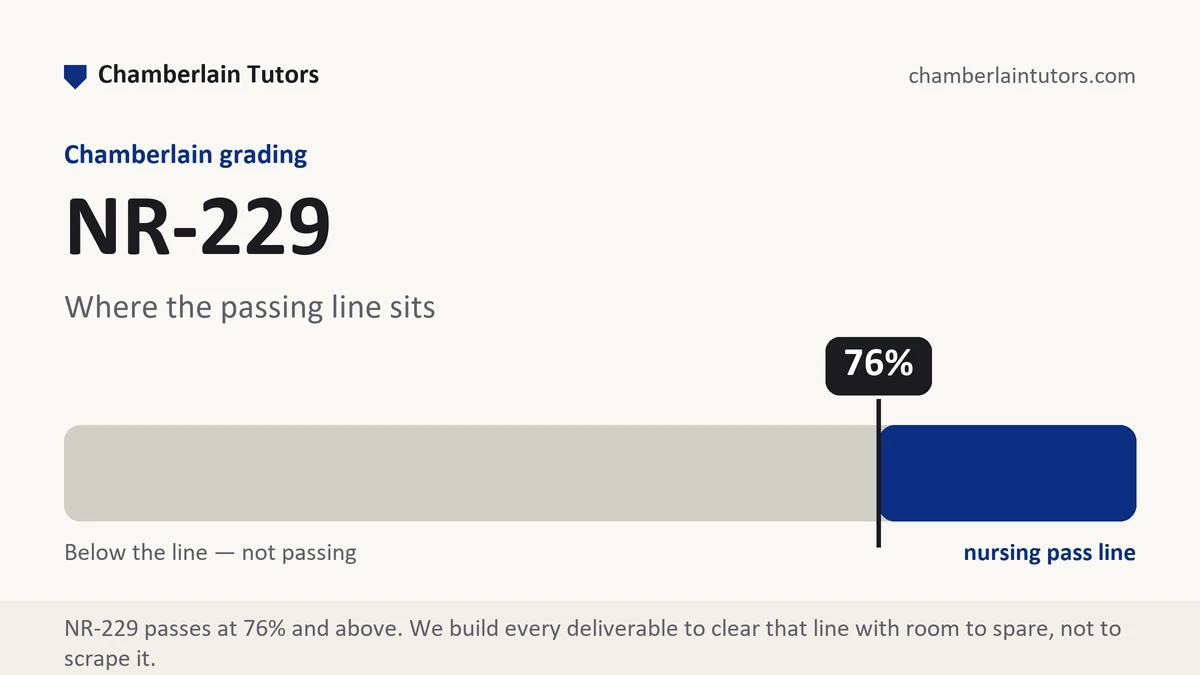
What NR-229 Week 3 asks for
Postconference, a family waiting room borrowed for an hour, seven students around a table still in scrubs. The instructor asks one of them a question that sounds simple and is not: of everything you found on your patient this morning, what matters most? The student starts listing, and the instructor stops her. Not a list. One thing. What could hurt him first? That question is the care plan compressed into a sentence, and the written work of this stage is the long-form answer: data gathered on a real person, a problem stated in nursing terms, a defensible claim about priority, interventions chosen for reasons you can cite, and criteria that would tell you whether any of it helped.
The care plan is a genre, and like every genre it has moves that graders check in order. The data must be real and sourced from your own assessment and the information legitimately available to you as a student on that unit. The problem statement must follow from the data actually presented, not from the diagnosis on the door. The priority must be argued, usually from a framework your section teaches, rather than assumed. The interventions must be things a nurse can do, each carrying a rationale anchored to your fundamentals text or published guidance. The outcomes must be measurable enough that a stranger could return and check them. Most first care plans fail not on knowledge but on linkage: every section is competent and no section follows from the previous one.
Because this is a clinical course, the boundary bears restating in the week it matters most. The assessment happened with your hands, on your clinical day, under supervision; the plan's execution, any charting in the facility's record, and anything bearing signatures are your own real work in the building. The academic document, the written care plan your section grades, is the layer a manual and a tutor can legitimately support: its structure, its linkage, its rationales, its prose. Nobody can supply you a patient, and nobody should. The plan is only as honest as the morning it came from.
Expect the workload shape to change here too. A care plan is not an essay you can produce in one sitting the night before, because half its raw material was captured on the unit in pencil. The students who do well at this stage treat the clinical day as data collection for the writing, leaving the facility with their assessment findings, the medications they looked up, and their tentative priority already noted, so the evening's work is building the argument rather than reconstructing the morning.
The NR-229 Week 3 method, step by step
Six moves that turn a clinical morning into a defensible care plan.
-
Leave the unit with your data already sorted
Before you hand back your report sheet, mark which findings are subjective, which are objective, and which surprised you. The surprise column is usually where the plan lives, and sorting at the door beats reconstructing at midnight from memory that has already smoothed the day over.
-
Write the problem from your data, not the medical diagnosis
The admission diagnosis explains why the patient is there; your problem statement explains what nursing care addresses today. Build it from findings you personally documented, in the format your section teaches, and check that every element of the statement can point back to a line in your data.
-
Argue the priority explicitly
Say why this problem outranks the others you found, using the prioritization framework your course teaches, airway and physiologic threat before comfort, safety before preference. One sentence of visible ranking logic is worth more than three extra interventions.
-
Choose interventions a student nurse can actually own
Each intervention needs a doer, a frequency and a method, and at least some should be independent nursing actions rather than restatements of medical orders. Repositioning on a schedule, targeted teaching, focused reassessment: these are yours. Administering what the provider ordered is the provider's plan, not your reasoning.
-
Attach a cited rationale to every intervention
The rationale is where the support row lives. One sentence per intervention naming why it works, with your fundamentals text or published guidance named and dated. A rationale that says to promote healing is decoration; a rationale that says what mechanism the action interrupts is analysis.
-
Write outcomes a stranger could verify
Each outcome carries a subject, a measurable change, and a time frame realistic for your shift or the care window. If nobody could stand at the bedside and check whether the outcome happened, it is a hope, and hopes are the most commonly marked-down element of first care plans.
A layout and word budget for a first care plan's written sections
Care plan formats vary by section, and your assigned template always wins. This frame budgets the prose portions our tutors see graded hardest, sized for a document of roughly 900 to 1,200 written words beyond the template's data grid. It is our own outline rather than anything the university issues, and your week's rubric outranks it wherever the two disagree.
| Section | What belongs in it | Word target |
|---|---|---|
| Patient context, de-identified | Age band, relevant history, and the reason nursing care is happening, with nothing that identifies a person or facility. | 90 to 120 |
| Assessment data, clustered | Your findings grouped so the pattern is visible, subjective and objective clearly separated, sources of data named. | 180 to 220 |
| Problem statement and linkage | The nursing problem in your section's format, plus two or three sentences showing which data drove it. | 110 to 140 |
| Priority argument | Why this problem first, ranked with the framework your course teaches, alternatives acknowledged in a clause. | 100 to 130 |
| Interventions with rationales | Three to five nursing actions, each with doer, frequency, method and a cited one-sentence rationale. | 260 to 320 |
| Outcomes and evaluation | Measurable criteria with time frames, and what you would do if the reassessment showed no change. | 140 to 180 |
Evidence craft for care plan writing
Every rationale points at a page. The intervention column runs on your judgment; the rationale column runs on the literature. Name your fundamentals text or the relevant published guidance with a year inside the rationale sentence, and vary the sources when the plan draws on more than one domain, mobility, skin, infection, teaching.
Data outranks diagnosis. When the plan's problem statement and the admission diagnosis pull in different directions, follow your data and say so. A patient admitted for one thing whose immediate nursing problem is another is not a contradiction; it is the ordinary state of real units, and noticing it in writing is exactly the reasoning this genre exists to display.
Keep the causal chain visible. The scoring logic of a care plan is a chain: this data, therefore this problem, therefore this priority, therefore these actions, checked by these criteria. Write the connective sentences that hold the links together. Graders mark broken chains far more often than wrong facts, because wrong facts are rare and broken chains are everywhere.
Measurability is a sentence-level skill. Will tolerate activity better is unmeasurable; will walk to the dayroom with standby assist by end of shift can be checked by anyone. Audit every outcome for a verb someone could observe, a quantity someone could count, and a clock someone could read.
Five mistakes that cost points in this week's territory
- Planning from the door sign. A care plan generated from the admission diagnosis rather than your own assessment reads as template-filling, and it usually collapses the moment a grader compares your data section to your problem statement.
- Unranked problems. Presenting three problems without arguing which comes first skips the exact cognitive move the assignment exists to grade.
- Interventions nobody owns. Monitor closely and encourage fluids have no doer, no dose and no schedule. Every action needs who, how often and how.
- Rationale-free actions. An intervention without a cited why forfeits the support row one line at a time, and in a plan with five interventions that is five separate deductions.
- Outcomes written as wishes. Improved comfort and better mobility cannot be evaluated, and the evaluation section is where first care plans most often bleed points.
Before you submit
- Every element of the problem statement traces to a line in your data section
- The priority is argued with a named framework, not assumed
- Each intervention has a doer, a frequency and a method
- Each rationale names a source with its year inside the sentence
- Each outcome is observable, countable and clocked
- No name, initial set, room number or facility detail identifies anyone
Building your first care plan for NR-229?
Send the template, the rubric and your de-identified data out of Canvas. A premium original draft comes back in 24 to 48 hours with the chain linked and the rationales cited, and revisions run until the grade lands.