NR-228 Nutrition, Health & Wellness is a two credit hour lecture course with no clinical or lab component attached. The catalog gives it three subjects: the basic nutrients required for optimal health, nutrition across the phases of the human life cycle, and the psychological and sociological implications of food. Its graded writing is almost always analytical rather than descriptive, and this page is about how that writing earns points.
What NR-228 actually grades
Three subjects, and the third one is where the grades separate. Anyone can list nutrients. Anyone can look up what an infant needs that an older adult does not. The part that carries weight is the psychological and sociological layer: why a person eats what they eat, what a food means inside a household, what a recommendation costs somebody in money, time, skill and standing at their own table. Written work in this course asks you to hold a number and a human being in the same paragraph.
That is why the dominant deliverable is an analysis rather than a report. You gather intake or population data, compare it against a published standard, interpret the gap in physiological terms, place it in a life stage, then explain what would make a change realistic for the person in front of you. Every step is a scoring row somewhere, and the interpretation steps are always worth more than the gathering steps.
How we help in this course
We draft the analyses: intake and diet analysis papers, life-cycle nutrition write-ups, cultural and psychosocial food papers, patient teaching plans, and the discussion posts that sit around them. Numbers get carried correctly and cited to a named standard, and the interpretation gets the space the scoring guide actually pays for.
Deliverables run the standard promise: a premium original draft in 24 to 48 hours, targeted at the A band of your course's actual scale, through the eight-person pipeline with both QA passes and the floor check, revised free until it lands.
How to write this course's nutrition analyses
Read the scoring guide before you look at the food record. A nutrition guide holds two kinds of row. Some are settled by a correct table or a correct figure and take no prose at all. The rest are settled only by explanation, and those are where an evening actually goes. Sorting the guide into those two piles first is what stops a long night being spent on the pile that pays least, and everything below assumes you have done it.
In NR-228 right now?
Send the week and the rubric from Canvas. First premium sample free, floor-checked, back in 24 to 48 hours.
Two credit hours, full weight grades
This is the quiet risk in NR-228. A two credit hour course looks like the one you can carry on momentum while the heavier nursing courses take your attention, and in a semester that splits into two eight-week sessions with weekly deliverables in every one of them, momentum is exactly what runs out. The floor does not shrink to match the credit hours. It applies here the way it applies to a four credit course, and points the graded pieces gave away are not recoverable from supplementary work later. Two credits of trouble ends a term as effectively as four.
The practical answer is to treat the small course as the one you finish first each week rather than last. Its deliverables are usually shorter, which means they are also the ones a good draft can lock down early, freeing the week for whatever is genuinely heavy.
Turning the scoring guide into a section plan
Copy the criterion rows into a blank document in the guide's own order and make each one a heading. Matching your sequence to the guide's sequence removes the most common complaint written on returned nutrition papers, which is that everything asked for was in there somewhere and had to be found.
Then convert the weights into words. Say an analysis is capped at 1,000 words and the guide is weighted by percentage: intake data and method 15 percent, comparison against reference standards 25, nutrient gaps interpreted 25, life stage and psychosocial context 20, recommendations 15. Multiply straight through and you get 150 words for method, 250 for the comparison, 250 for interpretation, 200 for context and 150 for recommendations. Tables, the reference list and any appendix sit outside that count unless your guide says otherwise, so check that line before you cut real sentences to make room.
Look at what the arithmetic just said. Interpretation and comparison together own half the paper, and both of them are prose. The intake table, which is the part most students spend an evening perfecting, earns 150 words of method description and nothing more. Substitute your own guide's numbers, run the same multiplication, and put each target in brackets beside its heading.
What a diet analysis write-up has to contain
Whatever your section calls the pieces, an intake or nutrition analysis keeps one shape. Each part exists to prove something specific.
| Part | What it has to prove | The version that loses points |
|---|---|---|
| The record and its window | How many days were recorded, which days, by what method, and what that method is known to miss. | A food list with no time frame, presented as though it were a measurement. |
| The standard, named | Which reference standard you compared against, for which age and sex group, from which edition or release. | Compared to the recommended amount, with no source and no group. |
| The comparison in units | Nutrient by nutrient, the intake figure beside the reference figure, with the shortfall or excess expressed in both the unit and the percentage. | A software screenshot pasted in and left to speak for itself. |
| Gaps interpreted | What a shortfall or excess actually does in the body, at the depth this course teaches, for the two or three nutrients that matter most here. | Every nutrient given one identical sentence about being important for health. |
| Life stage placed | What this phase of the life cycle demands that the previous one did not, and why the physiology changed. | The person's age stated in the introduction and never used again. |
| Psychological and social layer | What the food means: cost, access, schedule, cooking skill, household role, culture, appetite, mood. | A sentence acknowledging that everyone is different. |
| Recommendations that survive a real week | Food first, specific, affordable, and matched to what this person can actually do on a Tuesday. | Advice to eat more vegetables and drink more water, which fits anyone and helps nobody. |
| Evaluation | What you would remeasure, by what method, and after how long. | The plan ending at the recommendation, with no way to know whether it worked. |
Evidence and citation craft in nutrition writing
Nutrition is the subject where overclaiming is easiest, because the popular version of every finding has already reached the student before the evidence does. Four habits keep an undergraduate paper defensible.
Current sources, named by release. Reference intake values and national dietary guidance are revised on a schedule, so the year matters more here than in most subjects. Say which release you used and when it was published, inside the sentence that leans on it. Anything past five years needs an argument for still being there, and a nutrient reference table from a decade ago is not a source, it is a historical document.
Design and sample before findings. Most nutrition claims come from observational cohorts, short feeding trials or cross-sectional surveys, and those three do not carry equal weight. Say which one produced the number and in whom before you report what it showed. A twelve-week feeding trial in 40 volunteers and a twenty-year cohort of 90,000 adults cannot support the same sentence.
Association versus causal verbs. This is where nutrition papers bleed points. Diets are chosen, not assigned, so people who eat differently differ in many other ways at the same time. Write that an intake pattern was associated with an outcome, or occurred more often among a group. Keep caused, prevented and reversed for controlled designs that earned them.
Denominator and measurement window before any rate. A percentage of the reference standard means nothing until you say which reference group it belongs to, and a prevalence figure means nothing without the survey, its cycle and its sample size. Write that a given share of adults in a named national survey cycle fell below the standard, rather than that most people are deficient.
Passing analysis versus strong analysis
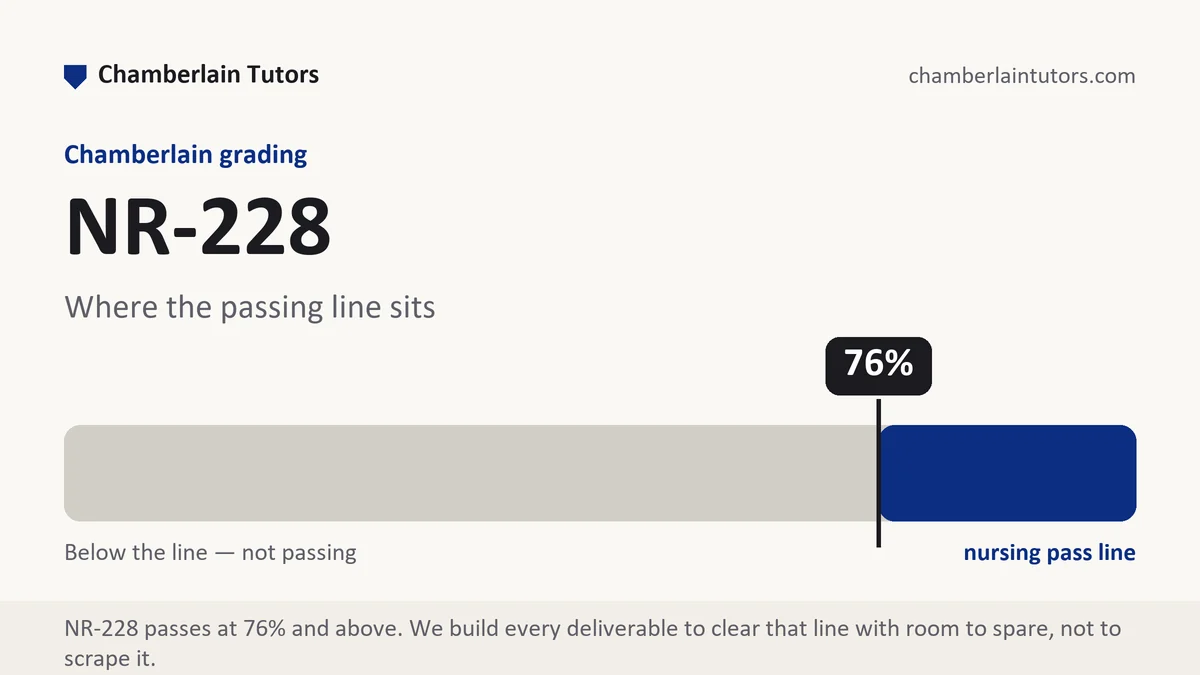
A passing NR-228 paper is arithmetically correct. The intake table adds up, the comparison is accurate, the recommendations are sensible. Correct and generic sits closer to the 76 floor than it feels, because a grader has read forty versions of the same sensible recommendation this session.
A strong paper does three things the passing one does not. It selects: instead of interpreting thirty nutrients equally, it names the two or three that matter for this person at this life stage and explains those properly. It connects: the psychosocial section is not an afterthought but the reason the recommendation section takes the shape it does, so the cost of a food and the schedule of a shift worker visibly change the plan. And it measures: the evaluation names what would be rechecked and when, which turns advice into a plan. Selection, connection, measurement.
Six mistakes that cost points here
- Submitting the software output as the analysis. An analysis tool produces the data, not the argument. Every table needs prose explaining what it means for this person.
- Comparing a short record to a standard built for usual intake. A few days of eating is a sample, and samples vary. Say so in the method sentence, and the limitation becomes a point earned rather than a flaw found.
- Treating a product claim as evidence. Marketing text, supplement labeling and wellness sites are objects of analysis, not sources for it.
- Writing recommendations for a kitchen the person does not have. Advice that assumes time, money, equipment and a full grocery store is the most common reason a strong analysis ends with a weak plan.
- Skipping the life cycle framing. The catalog names it explicitly. A paper that could describe any adult has left an entire strand of the course unanswered.
- Posting a board reply before checking the figures. Once a post publishes at Chamberlain there is no edit button, so a number you got wrong stays wrong where the whole section can read it.
Questions NR-228 students send
It is only two credit hours. Can I let this one coast?
My analysis reads like a data dump. How do I fix it without starting over?
Can I use my own intake for the analysis?
Where NR-228 sits in Chamberlain's programs
Open the exact program map for sequence, credit, and option context. The current student schedule and syllabus remain authoritative after transfer evaluation, electives, state rules, and approved plan changes.
The weeks, one by one
Week 1
A post-operative patient on a clear liquid tray is taking in almost no protein at the exact moment a surgical wound needs it most, and NR-228 Week 1 is where you learn to say that in writing with numbers behind it. Read the full Week 1 manual.
Week 2
In the simulation lab the admission screen is a box on a form, and students tick it in four seconds. Read the full Week 2 manual.
Week 3
A stroke patient fails a bedside swallow screen on day two, the tray upgrade is cancelled, and the whole nutrition plan has to be rebuilt around a route rather than a menu. Read the full Week 3 manual.
Week 4
An antepartum patient admitted for persistent vomiting has not eaten a full meal in nine days, and the nutrition question in front of the nurse is no longer about a balanced plate. Read the full Week 4 manual.
Week 5
On a step-down unit the chart says an 82 year old has lost seven pounds since her last admission, and nobody has written a word about why. Read the full Week 5 manual.
Week 6
A patient returns to the emergency department for the third time in five weeks with hypoglycaemia, and the discharge instruction that keeps failing tells him to eat regular meals with an insulin he cannot refrigerate. Read the full Week 6 manual.
Week 7
On a cardiac unit the same patient can carry a sodium restriction, a fluid limit and a diabetes plan at once, and the three do not automatically agree about breakfast. Read the full Week 7 manual.
Week 8
The teach-back station in the simulation lab is where students find out that knowing a diet and teaching one are separate skills, and the closing stage of NR-228 grades the second. Read the full Week 8 manual.