NR-224 Fundamentals: Skills carries three credit hours split as two theory and one lab, with 32 lab contact hours behind that single lab credit. It is where hands go on equipment for the first time: psychomotor practice in mobility, hygiene and comfort, wrapped around an introductory physics unit covering body mechanics, positioning and movement. The hands-on half is yours and stays yours. What we carry is the written half, the part that asks you to explain a skill rather than perform it. This page is the manual for it: scoring rows into a plan, what a step-and-rationale write-up must contain, and how to handle the physics numbers.
What NR-224 actually grades
A skills course grades two different things with two different instruments, and confusing them is the most common way students misjudge their standing. One instrument is the check-off, where you perform a procedure and are watched doing it. The other is the written and theory layer, where you explain why each step exists, what physics governs the movement, and what you would document afterward. The lab hours build the first. The scoring guides in Canvas grade the second, and the second is where the grade points sit.
The physics unit is what makes this course unlike other fundamentals work. Body mechanics, positioning and mobility are taught with real mechanical reasoning behind them: base of support, center of gravity, the direction a force acts in, why a load held close to the body loads the spine differently than the same load at arm's length. Written work expects that reasoning to show, so a step described without its mechanical logic reads as a memorized list.
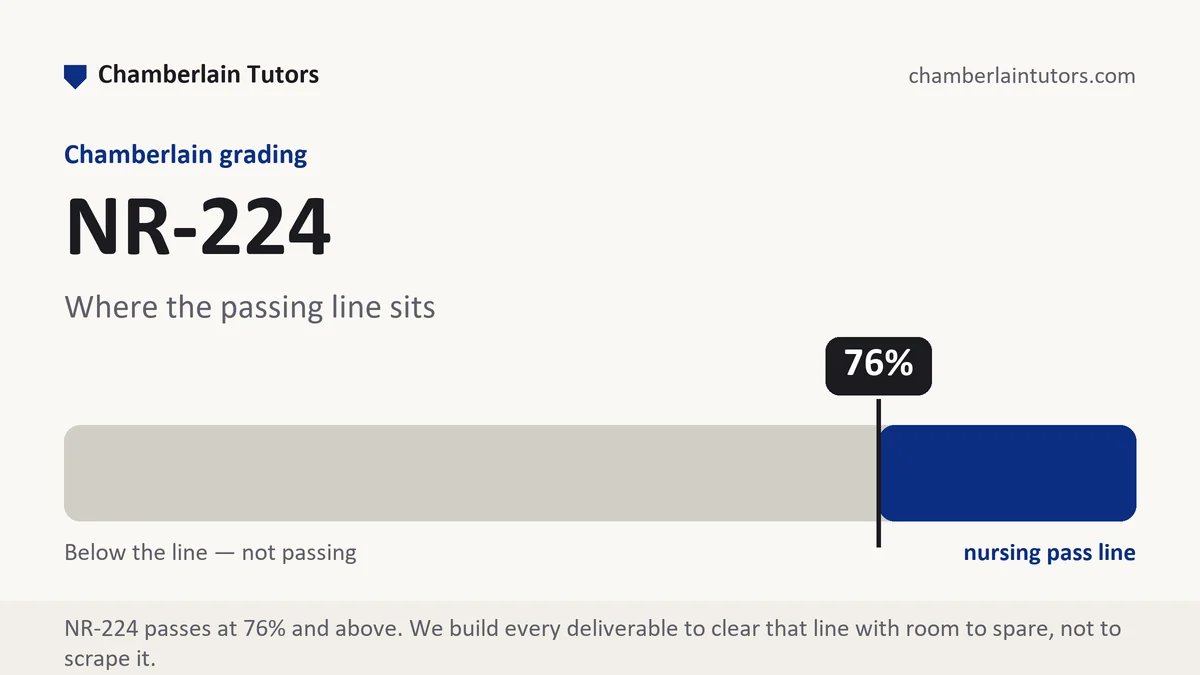
Everything sits on the standard calendar: a 16 week semester assembled from two 8 week sessions, graded work opening weekly in Canvas, discussion posts that lock as soon as they publish. Core nursing courses carry a 76 percent floor, and no amount of late extra effort rescues a weak weighted average, so the written layer deserves the same seriousness as the lab.
How we help in this course
We take the written layer only, and the boundary is worth stating plainly. We do not perform skills, attend labs, complete check-offs or sit assessments of any kind. What we draft is the writing around them: step-and-rationale explanations, safety and positioning write-ups, the physics reasoning in plain clinical language, documentation-style practice pieces, and board replies that compress all of it into a paragraph.
Terms match the rest of the site: a premium original draft in 24 to 48 hours, targeted at the A band of your course's actual scale, through the eight-person pipeline with two QA passes and the floor check, revised free until it lands.
In NR-224 right now?
Send the week and the rubric from Canvas. First premium sample free, floor-checked, back in 24 to 48 hours.
Reading a skills scoring guide backward
Start at the bottom of the guide rather than the top. The lowest performance column describes failure, and in a skills course it is unusually specific: it names the omission, the unsafe sequence, the missing rationale. Read that column for every row first and write down what it says you must not do. The result is a sharper checklist than the top column, which tends toward general praise.
Then sort the rows into two kinds, because skills guides mix them. Weighted rows behave normally and earn partial credit. Threshold rows do not: a safety element is usually present or absent, and a row written as a yes or no question cannot be part-satisfied by a nicely written paragraph. Handle threshold rows first, in full, before any prose is polished, because they are the cheapest points on the page and the ones a rushed submission drops.
Then budget the weighted rows. If a write-up caps at 700 words and the rows carry 45, 25, 20 and 10 percent, the shares work out at roughly 315, 175, 140 and 70 words. In a skills course the biggest row is nearly always rationale rather than description, and rationale is exactly what students compress, because listing the steps feels like the assignment and explaining them feels like extra. It is the reverse. The steps are the setup; the explanation is the deliverable. When your account of the procedure runs longer than your reasoning about it, the largest row on the page is underfed.
The shape of a step and rationale write-up
The dominant written genre in a skills course is a procedure explained with its reasoning attached. Whatever your week calls it, eight elements decide the score.
| Element | What it must make visible | Where marks go missing |
|---|---|---|
| Patient and setting in one line | Size, mobility status, lines or equipment, and where the movement happens, since all of it changes the technique. | A generic patient, which leaves every later decision unjustifiable. |
| Goal of the skill | What this action is for, stated as a patient outcome rather than as a task to complete. | Restating the procedure's name as if it were its purpose. |
| Preparation and safety checks | What you verify before touching anyone: identity, orders where relevant, equipment condition, help available, environment cleared. | Beginning at the first physical step, with preparation assumed. |
| Steps in order | A sequence someone could follow exactly, with nothing reordered for convenience of writing. | Steps grouped by theme rather than by the order they actually occur. |
| Rationale attached to each step | Why that step, in that position, with a reason drawn from mechanics, safety or comfort rather than from habit. | One paragraph of general rationale placed after the whole list. |
| The mechanics named | The physics of the movement said in the course's own terms: base of support, center of gravity, direction of force, distance of the load from the body. | Advice to lift with the legs, repeated without explanation. |
| Patient comfort and dignity | What you say, what you cover, what you ask permission for, treated as part of the procedure rather than as courtesy. | Comfort mentioned once in the closing sentence. |
| Documentation and follow-up | What you would record afterward and what you would watch for next, written the way a chart entry reads. | An ending that stops when the physical task stops. |
Evidence, and the numbers in the physics unit
Skills writing carries evidence like any other nursing writing, plus a numeric layer most courses do not have. Four habits protect both.
Cite the standard, in its current edition. Procedure steps come from published guidance rather than from what one nurse prefers, so name the source and check that its edition or revision year is the one still in force. Keep clinical sources inside a five year window unless your guide sets another, and when something older stays, put its justification in the same sentence.
Design and sample before any finding. If you claim a technique reduces injury, say what produced that claim first: "in a controlled trial of 240 nursing staff across four units" tells a grader what kind of evidence is being offered before the result arrives, and it is the difference between evidence and assertion.
Keep causal verbs for controlled designs. Observational work supports "was associated with fewer reported injuries" or "occurred less often on units that adopted the program". Only a controlled design supports "prevents" or "reduces". Safe handling literature attracts causal language constantly, and matching the verb to the design costs nothing.
Numbers need a base, a window and a unit. A rate without a denominator and a time frame is decoration: write "reported back injuries fell from 18 to 7 across roughly 300 staff over 12 months" rather than "injuries dropped 60 percent". The physics figures follow the same rule with units attached. Any force, mass, angle or distance you use in an explanation needs its unit and the condition it applies to, and a number carried through a calculation without units is the fastest way to lose a row you understood perfectly.
Where NR-224 write-ups separate
A passing NR-224 write-up lists the right steps in the right order and mentions safety. It is accurate and it is flat, because it reads as something copied out of a procedure list, and a grader cannot tell from it whether you understand why the sequence exists. With the 76 percent floor governing core nursing courses, flat and accurate is a thin place to sit for a whole term.
A strong write-up differs in three ways. Every step carries its own reason, placed with the step rather than pooled at the end, so the sequence reads as reasoning rather than recall. The mechanics are named in the course's own vocabulary at the moment they apply, which is what the physics unit exists to teach. And the patient stays present throughout: what they are told, what they can see, what hurts, what dignity requires, written into the steps rather than appended to them. Reasoned, mechanically explicit, patient-present.
Six mistakes that cost real points here
- Listing steps with no reasons attached. A correct sequence with the rationale missing scores as recall, and rationale is usually the heaviest row on the page.
- Skipping preparation. Identification, equipment check, environment and available help are graded elements, and starting a write-up at the first physical movement drops them silently.
- Treating the physics unit as decoration. Base of support and center of gravity are the explanation, not the vocabulary garnish. Naming them where they apply is what the mechanics row is scoring.
- Dropping units from calculations. A number without its unit and the condition it applies to reads as a guess, however correct the arithmetic underneath it was.
- Writing the patient out of the procedure. Consent, explanation, draping and comfort belong inside the steps. Added at the end, they look like an afterthought because they were one.
- Assuming the lab grade covers the written half. Performing a skill and explaining it are scored separately, and the writing is where the weighted average is built.
Questions NR-224 students ask
Will you sit my skills check-off or attend the lab for me?
The physics unit is where I am losing marks. What is it actually asking?
How much rationale is enough for each step?
Where NR-224 sits in Chamberlain's programs
Open the exact program map for sequence, credit, and option context. The current student schedule and syllabus remain authoritative after transfer evaluation, electives, state rules, and approved plan changes.
The weeks, one by one
Week 1
A skills course opens where every skill opens: with clean hands and the discipline of asepsis, and the written work of this first stage usually asks you to explain why the technique exists rather than merely perform it. Read the full Week 1 manual.
Week 2
Once hands are clean, a skills course reaches for numbers, and this stage usually belongs to vital signs: temperature, pulse, respirations, blood pressure, oxygen saturation and pain, measured correctly and then written about with the precision the measurements deserve. Read the full Week 2 manual.
Week 3
Medication safety is where a skills course gets serious, and the written work of this stage usually orbits the rights of administration, the checks that catch errors before they reach a person, and the arithmetic of dosage calculation practiced until it is boring. Read the full Week 3 manual.
Week 4
By the middle of a skills session the course usually crosses the line from clean to sterile, and the written work follows it: surgical asepsis, the logic of the sterile field, and the fundamentals of wound assessment and dressing change. Read the full Week 4 manual.
Week 5
The middle of a skills session usually turns to moving people safely: body mechanics, assistive devices, transfers, positioning, and the assessment that decides how much help a person needs before anyone lifts anything. Read the full Week 5 manual.
Week 6
Late-middle skills weeks typically take on the procedures students dread most: urinary catheterization, specimen collection, and the family of skills where sterile technique, patient dignity and infection risk all meet on the same square. Read the full Week 6 manual.
Week 7
Near the end of a skills session the course usually turns to the skill that carries all the others: communication. Read the full Week 7 manual.
Week 8
Final weeks in a skills course gather everything: sections typically close with validation of core skills in lab, a synthesis piece connecting technique to evidence across the term, and reflective writing on how a semester of check-offs becomes a clinical identity. Read the full Week 8 manual.