Medication safety is where a skills course gets serious, and the written work of this stage usually orbits the rights of administration, the checks that catch errors before they reach a person, and the arithmetic of dosage calculation practiced until it is boring. Expect a rationale or scenario piece on the safety system, possibly alongside calculation practice your section grades separately. Your section may print this as NR 224 or NR224; it is the same course. Chamberlain publishes no syllabi outside Canvas. The placement here is our teaching judgment from the course's catalog arc; your section's rubric decides what your week actually asks.
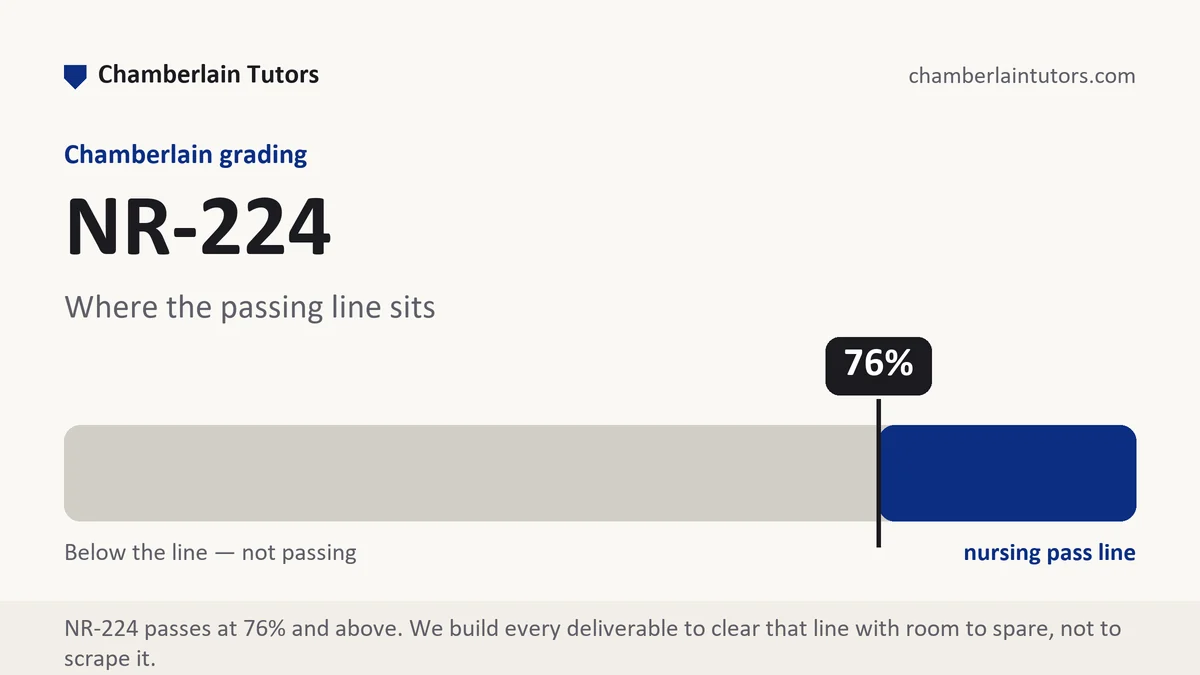
What NR-224 Week 3 asks for
What actually stands between a busy clinic and a medication error? Watch the nurse at a community health center juggling a waiting room of walk-ins: a child due immunizations, an older man picking up a blood pressure refill question, a teenager needing a tetanus booster after a bike crash. Every dose that crosses the counter passes through the same quiet machinery, right patient checked against two identifiers, right drug against the order, right dose against the arithmetic, right route, right time, and the machinery is deliberately redundant because any single check can fail on a crowded afternoon. The written work of this stage asks you to describe that machinery and, more importantly, to argue why it is built the way it is.
Sections usually set one of three deliverables here: a written piece on the rights and the checks, a scenario asking where an error chain could have been interrupted, or a reflection connecting lab practice to the safety system. Calculation work often runs alongside as its own graded strand, and while a manual cannot sit the math for you, the written pieces reward the same habit the math does: show your reasoning, one step at a time, so an error anywhere becomes visible instead of buried.
The boundary matters more in this week than most. Administering real medications happens under supervision in clinical settings, on real orders, with your own signature, and no part of that belongs to a tutor. The written layer, the essay on why three checks exist, the analysis of where a scenario's error slipped through, the reflection on your first supervised pass, is the layer this manual supports and the layer where the graded writing lives.
The NR-224 Week 3 method, step by step
Six moves for writing about medication safety with the seriousness the topic buys.
-
Map the rubric verbs before touching the topic
List wants the rights named. Explain wants why each check exists. Apply wants a scenario walked through the system. Confirm which you have been asked for, because safety topics tempt students into writing all three and scoring on none.
-
Treat the rights as a system, not a list
The strongest papers argue that the checks are redundant on purpose: each one catches the failures the others miss. One paragraph on that design idea outscores a bulleted recital every time.
-
Anchor the standard to a source
Safe administration practice is described in your fundamentals text and in published safety guidance, and naming one with its year inside the sentence turns your description into an evidenced claim rather than classroom memory.
-
Walk one error path end to end
If your piece involves a scenario, trace the near-miss through every checkpoint it passed: where it started, which checks it slipped by and why, and which check finally caught it or should have. Chains score; lists of contributing factors do not.
-
Show calculation reasoning in words
Where a dose enters your writing, write the setup: what is ordered, what is on hand, what unit conversion applies, then the arithmetic. A correct answer with visible reasoning wins full credit; a correct answer alone often does not.
-
End at the patient, not the policy
Close with what the system protects, the person on the other side of the counter, and what a beginning student does when unsure: stop, ask, verify. That final move is the professional behavior the week is really teaching.
A layout and word budget for a medication safety piece
Where do the words go? This is the frame our tutors keep beside a safety-system essay, sized for roughly 650 to 850 words. It is our own outline rather than anything the university issues, and your week's rubric outranks it wherever the two disagree.
| Section | What belongs in it | Word target |
|---|---|---|
| Why medication safety is systemic | The opening claim: errors are failures of systems more than of individuals, stated and sourced. | 80 to 110 |
| The rights, briefly | The checks named in your own words, one clause each, without letting the list swallow the essay. | 90 to 120 |
| Why the redundancy exists | The design argument: what each layer catches that the others miss, with one concrete illustration. | 150 to 180 |
| The scenario or scene | A near-miss traced through the checkpoints, or an honest moment from lab or a clinic observation. | 150 to 190 |
| The calculation habit | How visible arithmetic protects patients, with one worked example if your assignment allows it. | 100 to 130 |
| Close on the professional behavior | The stop-and-verify reflex, and what it costs a new nurse to skip it, stated without melodrama. | 60 to 80 |
Evidence craft for medication safety writing
Safety claims need published anchors. Statements about how errors happen and how systems prevent them belong to your fundamentals text and to published patient safety literature. Name the source in the sentence with a year; safety writing that runs on common sense alone forfeits its support row.
Never invent an error statistic. Figures about how many errors occur are widely misquoted, and a wrong number in a safety paper is worse than none. If you cite one, take it from a source you can name and date, and carry its base and window into your sentence. If you cannot, argue the mechanism instead; mechanisms need no statistics.
Keep drug references generic in essays. Unless your assignment names a medication, illustrate with classes and situations, a look-alike label, a unit conversion, rather than inventing a specific order. Invented clinical detail reads as fabrication in exactly the course that teaches you not to fabricate.
Sequence is evidence in error writing. When you analyze a near-miss, the order of events is your data. Write it as a timeline with each checkpoint named, because a grader can verify a chain but cannot verify a mood, and vague accounts of confusion score like vagueness always does.
Five mistakes that cost points in this week's territory
- The rights as the whole essay. Reciting the checks answers list, and almost every rubric at this level asks for more depth than list. The points live in why, not what.
- Blame-the-nurse analysis. Writing that an error happened because someone was careless misses the systems lens this stage teaches, and graders read it as a missed concept, not a moral stance.
- Hidden arithmetic. A dose stated without its setup cannot earn reasoning credit, and if the number is wrong, hidden work turns a partial-credit error into a zero.
- Invented specifics. Made-up drug names, doses and policies weaken a safety essay because the reader cannot check any of it. Real sources or generic illustrations, nothing in between.
- Skipping the unsure-student move. Papers that never mention stopping to verify read as overconfident, and overconfidence is the exact disposition this week is designed to sand off.
Before you submit
- The rights appear briefly and the argument about redundancy carries the essay
- At least one published source on safe administration is named with its year
- Any error scenario is traced through checkpoints in sequence
- Any calculation shows ordered dose, on-hand form, conversion and arithmetic
- No statistic appears without a named, dated source and its base
- Every reference appears in the text and every in-text citation appears in the list
Writing the medication safety piece for NR-224?
Send the instructions and the rubric out of Canvas. A premium original draft comes back in 24 to 48 hours with the system argued and the sources named, and revisions run until the grade lands.