NR-584 Week 1 is where a quality and safety course teaches you to say what went wrong in language that survives being read by someone who was not there. The opening territory is definitional and applied at once: the vocabulary of quality and of safety, the difference between them, and one problem from your own setting written so precisely that a reader could go look for it in the record. Your section may print this as NR 584 or NR584; it is the same course. Chamberlain publishes no syllabi outside Canvas. The placement here is our teaching judgment from the course's catalog arc; your section's rubric decides what your week actually asks.
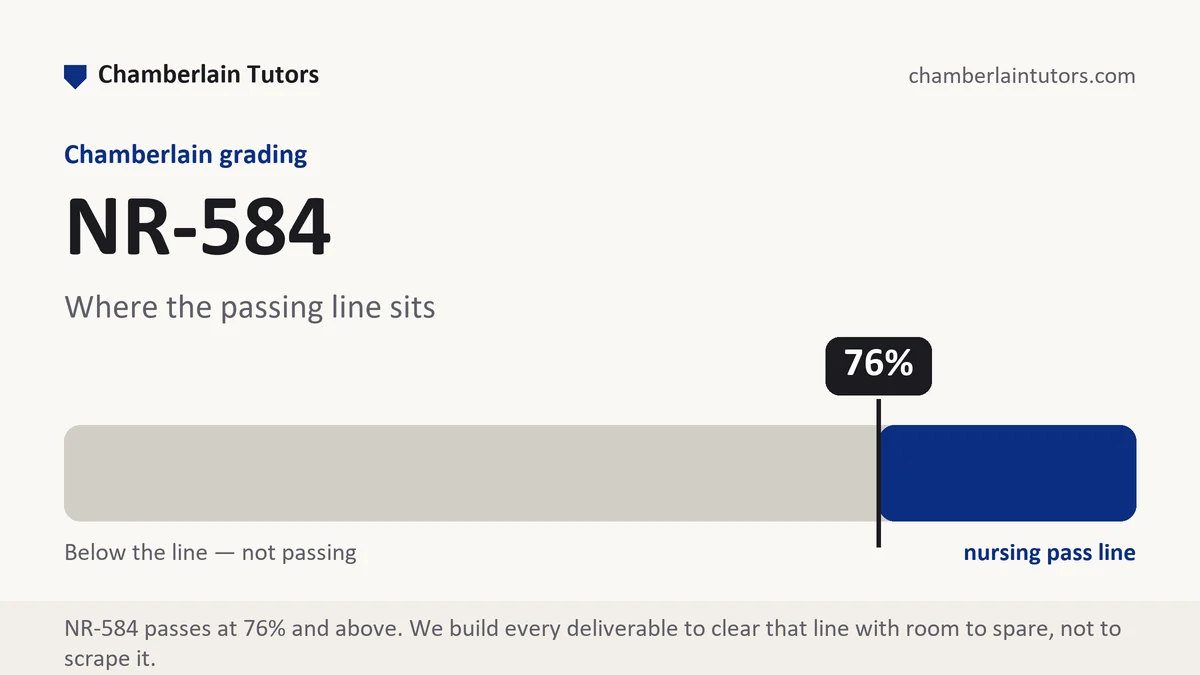
What NR-584 Week 1 asks for
Open a discharge record from last month and read only the medication reconciliation field. Half the time it will hold a list. Some of the time it will hold a list plus a note that the patient's own pharmacy was called. Occasionally it will hold nothing at all, timestamped anyway. That variation, visible in documentation before anyone has designed a study, is the raw material this course is built on, and the opening stage of a quality and safety sequence usually asks you to convert exactly that kind of observation into disciplined written language.
The catalog frames this course around quality management and safety principles, and a first stage in that territory nearly always does two things. It establishes the field's founding vocabulary, the reports that reframed harm as a product of systems rather than of individual carelessness, and the working distinction between quality, which asks how well care achieves what it intends, and safety, which asks how reliably care avoids injuring the person receiving it. Then it asks you to apply that vocabulary to one concrete situation you have seen. The application is where the points concentrate, and it is where most first drafts thin out into generalities.
Deliverables at this stage are typically short. A posted introduction that names a quality or safety concern from your practice, a brief written response that defines the core terms with citations, or both. Length is modest and signal density is high, which means the grader learns most of what they will assume about your writing from four or five hundred words. If your section runs a discussion this week, draft it in a document and paste once: posts do not reopen after submission in Canvas, and an opening post with a legend statistic in it is a correction you cannot make.
The habit to install now is the audit habit. A master's prepared nurse does not report that handoffs on the unit are unreliable; that nurse reports that in the twenty transfers reviewed, the receiving note carried the pending laboratory result in eleven of them. The first number is an impression. The second is a finding, and a finding is the unit of currency for the next seven stages of this course.
The NR-584 Week 1 method, step by step
Six moves that turn a workplace impression into an opening piece of quality writing.
-
Read your week's rubric for its verbs before you read the assigned chapters
Copy each scoring row into a blank document and reduce it to the verb it pays for. Define, differentiate, describe and apply demand four different amounts of work, and a row asking you to differentiate two concepts cannot be satisfied by defining both of them well.
-
Write the two definitions from published bodies, not from memory
Quality and safety each carry definitions issued by national organizations that your readings will name. Take one of each, cite it, and paraphrase closely enough that the issuing body would recognize its own idea in your sentence.
-
Add the separating sentence most drafts leave out
Care can be technically excellent and still unsafe in delivery, and it can be flawlessly safe while achieving very little. Write that distinction explicitly with an example attached to each half. Holding the two apart is the intellectual test the opening stage is built around.
-
Choose a problem you could locate in a record
Pick something documentation would show: a field left blank, a callback that has no entry, an allergy list that disagrees with the order set. Documentary problems can be counted, and countable problems can be improved, which is what the rest of the session will ask you to do.
-
Size the problem with one labelled figure
Attach either a published national rate, named and dated as published, or your own observation labelled plainly as an informal review of a stated number of records. Never let the two blur. The labelling, not the size of the number, is what earns the point.
-
Close on the advanced practice stake and proof outside Canvas
Finish by saying why this problem belongs to a master's prepared nurse rather than to a manager or a committee, then read the draft aloud once for register. Warmth, contractions and exclamation marks are the three habits that pull an otherwise sound opening piece down.
A layout and word budget for the opening definitional piece
Below is the frame our tutors keep beside a first submission in a quality course, sized for roughly 600 to 800 words. It is our own outline rather than anything the university issues, and your week's rubric outranks it wherever the two disagree. Scale the targets proportionally if your assigned length differs.
| Section | What belongs in it | Word target |
|---|---|---|
| The problem in one sentence | The documentary gap you will discuss, stated before any history or definition arrives. | 40 to 60 |
| Where the discipline came from | The founding reports named and dated, cited as origins rather than as current data. | 90 to 120 |
| Quality and safety, defined apart | One cited definition of each plus the sentence that shows they can move in opposite directions. | 140 to 170 |
| The gap in your own setting | What the record shows, who is affected, how often, and what the documentation looks like when it goes right. | 160 to 200 |
| One number, labelled | A published rate with its source, or your own count with its denominator and the period it covers. | 60 to 80 |
| The advanced practice stake | Why this problem falls to a master's prepared nurse, in forward-looking rather than summary language. | 90 to 120 |
Evidence craft for a foundations stage in quality
Cite the founding documents as history and date them. The reports that created this field are decades old and remain entirely citable for what they founded, which is the one clean exception to a currency window. What breaks the rule is presenting their counts as a description of care today. Name the report, give its year, then set a recent figure beside it and let the distance between the two do argumentative work.
Do not round legend upward. The famous harm estimates in this literature have been recalculated and contested more than once, and a grader in a quality course is precisely the reader who knows that. Attribute any figure to the specific report or study it came from, and if two credible estimates disagree, say so in a clause rather than picking the larger one.
Keep the scope of your own observation honest. What you saw in your own records supports a claim about your own records. A sentence about national practice needs a national source sitting next to it. Writing that separation visibly, rather than gliding between the two registers, is the hygiene that distinguishes graduate work from a well-written opinion.
Report counts with denominators and windows. Nine of forty-one transfers reviewed across one month is evidence a reader can weigh. Twenty-two percent is a number that hides how many records were behind it. In quality writing the denominator is not a detail; it is the part that tells the reader whether to believe the proportion.
De-identify everything that could point at a person or a place. No facility name, no unit small enough to identify, no patient particulars, no description of a colleague specific enough to recognize. The analysis carries the marks, never the scenery, and a de-identified example loses nothing analytically.
Five mistakes that cost points in this week's territory
- Using quality and safety as synonyms. The stage exists to separate them, so a draft that swaps the words freely fails its central task without ever looking wrong.
- Statistics with no parent document. A famous number quoted from memory reads to a quality grader the way a misquoted dose reads to a pharmacist.
- A problem the size of the health system. Inequity in American healthcare cannot be sized, owned or improved inside a short opening piece; a blank reconciliation field can.
- History that never lands. A recap of the founding reports that never reaches your own setting answers half the prompt and reads as a book report.
- No stake for the advanced role. Ending without saying why this belongs to you, specifically, leaves the application row unanswered, and that row is usually the heaviest one on the page.
Before you submit
- Every graded verb from your rubric has a visible answer somewhere in the draft
- Quality and safety each carry a cited definition, plus one sentence separating them
- Historical figures are attributed, dated, and paired with a current number
- The chosen problem is one a reader could look for in documentation
- Every count arrives with its denominator and the period it covers
- Nothing in the draft identifies a facility, a unit, a colleague or a patient
Opening NR-584 and the vocabulary is still new?
Send the instructions and the rubric out of Canvas. A premium original draft comes back in 24 to 48 hours with clean cited definitions and a problem sized honestly, and revisions run until the grade lands.