NR-542 Week 1 installs the model the rest of the session runs on: data, information, knowledge and wisdom, treated as four levels you have to earn rather than four words you name in an introduction. The opening written work usually asks you to explain the climb and apply it to something concrete, and the graded difference is whether your reader can point at the sentence where each level begins. Your section may print this as NR 542 or NR542; it is the same course. Chamberlain publishes no syllabi outside Canvas. The placement here is our teaching judgment from the course's catalog arc; your section's rubric decides what your week actually asks.
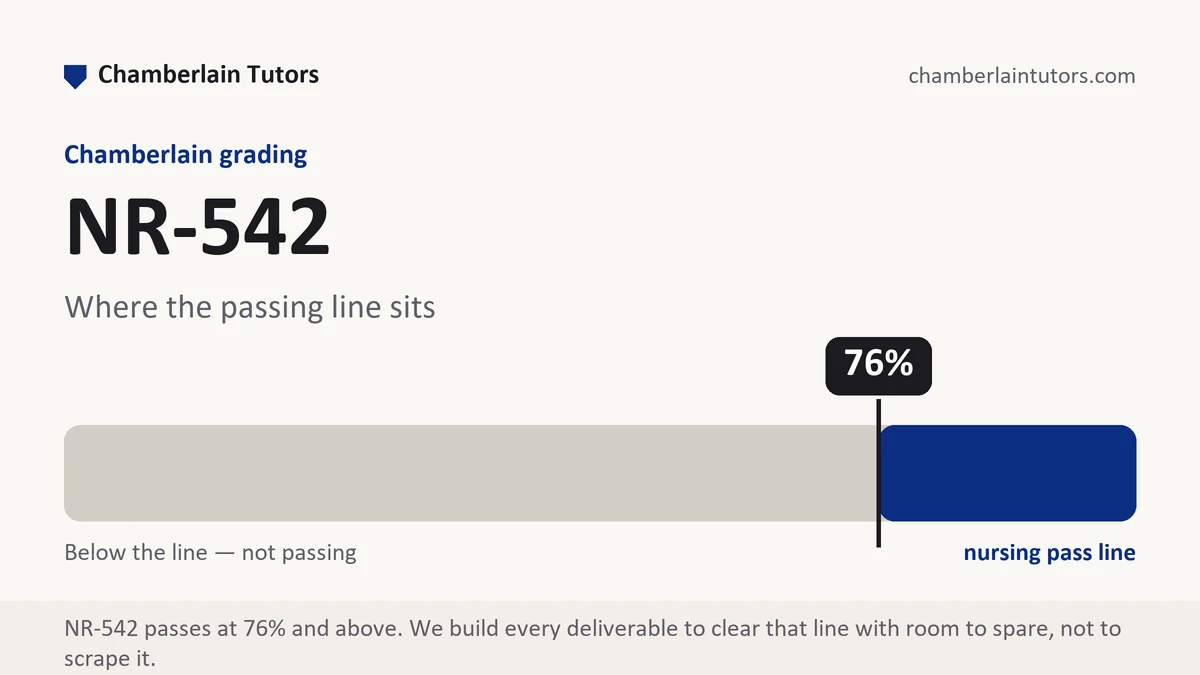
What NR-542 Week 1 asks for
A nurse manager forwards a fall report to her unit council with one line of commentary: this says nineteen and I can only remember eleven. Both numbers are correct. Nineteen is what the report counted, because one row was created for every safety event entry, and the entry form is used for near misses and for assisted lowerings as well as for falls with contact. Eleven is what the staff remember, because a fall people remember is a fall somebody landed from. Nobody made an error. What happened is that a set of records answered a question slightly different from the one being asked, and the gap between those two questions is the entire subject of this course.
The opening stage exists to give you vocabulary for that gap. In the model this course is built on, data are the recorded facts with no interpretation attached: nineteen rows, each with a date, a location, an event type and a reporter. Information is those facts placed in a context that answers a question: nineteen events across a defined period on a defined unit, of which eleven involved contact with the floor. Knowledge is the pattern you can defend across records, such as a concentration of contact falls in the two hours after shift change. Wisdom is the decision taken with the limits in view, including the awareness that the entry form itself shapes what gets counted.
Written work here typically asks you to define the levels and demonstrate them, sometimes against a supplied scenario and sometimes against a practice example of your own. The universal weakness is the announced climb. A paper defines all four levels accurately in its first page and then writes an opinion essay, and a grader with the model in front of them can see immediately that nothing was climbed. Definitions are the cheapest part of this assignment. Demonstration is the graded part.
If your section opens with a discussion as well, expect it to ask for an example from practice. Give it one with numbers in it. Posts do not reopen after submission in Canvas, and a post describing the model in the abstract is indistinguishable from every other post in the thread.
The NR-542 Week 1 method, step by step
Six moves that turn four definitions into a demonstrated climb.
-
Write the question as something records could answer or fail to answer
Falls on our unit is a topic. Whether contact falls cluster in the two hours after shift change on a 28-bed unit over one quarter is a question, and a question is what makes the climb possible.
-
Describe the data with no interpretation in the paragraph at all
Source, unit of the row, fields, who enters each one, and how many records. This is the hardest paragraph to write honestly because interpretation keeps leaking in, and it is the one that proves you understand the first level.
-
Name the context you added to make it information
A denominator, a time period, a comparison group, a category grouping. State the operation explicitly enough that somebody else could repeat it and land on your number.
-
Defend the pattern before you call it knowledge
A pattern needs stability, a plausible mechanism and a check against an alternative explanation. Two events in the same hour is a coincidence with a story attached, not a finding.
-
Put the limits inside the recommendation, not after it
Wisdom in this model is not a bolder decision; it is a decision that carries what the data cannot tell you. Write the recommendation and its limitation in adjacent sentences so the reader sees them as one judgment.
-
Label the transitions in the prose
A short clause at each step, such as placing these counts against the census for the same period turns them into, costs eight words and shows the grader exactly where each level starts. In this course that signposting is worth more than elegance.
A layout and word budget that makes each level visible
The frame our tutors keep beside an opening DIKW paper, sized for roughly 1,000 to 1,300 words. It is our own outline rather than anything the university issues, and your week's guide outranks it wherever the two disagree.
| Section | What belongs in it | Word target |
|---|---|---|
| The question | One answerable question, the setting, and why anyone would want the answer. | 100 to 130 |
| Data | Source, unit of the row, fields, who enters them, record count, with no interpretation present. | 200 to 240 |
| Information | The context added, stated as a repeatable operation, and the result it produced. | 190 to 230 |
| Knowledge | The pattern, its stability, the mechanism that would explain it, and one alternative explanation tested. | 230 to 280 |
| Wisdom | The decision, what it accepts, what the records cannot support, and what would change it. | 180 to 220 |
| Closing judgment | What the reader should now understand about the difference between having records and knowing something. | 70 to 90 |
Evidence craft for the opening data paper
Attribute the model rather than treating it as common property. The data to wisdom progression has an authorship and a literature in nursing informatics, and citing it properly with a year is the first thing a grader in this course looks for. Describing it as a well-known model without a source is a support failure in the opening paragraph.
Every count arrives with its denominator and its window. Nineteen safety events across one quarter on a 28-bed unit is data. Nineteen events is a number with no meaning attached. This habit is graded all session and it starts here.
Name the unit of the row before anything else. One row per event, per patient, per encounter or per day are four different data sets that look identical in a spreadsheet and answer completely different questions. Papers that skip this sentence produce arithmetic nobody can check.
Keep interpretation out of the data section on purpose. If a sentence in that section contains a word like concerning, high or improving, it belongs a level up. Moving it is a thirty-second edit and it is one of the clearest signals of understanding available in this paper.
Five mistakes that cost points in this week's territory
- Defining the model and then abandoning it. Four accurate definitions followed by an opinion piece is the most common weak submission in this course.
- A topic instead of a question. If no answer could be right or wrong, no climb is possible and the paper has nowhere to go.
- Interpretation smuggled into the data section. Adjectives at the first level collapse the distinction the whole model rests on.
- A pattern asserted as knowledge. Without stability, mechanism and an alternative explanation, you have an anecdote with a count attached.
- Limits stranded in a final sentence. A limitation that appears after the recommendation reads as a disclaimer rather than as part of the judgment.
Before you submit
- The question is stated in a form records could answer or fail to answer
- The unit of the row is named explicitly
- The data section contains no evaluative language
- The operation that produced information is repeatable from your description
- The pattern is tested against at least one alternative explanation
- The model is cited with its source and year
Starting NR-542 this week?
Send the prompt, any supplied data set and the rubric out of Canvas. A premium original draft comes back in 24 to 48 hours with each level of the model earned in visible sentences, and revisions run until the grade lands.