NR-518 Week 8 is where the session's separate skills are asked to do one job together. A closing deliverable in a population health course usually wants a proposal: a group, a problem measured properly, an intervention aimed at something the evidence says will move, an objective written so precisely that anyone could tell whether it was met, and an evaluation plan that would detect failure rather than decorate success. Your section may print this as NR 518 or NR518; it is the same course. Chamberlain publishes no syllabi outside Canvas. The placement here is our teaching judgment from the course's catalog arc; your section's rubric decides what your week actually asks.
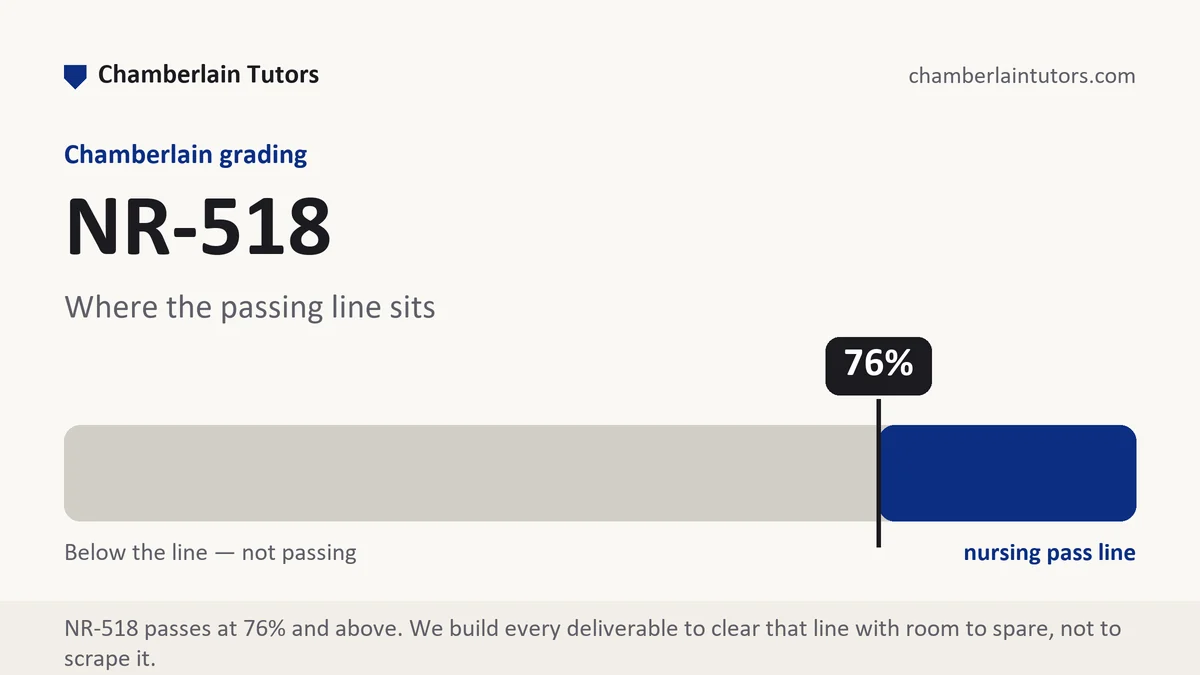
What NR-518 Week 8 asks for
The territory is planning and evaluation. A proposal is judged on whether its parts connect: the problem statement has to carry a measured burden, the intervention has to act on a determinant the earlier evidence identified, and the objective has to be expressed as a number moving in a named group by a named date. Vague objectives are the single most common weakness in closing papers. Improve awareness cannot be evaluated. Raise the proportion of adults in the clinic panel with a recorded blood pressure in the past twelve months from 61 percent to 80 percent within one year can be, and the second version writes half of your evaluation section for you.
Evaluation itself divides into three questions a grader reads for separately. Did the activity happen as planned, which is process. Did the thing you were trying to change move, which is outcome. And could the change have happened anyway, which is the design question the earlier evidence work in this course prepared you to answer. Add the practical layer that decides whether any of it survives: what it costs, who does it, what has to keep running after the pilot period, and whether the group hardest to reach was reached at all.
Closing deliverables tend to be longer than the weekly ones and often ask you to draw on material from across the session. Build the plan from the numbers you already assembled rather than starting a new topic in the last week. If your section runs a discussion this week, treat it as a rehearsal of your argument, since posts do not reopen once submitted in Canvas and a well argued objective posted early attracts useful challenge.
The NR-518 Week 8 method, step by step
Six moves that build a population health proposal whose evaluation section could genuinely report a failure.
-
Read your week's rubric as the outline it already is
Closing assignments usually print rows in the order a proposal is written: problem, evidence, objective, plan, evaluation, sustainability. Copy them into a blank file, keep the printed order, and give each row its own heading with the weight beside it, so a heavy row cannot end up as your shortest section.
-
State the problem with a measured burden in the group
One paragraph, one group, one number with its denominator and its period. This is where the measurement work from earlier in the session pays for itself, and a problem statement without a figure attached weakens every section that follows it.
-
Choose the target from the evidence, not from the habit
Name the determinant or the point in the disease course you intend to act on, and cite what supports acting there. Most weak proposals choose an activity first, usually education, and then look for a justification. Choosing the target first often changes the activity into something less obvious and more effective.
-
Write one objective a stranger could score
Name the indicator, the current value, the intended value, the group and the date. Read it back and ask whether two different people scoring it a year from now would agree. If they could disagree, the objective is not finished.
-
Build the plan as activities with owners
For each activity say who does it, how often, to how many people and with what resources. Reach is the population health measure, so include the denominator: not a series of sessions, but sessions offered to a stated number of the group with an expected attendance.
-
Design an evaluation that could report failure
Separate process indicators from outcome indicators, name the data source for each and say when it is collected. Then add the honest paragraph: what else could have moved this number in the same period, and what comparison would help you tell the difference.
A layout and word budget for a program proposal
Sized for a closing piece of roughly 1,400 to 1,700 words. This is our drafting frame rather than a university-issued form, and your week's rubric outranks it wherever the two disagree. Scale each target proportionally if your assigned length differs.
| Section | What belongs in it | Word target |
|---|---|---|
| Problem and group | Who, where, over what period, with a measured burden carrying its denominator and source. | 180 to 220 |
| Evidence for the target | The determinant or stage you intend to act on, with the evidence that acting there changes anything. | 220 to 260 |
| Objective | Indicator, baseline value, target value, group and date, in one sentence a stranger could score. | 90 to 120 |
| Activities and reach | Each activity with its owner, frequency, the number of people it is offered to and the resources it needs. | 280 to 330 |
| Evaluation plan | Process and outcome indicators, data sources, collection points, and the comparison that guards against wishful reading. | 300 to 350 |
| Equity and sustainability | Who is hardest to reach and what closes that gap, plus what keeps running after the first year. | 200 to 240 |
| Close | The claim you would be able to make if the objective were met, stated at defensible strength. | 80 to 100 |
Evidence craft for proposals
Cite evidence for the mechanism, not only for the problem. Papers reference the burden generously and then propose an intervention with nothing behind it. The stronger citation sits on the sentence that claims this activity moves this indicator, because that is the claim a reader would challenge.
Report baselines with their source and date. An objective is only scorable against a baseline someone can verify. Say where the current value came from, when it was measured and how it will be measured again, using the same definition both times.
Prefer evidence from a group like yours. An intervention that worked in a large urban system may not transfer to a rural clinic with two staff. Where the evidence comes from a different setting, say what differs and what you would watch to detect the mismatch early.
Keep the effect claim inside what the evidence design supports. Where your supporting studies are observational, your proposal predicts an association rather than promising a reduction. Careful verbs in a proposal read as competent planning rather than as hedging.
Five mistakes that cost points in this week's territory
- An objective no one could score. Improve, increase awareness and promote understanding cannot be evaluated, and every evaluation row after them collapses.
- Education chosen by default. Teaching is the right answer when knowledge is the barrier. Where the barrier is access, cost or transport, a session changes nothing and the proposal says so about itself.
- Process reported as outcome. Numbers attending are not the same as the indicator moving, and a plan that measures only attendance cannot tell whether it worked.
- No alternative explanation considered. A rate that fell during your program may have fallen anyway. Naming that possibility strengthens the proposal rather than weakening it.
- Silence about the people not reached. A program that raises the average while missing the group with the greatest burden has widened a gap, and this course grades that judgment.
Before you submit
- The problem statement carries a measured burden with its denominator and period
- The chosen target is supported by cited evidence that acting there changes the indicator
- The objective names indicator, baseline, target, group and date
- Every activity has an owner, a frequency and a number of people it reaches
- Process and outcome indicators are listed separately with their data sources
- Every reference appears in the text and every in-text citation appears in the list
Closing NR-518 this week?
Send the final prompt and its scoring guide from Canvas. A premium original draft returns in 24 to 48 hours with a scorable objective and an evaluation plan that holds up, and revision runs free until the grade lands.