NR-500NP Week 8 closes the foundations course by asking you to assess yourself against the outcomes your master's program is built on, then write a development plan for the rest of it. The graded quality is specificity: a plan made of actions with dates and checks, not a paragraph of intentions about lifelong learning. Your section may print this as NR 500NP or NR500NP; it is the same course. Chamberlain publishes no syllabi outside Canvas. The placement here is our teaching judgment from the course's catalog arc; your section's rubric decides what your week actually asks.
What NR-500NP Week 8 asks for
The territory is forward looking self assessment. Unlike the closing document of a practicum, this one is written near the start of a program rather than at the end of one, so it has very little accomplished work to point at. What it has instead is a set of program outcomes, a clear view of where you currently stand against each, and a stretch of coursework and clinical hours still ahead that can be planned deliberately.
Three parts usually carry the marks. First, a self assessment against the outcomes your program publishes, honest enough that at least two of them come out weaker than the rest. Second, a development plan in which every goal has an action, a resource, a date and a way to tell whether it happened. Third, an account of how the plan survives contact with the program's timeline: eight week sessions with deliverables every week, up to six starts a year, and the clinical hours your track requires arriving later in the sequence with courses gating access to them.
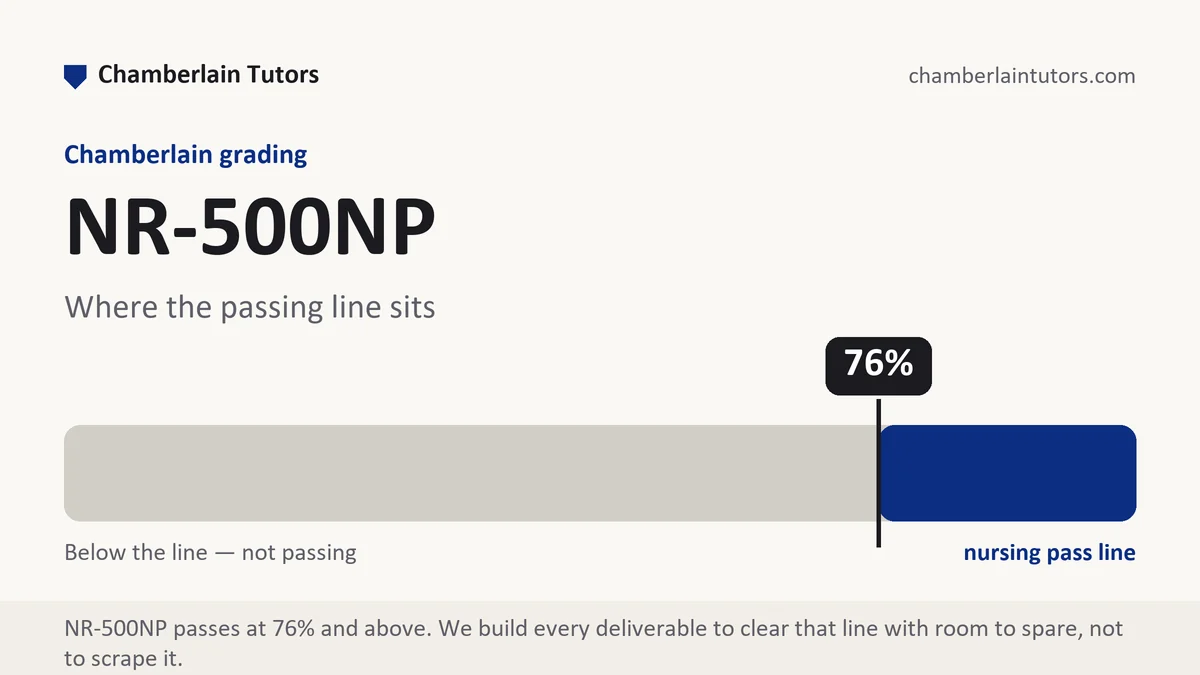
The scale matters here too. On the NP specialty scale there is no C band, so anything below 84 is a failing result and a run of merely acceptable weeks averages under that line faster than students expect. A development plan that ignores academic performance in favour of career aspiration has skipped the nearest and most consequential goal. The deliverable is typically a plan document of two to three pages, sometimes with a posted reflection, and it often lands in the same week as other closing work. If your section runs a discussion this week, remember that a submitted Canvas post cannot be edited.
The NR-500NP Week 8 method, step by step
Six moves that produce a plan someone could hold you to.
-
Assess against published outcomes, not against feelings
Take your program's stated outcomes as the yardstick and place yourself against each one with a sentence of evidence. Evidence at this stage means coursework, current practice, prior experience or feedback you have actually received.
-
Let two outcomes come out weak and say why
A self assessment strong across the board is not an assessment. Name the two thinnest areas, say what the thinness consists of, and make those the goals the plan actually works on.
-
Convert each weak area into one goal with a verb
Complete, produce, submit, present, obtain. Goals that begin with improve or understand cannot be checked, and a rubric row asking for measurable goals has nothing to score in them.
-
Attach a resource and a date to every action
Which course, which library workshop, which mentor conversation, which certification step, by which month. A plan without resources assumes availability, and availability is exactly what runs out later in a program.
-
Test the plan against the program calendar
Lay the goals across the sessions ahead, including the ones carrying clinical hours, and check that nothing lands in a session already full. Where two goals collide, move one rather than pretending both fit.
-
Write the review point and the fallback
When you will re-read this plan, what evidence you will judge it against, and what you will drop first if the calendar tightens. Naming the sacrifice in advance is what makes a plan realistic rather than optimistic.
A layout and word budget for a development plan
The frame our tutors keep beside a development plan of roughly 1,000 to 1,300 words. It is our own outline rather than a university form, and your week's rubric outranks it wherever the two disagree.
| Section | What belongs in it | Word target |
|---|---|---|
| Where you stand now | Current role, track, population focus, and what you bring into the program that is genuinely relevant. | 110 to 140 |
| Self assessment against outcomes | Each published program outcome with a sentence of evidence placing you against it. | 260 to 320 |
| The two priority gaps | The thinnest areas, what the thinness consists of, and why they matter for your track specifically. | 180 to 220 |
| Goals, actions and resources | Each goal with a verb, the actions under it, the named resource, and the month it happens. | 280 to 340 |
| Fit with the program calendar | The goals laid across upcoming sessions, with collisions resolved rather than ignored. | 150 to 190 |
| Review point and fallback | When you reassess, against what evidence, and what gets dropped first if the calendar tightens. | 110 to 150 |
Evidence craft for a development document
Cite the outcomes you are measuring yourself against. Program outcomes and professional standards are published documents with issuing bodies and years. Naming them turns a personal reflection into an assessment against an external yardstick, which is what the rubric is asking for.
Keep career claims inside what you can support. Statements about employment prospects, salary or demand need a source with a base, a place and a year, or they should be written as intention rather than as fact.
Do not cite requirements you have not checked. Certification eligibility, clinical hour totals and course sequences vary and change. Where your plan depends on one, attribute it to the issuing body or your program's own current materials and say when you checked.
Report feedback accurately and without naming anyone. Where a goal comes from something a faculty member, manager or colleague told you, describe the feedback and its role rather than the person, and represent it as what it was rather than sharpening it to fit the plan.
Five mistakes that cost points in this week's territory
- Goals made of intentions. Continue to grow professionally and stay current with evidence cannot be checked by anyone, which is precisely why they are the most common sentences in these papers.
- A self assessment with no weak areas. Uniform strength reads as avoidance, and it leaves the plan with nothing to work on.
- The academic scale ignored. A plan that never mentions performance in the coursework immediately ahead has skipped the goal with the shortest deadline attached to it.
- No resources named. Actions that assume time, mentors and workshops will simply be available are the first things to fail when the calendar tightens.
- A plan written past graduation only. Ambitions for five years out are fine in a closing paragraph. The graded section is the part that starts next session.
Before you submit
- Every published program outcome appears with a sentence of evidence
- At least two areas are identified as weaker, with what the weakness consists of
- Each goal starts with a verb that can be checked
- Every action names a resource and a month
- The goals have been laid against the session calendar and collisions resolved
- A review point exists with a stated fallback if time runs short
Closing NR-500NP this week?
Send the prompt and the rubric out of Canvas. A premium original draft comes back in 24 to 48 hours with the self assessment evidenced and the goals made checkable, and revisions run until the grade lands.