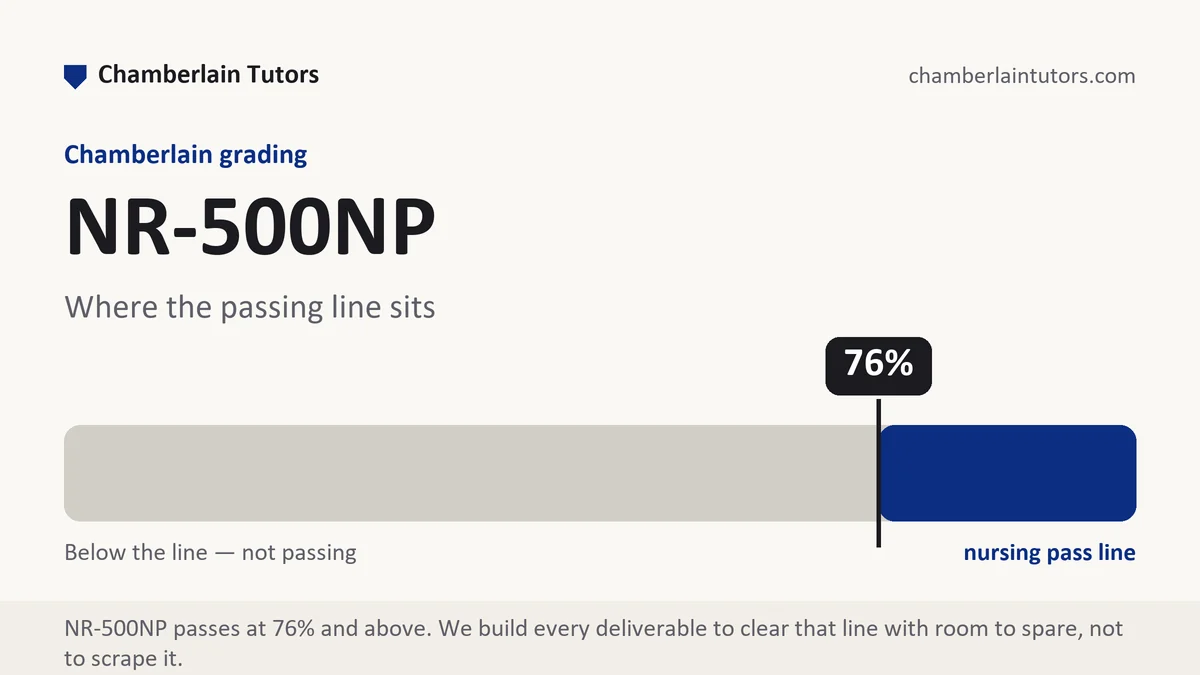
NR-500NP Week 1 sets the writing standard that the rest of the master's program will grade you against: a claim before description, sources that carry the claim, citation mechanics that survive checking, and a working understanding of academic integrity that goes past not copying. Your section may print this as NR 500NP or NR500NP; it is the same course. Chamberlain publishes no syllabi outside Canvas. The placement here is our teaching judgment from the course's catalog arc; your section's rubric decides what your week actually asks.
What NR-500NP Week 1 asks for
The territory of an opening foundations stage is the difference between undergraduate writing that is accurate and graduate writing that argues. Most students arrive able to produce the first and are surprised to be marked down for it. The shift being asked for is small to describe and hard to execute: every paragraph should be answerable to a claim, sources should be selected for what they settle rather than for what they mention, and the writer's own reasoning should be visible between the citations rather than replaced by them.
Academic integrity is the other half of this stage, and it is broader than plagiarism. It includes accurate representation of what a source said, distinguishing paraphrase from synthesis, self reuse of your own previous coursework, citation of ideas as well as sentences, and the professional dimension: the honesty standards that will later govern documentation and reporting when you are the provider signing the note.
At this point in an eight-week session the deliverable is usually short. Opening weeks tend to carry a written introduction of one to two pages, a posted response in the classroom, or a self assessment of graduate readiness, sometimes more than one. If your section runs a discussion this week, note that Canvas posts do not reopen once submitted, so the first version is the graded version and drafting outside the box is the only revision available to you. Treat whatever appears as a chance to set habits, because on the NP specialty scale a grade below 84 does not pass and there is no comfortable middle band to absorb a slow start.
The NR-500NP Week 1 method, step by step
Five moves that lift an accurate first submission into a graduate one.
-
Read your week's rubric as a set of verbs and weights
Strip each criterion row to its verb, then add the points behind the analytic verbs and the descriptive ones separately. That ratio is the ratio your finished document should have, and it is usually more analytic than instinct suggests.
-
Write the claim sentence before the paragraph
One line per planned paragraph, stating what that paragraph asserts. If a claim line reads as a topic rather than an assertion, the paragraph underneath it will be description, and you have found the problem before writing 200 words of it.
-
Choose sources by the job they do
A professional standard settles what a body expects. A research study settles what was observed. A textbook orients you and settles nothing in a graduate paper. Assign each source to a claim before you start writing, and drop any source you cannot assign.
-
Paraphrase from your notes, never from the open source
Read, close the document, write what it said in your own structure, then reopen to check accuracy and add the citation. Paraphrase produced with the original on screen tends to keep the original's sentence shape, which is exactly what integrity checks and experienced readers notice.
-
Run the citation reconciliation as a separate pass
Every in-text citation appears in the reference list and every reference appears in the text, spellings and years matched. Do this as its own task at the end, not while writing, because it is checking work rather than thinking work and it catches more errors when it is deliberate.
A layout and word budget for an opening scholarly submission
The drafting frame our tutors use for an opening piece of roughly 800 to 1,000 words. It is our own outline rather than anything the university issues, and your week's rubric outranks it wherever the two disagree. Scale each target proportionally if your assigned length differs.
| Section | What belongs in it | Word target |
|---|---|---|
| Opening claim | What this paper argues, stated in two or three sentences with no runway about the profession in front of it. | 70 to 90 |
| Position stated | Where you currently stand as a writer or a learner, specific enough to be checked later in the session. | 140 to 180 |
| Evidence for the position | Two or three sourced points that support the claim, each with the reason that source was chosen visible. | 230 to 290 |
| Application to your track | What the claim means for the advanced practice track you are enrolled in, named specifically. | 170 to 210 |
| Integrity commitment | What honest scholarship will look like in your own practice this session, in concrete behaviours. | 120 to 150 |
| Close | An answer to the question the prompt asked, not a summary of the paragraphs above it. | 60 to 80 |
Evidence craft at the opening of a graduate program
Set a recency rule and say what it is. Where your guide is silent, treat five years as the default boundary for anything empirical, and justify an older source inside the sentence that uses it. Foundational works stay usable when the sentence explains why the original is the right reference.
Prefer the body that issued the statement. Quoting a secondary article describing a professional standard puts a middleman between you and a document you could have cited directly. Go to the issuing organisation, and name it in the sentence rather than only in the list.
Represent findings at their own strength. A single study reports what happened in one sample. A synthesis reports across studies. Writing research shows when you have one study is an accuracy problem, and it is the integrity failure that experienced readers catch most often in student work.
Cite ideas as well as wording. A structure, an argument or a framework you took from a source needs attribution even when no phrase survived the rewrite. Uncited borrowed structure is the version of the problem most students genuinely do not know is a problem.
Five mistakes that cost points in this week's territory
- An introduction about the history of the profession. Under a short cap, that paragraph consumes the frame you needed for a claim, and it says nothing a grader did not know.
- Citation stacking. Three references behind one sentence signals collection rather than selection. One well chosen source that settles the claim scores better.
- Paraphrase that keeps the original's skeleton. Changed words over an unchanged sentence structure is still the source's writing, and it is visible to anyone who reads both.
- Reusing your own earlier coursework without saying so. Self reuse has rules, they vary by program, and assuming your own work is automatically reusable is a costly assumption to test in Week 1.
- Posting a discussion reply straight into Canvas. Posts do not reopen once submitted, so the draft you paste is the draft that is graded.
Before you submit
- Every paragraph has one claim, and the claim is an assertion rather than a topic
- Each source is assigned to the specific claim it settles
- No paraphrase was written with the original document on screen
- Findings are described at the strength their design supports
- In-text citations and the reference list reconcile in both directions
- The word budget matches the rubric weighting rather than your interest
Opening NR-500NP this week?
Send the prompt and the rubric out of Canvas. A premium original draft comes back in 24 to 48 hours with the claims built and the citations reconciled, and revisions run until the grade lands.