NR-393 Week 1 opens a lecture-only elective, which means the entire grade lives in what you write, and the opening stage almost always asks you to argue why a nurse in 2026 should care what nurses did in 1876. The winning move is to connect one specific historical practice to one specific habit you can observe on a unit today, rather than to praise history in general. Your section may print this as NR 393 or NR393; it is the same course. Chamberlain publishes no syllabi outside Canvas. The placement here is our teaching judgment from the course's catalog arc; your section's rubric decides what your week actually asks.
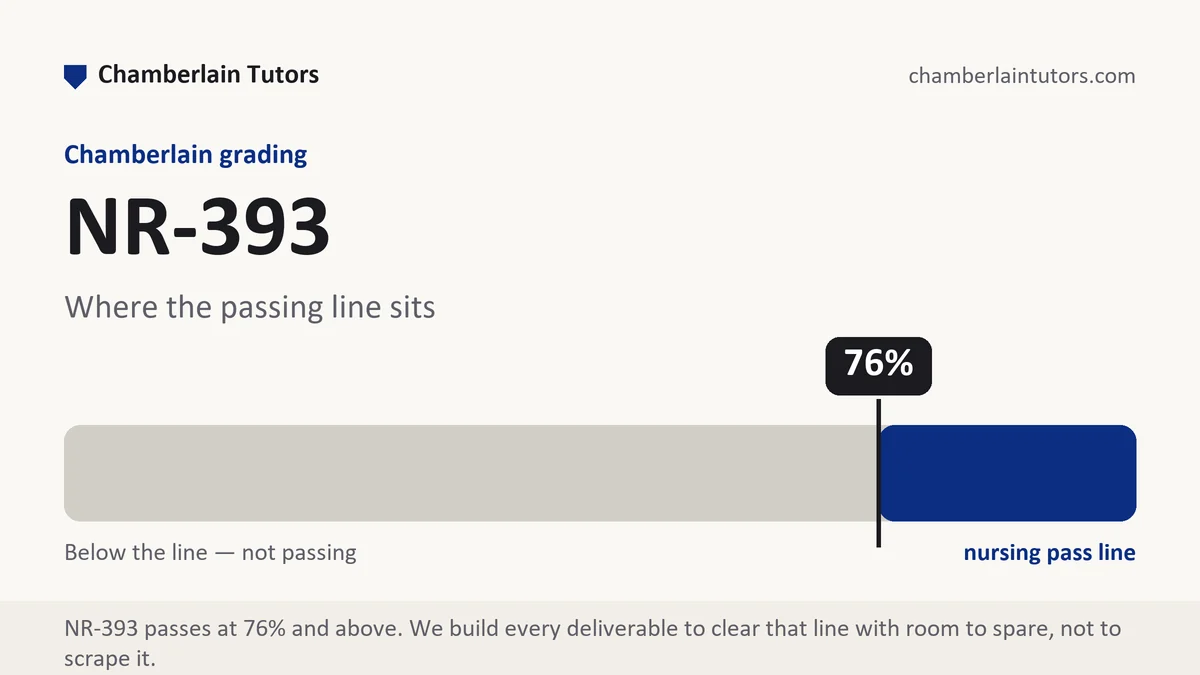
What NR-393 Week 1 asks for
Picture an evening medication pass in a long-term-care facility. The nurse checks two identifiers, documents in real time, and repositions a resident to protect skin that a century ago would simply have broken down. Every one of those motions has a date of birth somewhere in nursing's past, and the resident in the third room, who trained as a nurse herself in the 1960s, could tell you how different the same pass looked when she ran it. An opening week in a history elective asks you to start seeing practice that way: not as a set of timeless rules but as the current end of a long argument the profession has been having with itself.
Because this course carries no clinical component, the deliverables are entirely written, and the first stage usually runs small: an introduction post, a short reflection on why nursing history belongs in a BSN program, or a first response to assigned reading about caregiving before the modern era. Small does not mean casual. A discussion post in Canvas does not reopen after submission, and the first thing your instructor learns about you is whether your sentences hold together under a deadline. Treat the opening post as the writing sample it is.
The intellectual habit to install this week is the difference between a fact and a claim about a fact. That care of the sick was once household and religious work rather than a licensed occupation is a fact you can cite. That this origin still shapes how the public sees nursing today is a claim, and claims are what graded writing is made of. A Week 1 piece that states one modest, arguable claim and supports it beats a piece that recites twenty accurate dates and argues nothing, in this course and in every history course ever taught.
The NR-393 Week 1 method, step by step
Six moves that turn an opening reflection into an argument a grader can score.
-
Orientation: read the catalog arc before the first module
This course travels from nursing's early years to the current century, so whatever you write in Week 1 is the doorway to that whole span. Read your section's rubric first, reduce each scoring row to its verb, and notice whether the week asks you to describe, reflect, or connect. Those are three different papers.
-
Selection: choose one practice you can watch today
Pick something concrete from a setting you know: a skin assessment in a nursing home, a handoff at shift change, a family teaching moment before a discharge. One observable practice gives your reflection a spine that a general love of history never will.
-
Sourcing: separate primary accounts from textbook summaries
Your assigned reading is a secondary source, which is fine for orientation, but note early where it points: letters, training manuals, hospital records, early journals. Naming the kind of evidence behind a historical statement is what makes writing about the past scholarly rather than sentimental.
-
Connection: draw the line from then to now in one sentence
The core sentence of a Week 1 piece has the shape: this practice existed then in that form, exists now in this form, and the change happened because of a nameable pressure. Write that sentence before you write anything else, then build the paragraphs around it.
-
Attribution: cite historical claims the way you cite clinical ones
A date, a name, or a description of nineteenth-century care all need a source in APA form, exactly as a lab value would in a care plan. Getting the citation habit right in an elective's easiest week is cheaper than losing the same points across eight stages.
-
Registration: set an undergraduate scholarly tone and hold it
First person is often welcome in a reflection, but warmth is not a substitute for structure. No exclamation marks, no inspirational closers, no claims about angels. The profession's past is interesting enough when described accurately.
A layout and word budget for an opening reflection
The frame below fits an opening reflection or long-form post of roughly 500 to 700 words, which is a common size for the first stage of a lecture elective. It is our own outline rather than anything the university issues, and your section's rubric outranks it wherever the two disagree. Scale proportionally if your assignment runs longer.
| Section | What belongs in it | Word target |
|---|---|---|
| Opening claim | Your one arguable statement about why the past bears on present practice, stated before any history is retold. | 50 to 70 |
| The practice today | One concrete, observable habit from a real setting, described precisely enough that a reader could picture it. | 90 to 120 |
| The practice then | The same territory in an earlier era, drawn from your assigned reading and cited, with dates kept honest. | 110 to 140 |
| The pressure that changed it | The event, figure, or reform that pushed the practice from then to now, named as a cause rather than listed as trivia. | 100 to 130 |
| What it means for you | The reflective turn: what seeing this lineage changes about how you will practice or study, kept specific. | 80 to 110 |
| Close | One sentence returning to your claim with the evidence now behind it, not a restatement of the whole post. | 40 to 60 |
Evidence craft for writing about nursing's past
Every date travels with a source. Historical writing is the one genre where readers check numbers for sport. A year attached to a reform or a first school of nursing belongs to a cited source, not to memory, and two textbooks sometimes disagree by a year or two, which is itself worth a clause if you notice it.
Name the kind of evidence, not just the fact. Saying that early training records show twelve-hour ward shifts is stronger than saying nurses worked twelve-hour shifts, because it tells the reader how the past is known. This single habit separates history writing from history trivia at every level of study.
Guard against presentism. Judging 1880 by 2026 standards is the classic beginner error. You can note that a past practice would be unacceptable now while still explaining why it made sense inside its own moment, and rubric rows about analysis usually reward exactly that double vision.
Keep your own experience as illustration, never as proof. A scene from your CNA years in a memory-care unit can open a paragraph beautifully, but the claim it introduces still needs a published source behind it. The order that scores is claim, source, then your scene showing the claim alive on a real floor.
Five mistakes that cost points in this week's territory
- Timeline recitation. A paragraph that marches through six dates in chronological order answers no question and makes no claim. Two dates in the service of an argument beat six in a row.
- Hero worship. Calling a historical figure inspiring is a feeling, not an analysis. Say what the figure changed, how, and against what resistance, and the admiration takes care of itself.
- Presentism. Scolding the past for not being the present reads as naive in a history course and usually forfeits the analysis row.
- Uncited common knowledge. Facts that feel famous still need sources in academic writing, and opening weeks are where instructors decide whether you know that.
- Treating an elective as a throwaway. Lecture-only courses put the whole grade in the writing. There is no clinical score to average against a careless post.
Before you submit
- Your claim appears in the first three sentences, before any retold history
- One present-day practice is described concretely, from a nameable kind of setting
- Every date and named figure carries an APA citation
- The cause of change is argued, not just listed
- The reflective turn says what changes for you, specifically
- Every reference appears in the text and every in-text citation appears in the list
Starting NR-393 this week?
Send the instructions and the rubric out of Canvas. A premium original draft comes back in 24 to 48 hours with the claim up front and every date sourced, and revisions run until the grade lands.