NR-393 is a three-credit lecture course that traces nursing from its early years to the present century. Almost nobody loses points here for not knowing the dates. Points go missing because a paper recounts what happened without arguing what it changed. The graded skill is the line you draw from a past event or figure to something a nurse does, is permitted to do, or is held to today.
What NR-393 actually grades
The catalog builds this course around one idea: the impact of historical events and figures on professional practice today. That word impact is the whole rubric in miniature. A narrative of a reformer's life is a report; an account of how her work altered who was allowed to call herself a nurse, what training required, or how a hospital was organized is an analysis, and only the second one earns the upper columns of a scoring guide.
The other thing this course quietly tests is source discipline. History runs on documents, and a paper that cites an anonymous timeline page for a claim about 1873 is making a claim it cannot support. You are expected to know the difference between the record and somebody's summary of the record, and to make that difference visible in your citations.
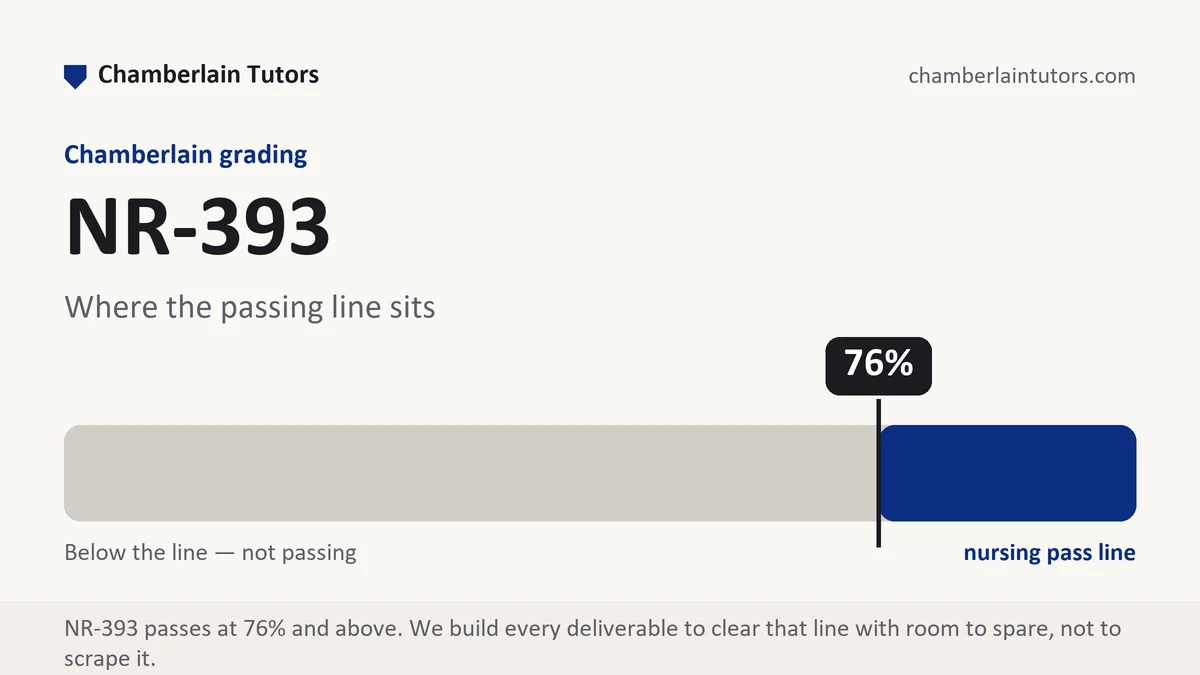
Practical shape: an eight-week session, half of the sixteen-week semester, with new starts as often as six times a year. Something is due every week, Canvas holds the work, and once a discussion post is submitted it stays exactly as written. The seventy-six percent floor that governs core nursing coursework does not soften because a course is an elective, and no amount of extra reading fixes a weighted average that has already slipped.
How we help in this course
Our writers treat this as a history course rather than a nursing course with dates in it, which means sourcing to period evidence and current scholarship, attributing interpretation to whoever made it, and building the present-day line as an argument rather than a closing compliment to the profession.
The terms are the site's standard: an original premium draft inside 24 to 48 hours, aimed at the A band of your actual scale, two independent quality passes plus the floor check, free revisions until it lands where you need it.
Turn the scoring guide into a plan before you read the prompt
The prompt in a history course usually sounds open. Choose a figure, choose an era, discuss an event. Openness is exactly why students overwrite the narrative and underwrite the analysis, because narrative is the part that comes naturally. The scoring guide is where the actual proportions are announced, so read it first.
Copy each criterion row into a document and strip it to its verb: describe, analyze, connect, evaluate, support. Those verbs become headings in the rubric's order. Two of them will be doing very different jobs, and confusing them is the classic error here: describe wants the record, analyze wants the consequence.
Now price the rows. Picture a week that holds the paper to 1,400 words with four rows carrying 35, 30, 20 and 15 percent. The multiplication hands you 490 words, 420, 280 and 210. If the 35 percent row is the one asking about influence on practice today, then 490 words belong to the present, which is around three times what a first draft gives it. The biographical background that felt like the whole assignment may be living under the 15 percent row at 210 words, which is one paragraph. Whether the reference list and title page count toward that limit is a line worth finding in your own guide before you cut anything real.
Keep the numbers in brackets next to each heading while you draft. In this course the bracket that never gets deleted is nearly always the analysis one, and seeing it sit there unmet is more useful than any amount of rereading.
The shape of a historical analysis paper
Whatever the week calls it, the dominant deliverable is a short historical analysis: a claim about change, evidence from the period, and a defended line to the present. These parts recur, and a grader can find each one or fail to.
| Element | The job it does | What a weak one looks like |
|---|---|---|
| The claim | That you are arguing something contestable about change, not announcing a topic. One sentence naming what shifted and why it mattered. | "This paper will discuss the life and contributions of a nursing leader." |
| Period context | The conditions that made the development possible or necessary, carried only as far as the argument needs. | Two paragraphs of general history that the rest of the paper never uses. |
| The evidence | Specific documents, records, published accounts or contemporaneous reporting, each with its date and origin stated. | Undated assertions traced to a website with no author. |
| The mechanism of change | How the development actually moved practice: training requirements, licensure, hospital organization, scope, workforce composition, public standing. | A statement that the figure inspired nurses everywhere. |
| The line to today | One concrete present-day feature of nursing you can trace back through the mechanism you just described. | A closing paragraph asserting that nursing is now a respected profession. |
| Limits and counter-reading | What the evidence cannot settle, or how a different historian reads the same development. | Silence, which reads as not knowing the debate exists. |
In NR-393 right now?
Send the week and the rubric from Canvas. First premium sample free, floor-checked, back in 24 to 48 hours.
Sources and citation craft for history
This is the one nursing course where old sources are the point, which makes the usual rules read backwards until you separate two categories.
Currency applies to scholarship, not to the record. An 1890 training school register is evidence precisely because it is from 1890. A 1994 article interpreting that register is scholarship, and scholarship ages: historians revise each other, and recent work often overturns the tidy version still circulating in survey textbooks. Keep period documents at any age and hold your interpretive sources to the same five-year expectation you would use elsewhere, or state why an older interpretation still stands.
Provenance before the quotation. Say what the document is, who produced it and when, before you use anything from it. "In a report her committee submitted to Parliament in 1858" costs nine words and converts a quotation into evidence. A quotation floating with only an author and year attached is the historical equivalent of a lab value with no reference range.
Verbs sized to what the record supports. Documents rarely prove causation. "Followed", "coincided with", "was accompanied by" and "contributed to" are the honest verbs for most historical sequences; "caused" and "created" need an argument you have actually built. Graders in this course read those verbs closely, because overclaiming is how a narrative disguises itself as an analysis.
Denominators, dates and definitions before any number. Historical figures need three things attached, not two. Give the base and the year, and also say what was being counted, since the categories moved: who counted as a trained nurse, what counted as a hospital death, and which populations were recorded at all changed repeatedly across the period this course covers. "Of the 187 women admitted to the program between 1873 and 1880" is usable evidence. "Most nurses at the time" is not.
Correct chronology versus a real argument
A passing NR-393 paper is chronologically correct and pleasant. It moves from early years to the present, mentions the right names in the right order, and closes by admiring the profession. Accuracy of that kind reads as an encyclopedia entry, and encyclopedia entries do not reach the top performance column no matter how clean the prose is.
A strong paper is narrow, argumentative and traceable. Narrow: it takes one development rather than a century, which is what lets it use specific evidence instead of general statements. Argumentative: it states something a reasonable classmate could dispute, then defends it. Traceable: the present-day claim at the end connects backward through a named mechanism, so a reader can follow the chain from a document to a rule, a role or a requirement that exists today. If your final paragraph could be pasted into any other student's paper without editing, the line to the present has not been drawn yet.
Six mistakes that cost real points in NR-393
- Biography instead of analysis. Birth, training, achievements, death. Accurate, orderly, and scored as description, which is usually the lightest row on the guide.
- Judging the past by today's standards without saying so. Evaluating a nineteenth-century practice as unacceptable is fine if you name the standard you are applying; doing it silently reads as not understanding the period.
- Citing a summary for a specific claim. Encyclopedias and timeline pages are for orientation. If you state that a school opened in a given year with a given class size, cite something that would know.
- Treating a board post as reversible. Chamberlain discussion posts cannot be edited after submission. Draft outside Canvas, check every date once, then paste.
- Praise as evidence. Adjectives like tireless, pioneering and visionary occupy space a grader wanted spent on what changed. Cut them and the paper usually gains room for the analysis row.
- Ending on the profession rather than on the argument. A conclusion that widens into general tribute abandons the specific claim you spent the paper earning. Land on your claim, restated with the weight the evidence now gives it.
Questions NR-393 students send
How many primary sources does a short history paper actually need?
How do I connect a historical figure to my own practice without it sounding forced?
Two of my sources give different dates for the same event. What do I do?
The weeks, one by one
Week 1
NR-393 Week 1 opens a lecture-only elective, which means the entire grade lives in what you write, and the opening stage almost always asks you to argue why a nurse in 2026 should care what nurses did in 1876. Read the full Week 1 manual.
Week 2
NR-393 Week 2, by our reading of the catalog arc, is where the course reaches the nineteenth-century reforms most students associate with Florence Nightingale: sanitation, trained observation, the first formal training model, and the claim that nursing is skilled work requiring education. Read the full Week 2 manual.
Week 3
NR-393 Week 3, in our reading of the arc, covers the era when American nursing built its institutions: hospital training schools multiplying by the hundreds, the first state registration laws, early professional associations, and the fight to define who could call herself a nurse. Read the full Week 3 manual.
Week 4
NR-393 Week 4, as we place the arc, takes the course out of the hospital and into tenements, schools, and rural districts: the rise of visiting nursing, settlement houses, school nursing, and the idea that a nurse's patient can be a neighborhood. Read the full Week 4 manual.
Week 5
NR-393 Week 5, as we place the arc, brings the course to nursing in wartime: the military nursing corps, the evacuation chains of the twentieth century's wars, and the innovations that crossed back into civilian care, triage among them. Read the full Week 5 manual.
Week 6
NR-393 Week 6, in our reading of the arc, covers the mid-twentieth-century transformation of the hospital: antibiotics changing what admission meant, monitoring and intensive care concentrating the sickest patients in special rooms, staffing models reorganizing who did what at the bedside, and. Read the full Week 6 manual.
Week 7
NR-393 Week 7, as we read the arc, covers the later twentieth century's widening of the profession: nursing education moving decisively into colleges, nursing research and theory claiming scholarly ground, advanced practice roles emerging from a primary care shortage, and the long, uneven. Read the full Week 7 manual.
Week 8
NR-393 Week 8, as we place the close of the arc, brings the course into the current century and asks for synthesis: informatics and the electronic record, evidence-based practice as the profession's working method, the pandemic years as history you lived through, and a final piece of writing that. Read the full Week 8 manual.