By the third stage, a professional concepts course usually turns the lens on the writer: a paper analyzing your own transition in practice, from task-driven work toward practice that is anchored in standards and evidence, argued with sources rather than told as memoir. Your section may print this as NR 300C or NR300C; it is the same course. Chamberlain publishes no syllabi outside Canvas. The placement here is our teaching judgment from the course's catalog arc; your section's rubric decides what your week actually asks.
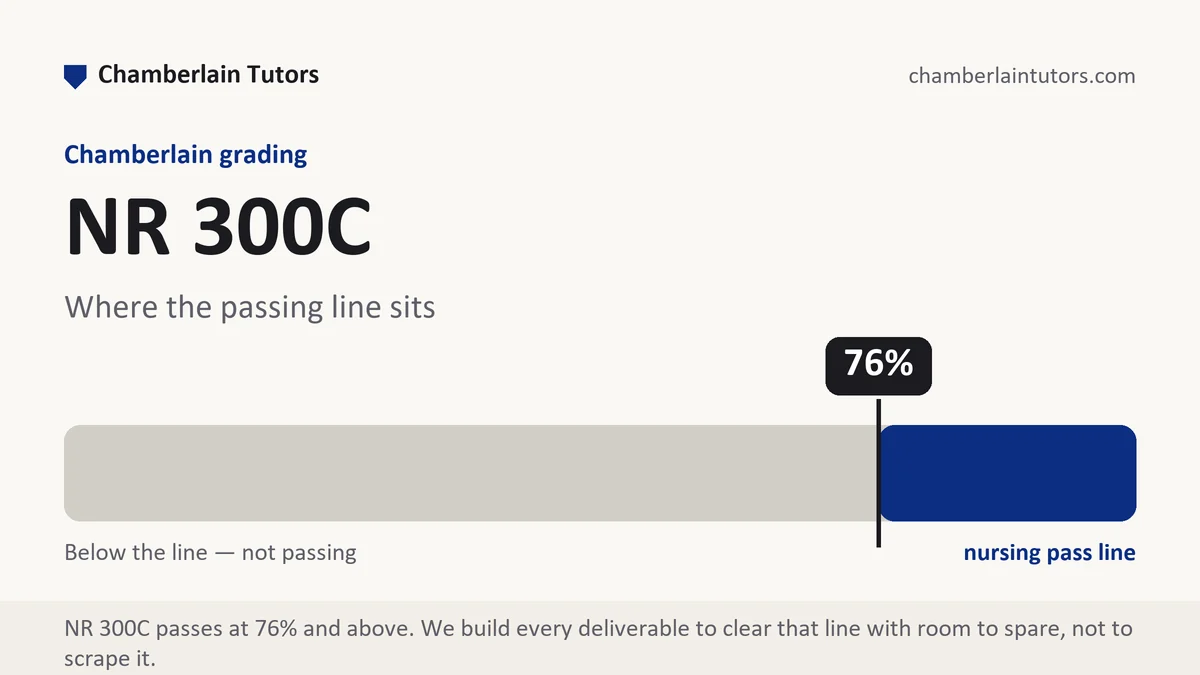
What NR-300C Week 3 asks for
Open any nurse's competency file from their first year and set it beside the same file three years on. The early entries record tasks signed off: skills demonstrated, checklists completed, modules finished. The later entries start to record judgment: a committee joined, a practice question raised, a process change proposed. A transition paper asks you to write the story that connects those two files, and to write it as analysis. The graded question is not what happened to you. It is what changed in how you practice, what drove the change, and what the professional literature says about transitions like yours.
This is the stage where reflective writing and scholarly writing have to work together, and most of the lost points come from letting one of them take over. All memoir and the paper has no sources and no framework; all framework and the paper has no evidence that a real transition occurred. The structure that scores keeps both in harness: a specific documented change in your practice serves as the case, and published writing about professional role development serves as the lens you examine it through.
The deliverable is usually a formal paper of moderate length, sometimes paired with a discussion post where you trade transition experiences with classmates. For the paper, expect the rubric to want an introduction with a stated purpose, organized body sections, at least a small number of scholarly sources, and formatting in the course's required style. Reflective content does not suspend those mechanics, and a well-referenced paper about your own growth is precisely the demonstration this course is looking for: the transition, performed on the page. Budget your drafting time accordingly: students consistently underestimate how long it takes to find the right framework sources, and a transition paper started the night before reads exactly like one, with the reflection carrying everything and the scholarship bolted on in the final hour. Two evenings for reading and one for writing beats the reverse split every time this assignment is graded.
The NR-300C Week 3 method, step by step
Six moves that turn personal history into an analyzed transition.
-
Choose one change you can prove happened
Pick a shift in your practice that left a paper trail: a certification earned, a role added, a responsibility assigned, a habit that shows up differently in your charting. A provable change gives the paper a spine that pure recollection cannot.
-
Fix the before and after in concrete terms
Write one paragraph describing your practice before the change and one describing it after, using observable behaviors. What you did, decided, escalated or documented differently. Feelings may appear, but behaviors carry the analysis.
-
Find published writing on professional role transition
Nursing literature discusses how nurses move through stages of skill and role development. Locate one or two scholarly treatments of that territory through the library and read them before drafting, because they will supply the vocabulary your analysis needs.
-
Map your case onto the framework, honestly
Say where your experience matches what the literature describes and where it does not. A paper that reports a clean match everywhere reads as fitted after the fact; the mismatches are usually where the genuine analysis lives.
-
Name what drove the change
Education, mentorship, a difficult event, a new environment. Identifying the driver turns your story into a claim about how professional growth happens, which is the level the assignment is actually pitched at.
-
End with the next transition, not a summary
Close by naming the move your practice still has to make and what this course contributes to it. A forward-looking close does the work of a conclusion while showing the grader that the analysis continues past the page.
A layout and word budget that keeps memoir and analysis in balance
The frame below suits a transition paper of roughly 900 to 1,200 words. It is our own outline rather than anything the university issues, and your week's rubric outranks it wherever the two disagree. Scale proportionally for other lengths.
| Section | What belongs in it | Word target |
|---|---|---|
| Purpose statement | The transition you will analyze and the framework you will use, announced in the opening paragraph. | 80 to 100 |
| Practice before | Observable behaviors from the earlier period, anchored in verifiable detail rather than adjectives. | 150 to 180 |
| The turning territory | The events, education or pressures that drove the change, told compactly and without dramatization. | 150 to 190 |
| Practice after | What is observably different now, in decisions, documentation habits and scope of concern. | 150 to 180 |
| The literature's lens | What published work on role transition says, applied to your case, matches and mismatches both named. | 250 to 300 |
| The next transition | The growth still owed and how this program figures in it, closing the paper facing forward. | 100 to 130 |
Evidence craft for writing about your own growth
Your experience is the case, not the authority. Claims about how nurses in general develop belong to the literature and arrive with citations. Claims about what you did belong to you and arrive with detail. The paper fails when the two swap jobs and personal memory starts underwriting general claims.
Anchor the before-and-after in artifacts. A changed practice shows up somewhere: in the kinds of notes you write, the meetings you attend, the questions you ask in report. Naming those observable traces, without reproducing any actual patient record, is what makes a self-description credible.
Introduce every framework with its author and year. Concepts about role development belong to the scholars who published them. Attribute the idea in the sentence where it first appears, then keep using its vocabulary consistently instead of drifting into synonyms.
Let one honest mismatch stand. Where your path diverged from the published pattern, say so and offer a reason: setting, timing, support, circumstance. Graders reward the divergence sentence because it proves the framework was applied rather than pasted.
Five mistakes that cost points in this week's territory
- A career tour instead of one transition. Every job since licensure, narrated in order, spreads the paper too thin to analyze anything. One change, examined closely, wins.
- Growth claimed in adjectives. More confident and more professional cannot be verified. Changed behaviors can, and the rubric's analysis rows are asking for the verifiable kind.
- Zero sources in a reflective paper. Reflection does not waive the evidence requirement in a concepts course; the transition literature is there to be used and its absence is visible instantly.
- Forcing a perfect fit with the framework. A case that matches the model at every point reads as constructed. The honest mismatch is worth more than the clean story.
- Casual register for serious content. A paper about professional maturation written in text-message rhythm undercuts its own thesis on every line.
Before you submit
- One specific transition is named in the purpose statement
- Before and after are described in observable behaviors
- At least one scholarly source on role transition is applied, not just cited
- One divergence between your case and the framework is acknowledged
- No patient, colleague or facility is identifiable anywhere in the paper
- Formatting, citations and references meet the course's required style
Drafting your NR-300C transition paper?
Send the instructions and the rubric out of Canvas. A premium original draft comes back in 24 to 48 hours with the case built and the framework genuinely applied, and revisions run until the grade lands.