NR-300C Directed Independent Study is the three credit hour version of the service learning study, the same community-based, student-planned project design as the one credit variant at triple the contact hours. At three credits the project has a full arc, and the writing that decides the grade is the final report: what the problem was, what you did, what changed, what evidence supports that claim, and what you are honestly unable to claim at all. That last part is where the strongest and weakest reports separate.
What NR-300C actually grades
Whether the project produced something and whether you can describe the something accurately. Three credits of contact hours is enough to build a resource, run a series of sessions, or complete a small assessment of a community need, so the guides at this level usually contain an outcomes row and an analysis row rather than only a reflection row. The trap is overclaiming. A student who ran four sessions with eleven participants and writes that the project improved health outcomes has said something the evidence cannot carry, and the analysis row is precisely where a grader tests that.
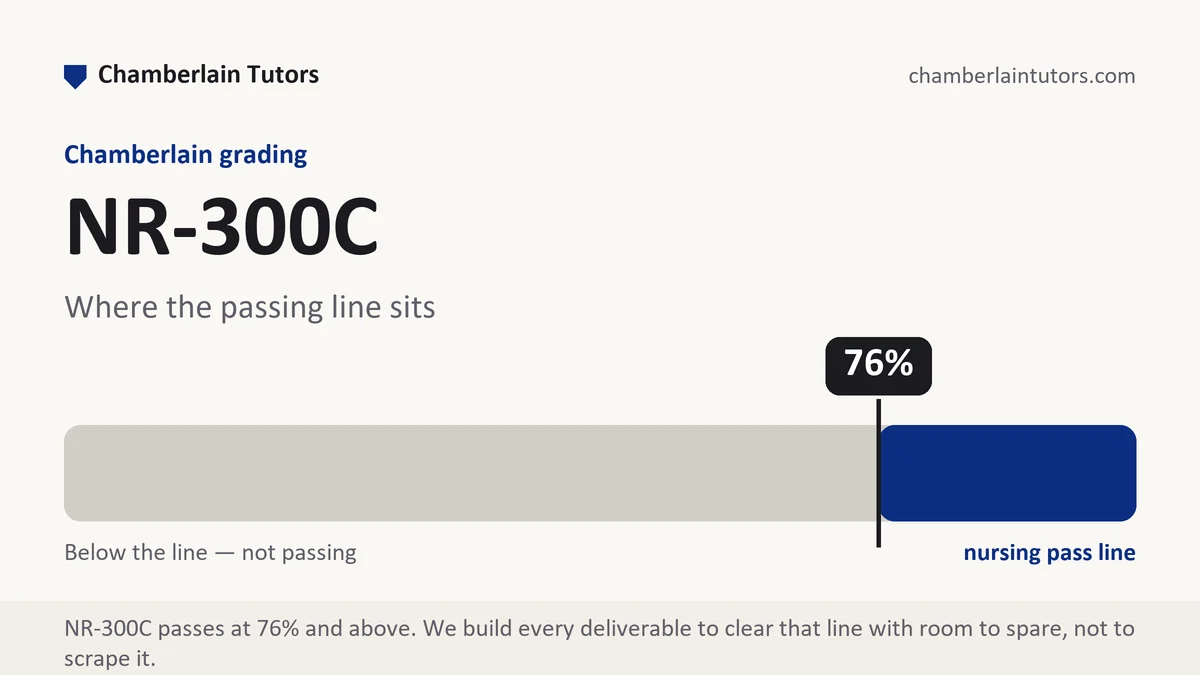
Core nursing courses carry a 76 percent passing floor, and a self-directed study is no exception to it. What makes the three credit version demanding is not volume but sequence: the final report has to be consistent with the plan and the mid-project work you already submitted, so a study that drifted without documentation produces a report that cannot be written honestly at the end.
How we help in this course
We write the final report and everything that feeds it: the background, the methods section describing what you actually did, the outcomes with their limits stated, the analysis, the sustainability discussion and the closing reflection. Our drafts are built to say exactly as much as the evidence supports and no more, which is the register that scores at this level.
The project stays yours. We do not contact organizations, arrange placements, sign documents or record hours. What we contribute is the written record of work you performed, structured the way the scoring guide reads it.
In NR-300C right now?
Send the week and the rubric from Canvas. First premium sample free, floor-checked, back in 24 to 48 hours.
Read the rubric before the prompt
The final report is the longest document in the study, which means misallocating it is expensive. Open the guide, list the criterion rows, and reduce each to a verb: describe, implement, evaluate, analyze, reflect. Five rows is common at this credit level, and the fifth is usually the one students discover after submitting.
Convert to a budget before drafting. A 2,000 word report with rows at 25, 25, 20, 20 and 10 percent yields roughly 500, 500, 400, 400 and 200 words. Notice what that arithmetic forbids: 900 words of background. Background is almost never a separate heavy row at this stage, because the problem was justified in your proposal and the guide now wants the doing and the interpreting. Students who reuse their proposal introduction as a third of the final report lose 400 words of scored writing to material that was already graded once.
Bracket the targets. If the outcomes section will not fill, resist the urge to inflate the claims; fill it instead with what you measured, how you measured it, and what the measurement cannot tell you, all of which is scored writing.
One preparatory step pays for itself in this report. Build a two-column list of everything you actually delivered, sessions, materials, contacts, counts, dates, before writing a word of prose, and put every number in it as a whole number with its base beside it. Reports written from that list stay accurate under pressure; reports written from memory drift toward the version of the project you meant to run. The list also exposes the gap between planned and delivered hours early enough to explain it deliberately in the methods section rather than being asked about it after submission.
The shape of a final project report
The dominant deliverable at this credit level assembles from these parts. Each answers a question a grader will look for by name.
| Part | What it has to deliver | The version that overclaims |
|---|---|---|
| Problem, in brief | Two paragraphs at most, with the local evidence compressed and cited. | The proposal introduction pasted in at full length. |
| What was actually done | Dates, sessions, counts, materials, role, hours as delivered rather than as planned. | The plan restated as though everything ran to schedule. |
| What was measured | The instrument or observation used, with its base, and when it was taken. | An impression that participants seemed more confident. |
| Results, stated plainly | Counts before and after, in whole numbers, with the sample size visible. | Percentages calculated on a handful of people. |
| Limits, named first | Sample size, no comparison group, self-report, short window, your own involvement. | A limitations sentence added after the conclusions were drawn. |
| Sustainability and handoff | What remains after you leave and who holds it. | A hope that the organization will continue the work. |
| Reflection on practice | What the project changed in how you will practice, tied to specific moments. | A statement that the experience was valuable. |
Evidence and citation craft at this level
A final report cites two literatures and reports one small dataset of its own, and each has rules. Four habits carry the analysis row.
Currency, with older sources argued. Anything past five years needs a reason stated in the sentence, which at this stage usually means you are citing the origin of a method rather than current data. Say which, and the age becomes a deliberate choice.
Design and sample before every borrowed finding. "In a quasi-experimental study of 480 participants across six community sites" tells your reader how much your comparison is worth. Comparing your eleven participants to that study is legitimate; comparing them silently is not.
Association verbs, and honest ones about your own project. Observational literature supports association only. Your own project supports even less: with no comparison group and a short window, you can say that scores rose among those who attended, not that your sessions raised them. Writing the weaker verb is what a grader marking analysis is hoping to see, because it shows you know what your design can carry.
Denominator and window before any rate, especially your own. Report 8 of 11 rather than 73 percent. Small-sample percentages are the single most common overclaim in these reports, and they invite a reader to recompute the number and lose confidence in everything around it. Give the base, give the period, and let the reader judge.
What separates a passing report from a strong one
A passing NR-300C report is complete and generous to itself. It describes a project that happened, claims a benefit, and reflects warmly. It scores in the low eighties because the claims are larger than the evidence and the limits arrive as an afterthought, if at all.
Strong reports do three things. They put limits before conclusions, so the reader knows exactly how much weight the results can bear before being asked to accept them. They report counts rather than percentages when the sample is small, which reads as precision rather than modesty. And they name what remains after they leave, a document, a trained volunteer, a scheduled slot, an agreement, because sustainability is the part of service learning that separates a project from a visit. Limits first, counts not percentages, something left behind.
Mistakes that cost points here
- Recycling the proposal as the introduction. That material was graded already. Compress it to two paragraphs and spend the space on what the guide is scoring now.
- Claiming outcomes a small project cannot support. Improved health is not available to you. Attendance, completion, stated confidence and delivered materials are.
- Percentages on single-digit samples. They read as inflation and they invite arithmetic the reader will do against you.
- Limitations as a closing formality. Named early, limits make the analysis look rigorous. Named last, they look like a disclaimer.
- No handoff. A project that ends when you stop attending has produced an experience rather than a change, and the sustainability row will say so.
- Reflection with no incidents in it. Reflection rows want specific moments that changed your thinking, not a summary of how the term felt.
Questions NR-300C students ask
My project did not achieve what I hoped. How do I write that without failing?
How do I write an outcomes section when I only have a handful of participants?
What counts as sustainability for a student project?
The weeks, one by one
Week 1
NR-300C opens the third segment of the professional nursing concepts bridge, and the natural first stage is learning to read professional standards as working documents rather than as wall posters: what a published nursing standard actually requires, where it lives, and how to write about your own. Read the full Week 1 manual.
Week 2
The second stage of a professional concepts course typically moves from standards to scholarship: how to search a nursing database, how to tell a peer-reviewed research article from everything else that looks like one, and how to summarize what you found in accurate, cited prose. Read the full Week 2 manual.
Week 3
By the third stage, a professional concepts course usually turns the lens on the writer: a paper analyzing your own transition in practice, from task-driven work toward practice that is anchored in standards and evidence, argued with sources rather than told as memoir. Read the full Week 3 manual.
Week 4
The middle of a professional concepts course is where standards stop being reading material and start being measuring instruments: this stage typically asks you to hold a real practice pattern up against a published expectation, name the gap between them precisely, and propose what would close it. Read the full Week 4 manual.
Week 5
Somewhere past the midpoint, a professional concepts course usually pauses to service the machinery itself: paraphrase that transforms rather than reshuffles, citations placed where debts actually occur, references formatted so they can be followed, and a prose register that carries scholarship without stiffness. Read the full Week 5 manual.
Week 6
As the session builds toward synthesis, the concepts sequence typically turns to the professional nurse as a team member: analyzing how communication succeeds and fails between disciplines, applying a structured communication framework to a specific exchange, and writing about collaboration with. Read the full Week 6 manual.
Week 7
Late in the concepts sequence the writing usually turns to accountability: how professional nurses participate in quality and safety, what a just response to error looks like, and how to write about improvement using measures rather than resolve. Read the full Week 7 manual.
Week 8
Closing stages of a concepts course usually ask for synthesis with a forward edge: a professional development plan or capstone reflection that gathers the session's threads, standards, scholarship, collaboration and accountability, into goals someone could actually verify later. Read the full Week 8 manual.