In the MSW sequence, MSW-555 is MSW capstone and integrative seminar. Students search the code mid-panic more than any title, so this page answers the code: here is the honest read and the service behind it.
What MSW-555 actually grades
The MSW's integrative finale, binding two years of clinical writing and two practicum placements into a capstone seminar. It grades synthesis: theory, practice, and reflection braided deliberately rather than stacked.
How we help in this course
We stage the capstone like the integrative document it is, sections planned against the seminar's calendar, drafted in person-first clinical register, your placements' specifics woven through as you share them. Confidential without exception, like all MSW work here.
The service terms match the whole site: 24 to 48 hour delivery, A-band targeting on your scale with the floor math shown, two independent QA passes, free revisions until the target is met.
Writing the capstone document, section by section
Seminar materials live inside Canvas, so any manual built around week numbers would be guesswork with a schedule attached. This one is built around the document instead, which is the thing that does not change: how to read the scoring guide before the seminar prompt, what each part of an integrative capstone has to prove, how practice evidence and case material have to be handled, and what integration looks like when it is genuinely happening rather than being claimed. Read it beside the guide for whatever section is due.
In MSW-555 right now?
Send the week and the rubric from Canvas. First premium sample free, floor-checked, back in 24 to 48 hours.
Grading a braid, not a stack
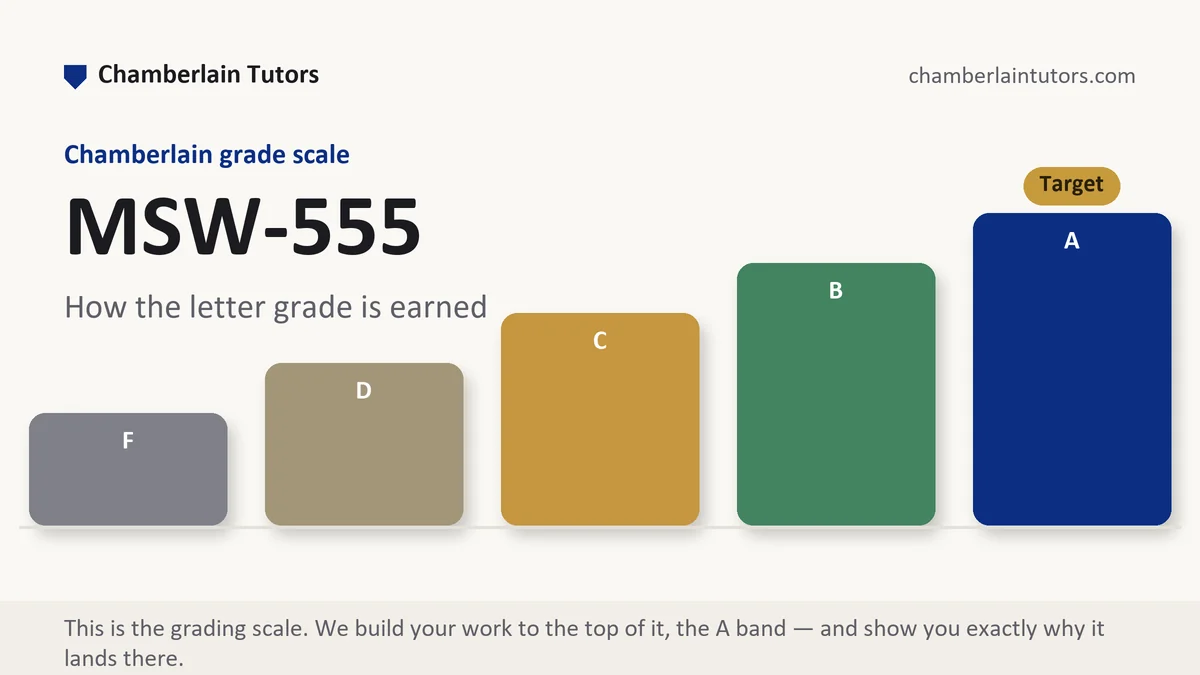
MSW-555 grades synthesis: two years of clinical writing and two practicum placements reconciled into one capstone seminar document where theory, practice, and reflection have to braid rather than pile. The MSW scale sharpens the demand, an A begins at 93 and the C band runs only 73 to 76, so the difference between deliberate integration and stacked summary is measured in whole letter grades. The desk stages the document like the integrative work it is, sections planned against the seminar's calendar, drafted in person-first clinical register.
Confidentiality, stated as policy rather than promised
Capstone writing draws on real placements and real clients, which is why every MSW engagement here runs confidential without exception: your placements' specifics enter the drafts only as you share them, anonymized to professional standard, and the originality pass certifies each section is written from scratch for you alone. Turnitin screening at Chamberlain makes that construction non-negotiable anyway; we build for it rather than around it.
Starting the seminar with the plan already drawn
Send the seminar syllabus and a list of your placement contexts, and intake returns a staged map: which section drafts when, where your materials plug in, what each hand-off needs from you. Deliverables run the site standard, 24 to 48 hours each, revisions free until the seminar's grade posts, and the first section draft is free if you want the register proven first. Two years of work deserve a deliberate final document, and deliberateness is a schedule, not a mood.
Read the scoring guide before the seminar prompt
The prompt for a capstone section describes what to write about. The scoring guide describes what will be counted, and on a long document those are further apart than they look. Before drafting, rebuild the guide as your outline: one heading per criterion row, in the guide's own order, with the row's weight written beside it. Anything the guide does not ask for is optional, and on a capstone there is rarely room for optional.
Then price the document. Suppose the finished piece runs 3,000 words and an illustrative guide weights practice context at 15, the theoretical frame at 20, the evidence base at 20, integration with practicum learning at 25, ethical analysis at 10, and implications for practice at 10. Hold back 250 words for the opening and the close and 2,750 remain across 100 points, which comes to roughly 27 words per point. Integration takes about 690 words, the frame and the evidence about 550 each, the practice context about 410, and ethics and implications about 275 apiece. Substitute your own weights, because these are not your section's.
Then do the second division, the one capstone writers skip. Divide those words by the drafting weeks you actually have left, not the weeks in the session, and the weekly target lands in the low hundreds. A capstone written at that pace is a document; the same capstone attempted in the last ten days is a stack of summaries with a deadline attached, and the difference shows in the integration rows before anyone reads closely.
The parts of an integrative capstone document
An integrative document is not a longer paper. It is one where the parts have to refer to each other, and each part carries a burden of proof of its own.
| Part | What it must prove | Summary version versus integrated version |
|---|---|---|
| Practice context | A specific setting, population and role, described closely enough that later sections can point back at it | Summary describes the agency; integration describes the situation the paper keeps returning to |
| Theoretical frame | One or two frames chosen for a reason, with what they predict about your context made explicit | Summary defines the theory; integration uses it to explain a decision you actually made |
| Evidence base | Literature that speaks to your population and your intervention, with design and sample stated | Summary lists studies; integration says which findings apply to your clients and which do not |
| Integration with practicum learning | That two years of placement work produced specific changes in how you practice | Summary recounts what happened; integration names what you now do differently and why |
| Ethical and cultural analysis | A real tension you encountered, worked through rather than resolved by naming a principle | Summary names principles; integration shows two of them in genuine conflict and how you decided |
| Implications for practice | Something a supervisor, agency or policy reader could act on | Summary calls for more research; integration addresses a named audience with a concrete recommendation |
| Self-assessment | An honest account of where you are strong, where you are not, and what comes next | Summary reports growth; integration identifies a gap and the plan for closing it |
Practice evidence and case material, handled properly
Two disciplines run through every section of this document: how you cite what others found, and how you write about people you actually served.
Check whether a citation still describes current law or practice. A policy reference from before a rule change is not merely dated, it can be wrong, and a capstone arguing from superseded policy loses more than a currency row. Practice guidance moves more slowly, so date it and prefer the issuing body's most recent statement.
Give the design and the sample before the finding. Say whether a study tested an approach under controlled conditions or in ordinary agency practice, in how many people, of what ages and circumstances, before you report what it showed. The two kinds of study support different claims, and the distinction is exactly what a capstone reader is checking.
Ask whether the sample resembled your clients. An intervention validated in one population is a hypothesis in another, not a finding, and writing that sentence yourself is worth more than extra citations. Where the fit is poor, say so and say what you would watch for.
Rates are arguments about who was counted. Recidivism, removal, readmission, completion and engagement rates all depend on who entered the denominator, who was excluded, and how long anyone was followed. Give those three before the number, and never compare two rates from sources that defined them differently.
Write case material so it could not be traced. Composites and de-identified accounts only: no names, no agency identifiers, no dates or event sequences that would single a person out, no detail memorable precisely because it is unique. Change what carries no clinical meaning and keep what does, since altering the detail your analysis rests on turns the case into fiction.
What integration looks like when it is working
A capstone that passes contains a theory section, a literature section, a reflection and a conclusion, all correct and all sitting beside each other without speaking. Everything in it is true and nothing in it is connected, and that gap is what the seminar's heaviest rows are built to measure.
Integration is visible in four moves. One case, or one population, is carried the whole way through, so the situation introduced in the context section is the one the theory explains, the one the evidence speaks to, and the one the ethical analysis wrestles with. The theory is put to work on a decision you actually made, including the places it failed to account for what you saw, because a frame that explains everything has explained nothing. Reflection lands on behavior rather than feeling: not that a placement was formative, but that you now open assessments with a different question, and here is the moment that changed it. And the implications are addressed to somebody in particular, a supervisor, an agency board, a policy audience, with a recommendation specific enough that they could say no to it.
Where capstone documents lose points
- Sections that never refer to each other. The most common failure here, and the one the integration rows exist to find.
- The vanishing frame. A theory introduced early and absent from every case discussion afterwards scores as a definition, not as an application.
- Identifying detail left in case material. A professional standard first and a scoring row second, and the one error that cannot be repaired afterwards.
- Reflection that stops at feeling. Growth described without a named change in what you do reads as sentiment, and sentiment is unscoreable.
- Ethics as a list of principles. Naming values is not analysis; analysis is two legitimate obligations in conflict and how you chose between them.
- Starting late. Staged sections are graded as they arrive, whatever reaches the seminar board stays as submitted, and a document assembled at the end reads like an assembly.
Questions from students in the seminar
How much of my placement can actually go on the page?
My two placements have nothing in common. How am I supposed to integrate them?
What does the seminar actually mean by integration?
Where MSW-555 sits in Chamberlain's programs
Open the exact program map for sequence, credit, and option context. The current student schedule and syllabus remain authoritative after transfer evaluation, electives, state rules, and approved plan changes.
The weeks, one by one
The public curriculum verifies MSW-555 but does not publish its Week 1 through Week 8 Canvas assignments. Week manuals are added only from verified real deliverables; session length is never used to invent them.