UNIV-102 University Seminar II is the one credit follow-on to the first seminar, and the catalog gives it three subjects: chemistry, medical terminology and the use of scholarly sources. That third item is the one that shows up in almost every graded submission. This is the course where Chamberlain decides whether you can tell a scholarly source from something that merely sounds authoritative, and whether you can say why. Written work here is short, but it is judged on the quality of what you brought to it as much as on the sentences you wrote.
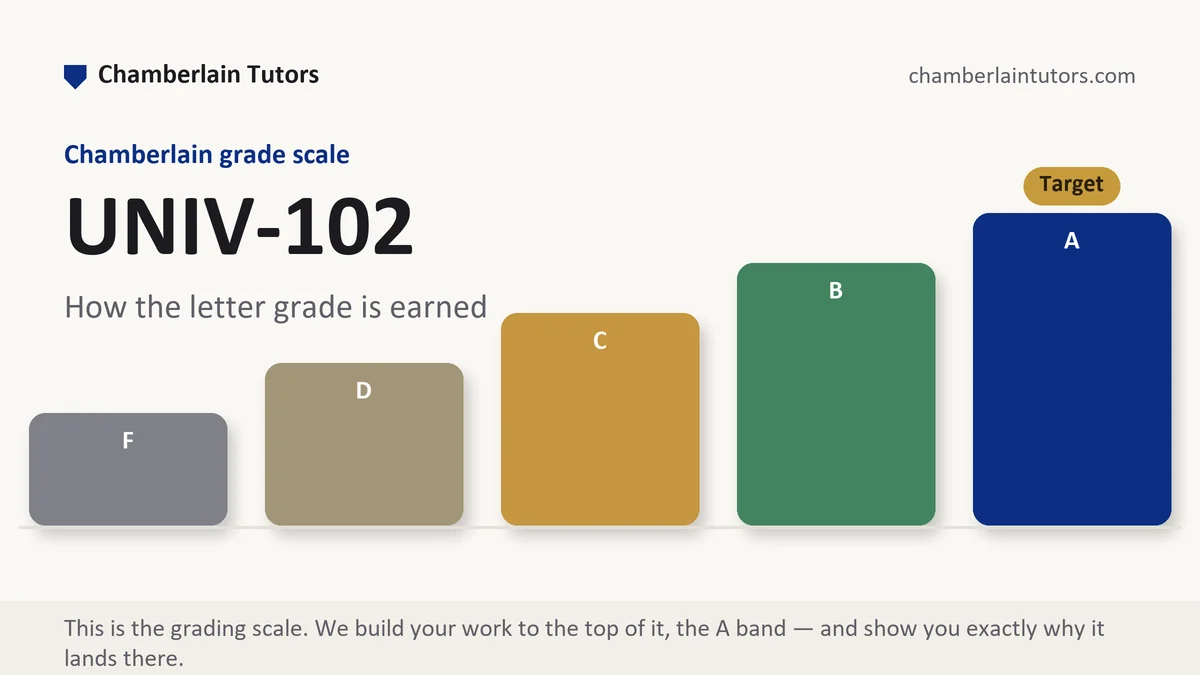
What UNIV-102 actually grades
The house deliverable in this seminar is the source evaluation: you find something, you judge it, you say what it is good for. Sometimes that arrives as a short annotated entry, sometimes as a paragraph inside a discussion post, sometimes as a comparison of two items. The scoring rows behind all of those versions ask the same questions. Who produced this. On what evidence. How current is it. What can it legitimately be used to claim.
Terminology gets graded alongside it, and not as a spelling test. The row that pays is precision in use: choosing the exact term, defining it once for a general reader, then holding it steady. A submission that uses two words for the same thing across three paragraphs reads as uncertain even when both words are correct.
The chemistry content behaves the same way. The seminar wants you writing about substances and reactions in accurate language at the level a first year student can support, not performing expertise. This is one credit with weekly Canvas deliverables, so the individual pieces are small. What they are building is the sourcing discipline every later paper will assume you have, in a course where getting it wrong is cheap.
How we help in UNIV-102
Our writers evaluate sources the way a librarian would and write them up the way a grader wants: verdict first, reasons attached to specific features of the item, then a statement of what it can and cannot support. Every draft comes back with the reference entry built correctly, which is the part students most often lose free marks on.
Deliverables run the standard promise: a premium original draft in 24 to 48 hours, targeted at the A band of your course's actual scale, through the eight-person pipeline with both QA passes and the floor check, revised free until it lands.
In UNIV-102 right now?
Send the prompt, the rubric from Canvas and any sources you were given. First premium sample free, floor-checked, back in 24 to 48 hours.
Read the rubric before you open a database
Searching before reading the scoring guide is how students end up with six interesting articles and no submission. Copy the criterion rows into a blank file first and sort them into two piles: rows about the source you chose, and rows about the writing you produced. Selection rows are satisfied before you type a word, and they are usually easier to secure than writing rows, which is why leaving them to chance is expensive.
Then turn the weights into a plan. Say the week allows 900 words across four rows weighted 35, 30, 20 and 15 percent. That divides into 315, 270, 180 and 135 words. If the 35 percent row is the evaluation itself, then a third of the document is judgment and not description, which is the reverse of how most annotated entries get written. Draft the 315 word evaluation first, while your reading is fresh, and let the summary shrink to fit what remains.
One extra column pays for itself. Beside each row, note the specific feature of the source you will point at to earn it: the author's affiliation, the reference list, the publication date, the sponsoring body, the peer review statement. A grader wants the judgment attached to something visible, and writing that column before you draft means you never write a claim you cannot support.
The shape of a source evaluation
Whatever costume the week puts it in, the evaluation moves through the same parts. Each is short, and each is checkable by a grader who opens the same source.
| Part | What it has to prove | How a thin version looks |
|---|---|---|
| The reference entry | A complete, correctly formatted entry, since a malformed one costs marks in a course that is partly about formatting. | A pasted web address with no author, date or title. |
| What kind of thing this is | Research article, review, professional guideline, government page, textbook or news item, named as such. | Everything called an article regardless of what it is. |
| Who made it and on what basis | Author credentials or the publishing body, plus whether the piece rests on data, on other sources or on opinion. | An assertion that the author is an expert with no basis given. |
| Currency, with a reason | The date, and whether that date matters for this particular claim, since some facts age quickly and others do not. | A note that the source is recent, used as if recency alone were quality. |
| The verdict | A direct statement of whether it is appropriate for academic use, and where its limits sit. | A balanced paragraph that never actually decides. |
| The legitimate use | The specific kind of claim this source can support in a nursing paper, and one it cannot. | A closing sentence saying the source will be useful. |
Sourcing and citation craft
Four habits do most of the work in a source-focused seminar, and every one of them survives into your final year.
Search the library, then the open web. A university database returns items with the information you need to evaluate them already attached: author, affiliation, journal, date, references. Open web results hide those fields, so you spend your evaluation time reconstructing basics instead of judging quality. Start where the metadata lives.
Check peer review as a fact, not a feeling. A journal either states its review process or it does not, and a database filter is not proof by itself. Say how you established it, whether through the journal's own statement or a library indicator. That one clause converts an assumption into evidence and it is the sentence graders look for.
Build the reference from the source, not from a generator. Automatic tools misread author fields, drop issue numbers and invent capitalization. Cross-check every entry against the item itself, keep sentence case for article titles, and put the digital object identifier in when the source has one. Reference accuracy is one of the few rows you can guarantee in advance.
Define terminology once, in the sentence it first appears. Medical vocabulary is the point of this course, so use it, but write for a reader who has not taken the same chapter. Give the word, give the plain meaning in a clause, then use the word from then on without apology.
What separates a passing answer from a strong one here
A passing evaluation describes the source and lists its features. It reports what the article is about, notes that the author holds a doctorate, observes that it was published recently, and concludes that the source is credible. Every sentence is defensible and the whole thing is a summary with a label attached.
Strong evaluations differ in three ways. They rank the reasons, saying which feature actually carries the credibility and which is incidental, because a doctorate matters less than a stated method and a grader knows it. They name a limit, since a source with no stated limits has not been evaluated. And they finish by matching the source to a use: this can support a definition but not a prevalence figure, this can frame a discussion but not settle it. That last move is what a nursing program is really training, and it is visible in a single well built sentence.
Six mistakes that cost points in UNIV-102
- Summarizing where the row says evaluate. Content summary answers a small row and starves the large one sitting beside it.
- Trusting a citation generator. A generated reference with a missing element loses easy marks in the one course where formatting is explicitly on the guide.
- Calling a website scholarly because the organization is well known. Reputable and scholarly are different categories, and the rubric usually cares about the second.
- Ignoring the date because the topic feels timeless. Say why the age is acceptable rather than leaving the grader to wonder whether you noticed.
- Posting an evaluation before checking the reference. Chamberlain discussion posts do not reopen once submitted, so a broken entry stays broken in front of the section.
- Using terminology to decorate. A technical word used slightly wrong costs more than the plain word used exactly right.
Questions UNIV-102 students ask
How do I tell whether a journal article is peer reviewed?
Can I cite a professional organization's website?
My source is from 2016. Is that automatically too old?
Where UNIV-102 sits in Chamberlain's programs
Open the exact program map for sequence, credit, and option context. The current student schedule and syllabus remain authoritative after transfer evaluation, electives, state rules, and approved plan changes.
The weeks, one by one
The public curriculum verifies UNIV-102 but does not publish its Week 1 through Week 8 Canvas assignments. Week manuals are added only from verified real deliverables; session length is never used to invent them.