NR-720 Topics in Healthcare Systems Leadership I is a three-credit doctoral course that asks you to synthesize advanced nursing leadership concepts for senior-level roles in changing healthcare systems. The graded writing is executive writing, which has its own rules: the recommendation appears early, the analysis is compressed, the numbers are attached, and every claim is written for a reader who will act on it rather than admire it. Unit-level improvement writing does not score here, however good it is, because the altitude is wrong.
What NR-720 actually grades
The first demand is altitude. A systems-level analysis considers more than one unit or service, accounts for capital, workforce and payment, and recognizes that any change consumes attention that the organization is spending elsewhere. Writing at this altitude means naming what will not get done if your recommendation is adopted, which is a question senior leaders ask and staff-level proposals rarely answer.
The second demand is synthesis in the strict sense. The course expects leadership, quality, finance and workforce material to be fused into one argument rather than handled in separate sections that never meet. A grader is looking for the paragraph where a workforce constraint changes a quality strategy, or where a payment arrangement decides which of two clinically equal options is viable. That paragraph is where the synthesis row is won.
How we help in NR-720
Our doctoral bench writes to executive altitude by default: a decision named in the opening, an environmental read built from cited sources, options costed, and governance attached to the recommendation. Drafts come back with the tradeoff stated openly, because that is the sentence senior readers look for first.
Deliverables run the standard promise: a premium original draft in 24 to 48 hours, targeted at the A band of your course's actual scale, through the eight-person pipeline with both QA passes and the floor check, revised free until it lands.
In NR-720 right now?
Send the week and the rubric from Canvas. First premium sample free, floor-checked, back in 24 to 48 hours.
Read the rubric before the prompt
Systems prompts are wide, and the rubric is what stops a wide prompt from becoming a shallow paper. Copy the rows into a blank document and ask of each one: at what level does this row live. Rows that could be answered about a single unit are usually rows you are about to underwrite, because the guide expects them answered about a service line, a region or an organization.
Then convert weights into a budget. A 2,500-word paper with four rows at 40, 24, 20 and 16 percent leaves 1,000, 600, 500 and 400 words. In NR-720 the 1,000-word row is normally the strategic analysis, and the recommendation, which students expect to be the centerpiece, often sits at 400. That ratio is correct for the genre: an executive reader wants the reasoning that would let them defend the decision to a board, not more description of the decision itself.
Write the decision statement before anything else. One sentence, naming the body that decides, the choice in front of them, and the date by which it matters. Every section afterwards should be checkable against that sentence, and anything that does not help the reader make that choice comes out.
The shape of an executive strategic analysis
Whether your week calls for a strategic analysis, an executive brief or a systems leadership paper, these are the parts a senior reader scans for. Each gives a senior reader something they need in order to decide.
| Part | What it has to prove | How a thin version looks |
|---|---|---|
| The decision, stated up front | What is being decided, by whom, and why the timing matters now. | An introduction about change in healthcare. |
| Environmental read | Demand, competition, regulation and payment shifts, each with a cited source and a date. | A four-box analysis with no citations in any box. |
| Internal capability | Workforce, capacity, capital position and current performance, stated in numbers. | A description of organizational strengths in adjectives. |
| Options, genuinely different | Two or three real alternatives including maintaining the current course, each described as an executable path. | One option with two versions of itself alongside. |
| Financial and workforce implications | What each option costs, what staff it requires, and where those staff come from. | Resource needs mentioned without quantity. |
| Recommendation with its tradeoff | One option chosen, with what the organization gives up in order to do it. | A recommendation presented as having no downside. |
| Governance and metrics | Who owns delivery, what committee receives the reporting, and which few measures decide success. | A promise that outcomes will be monitored closely. |
Evidence craft at systems level
Four habits separate a systems paper that a senior reader trusts from one they discount.
Source the environment, not the impression. Claims about demand, workforce supply, payment change or competitor activity all have public sources: state health data, federal workforce projections, regulatory filings, published rate notices. Cite them with their year, because a projection published three years ago may already have been revised.
Check that a benchmark is comparable before you use it. Comparing your organization to a published average is only meaningful if the case mix, size and setting resemble it. Say which peer group the benchmark comes from and what makes your organization more or less like it. Benchmarks used without that sentence are where systems papers lose evidence marks most often.
Keep the verb inside the design. Most systems evidence is observational: organizations that adopted a model performed differently from those that did not, and the ones that adopted were different to begin with. That buys was associated with. Reserve stronger language for controlled evidence. Where your guide sets no recency rule, market, workforce and payment sources older than five years need a stated reason.
Every rate carries a denominator and a window, and every dollar a year. Write that 312 of 4,760 discharges in the prior fiscal year returned within 30 days, then give the rate. For finance, name the fiscal year, say whether the figure is operating or capital, and separate one-time from recurring. Executive readers check those distinctions first.
What separates a pass from a strong pass here
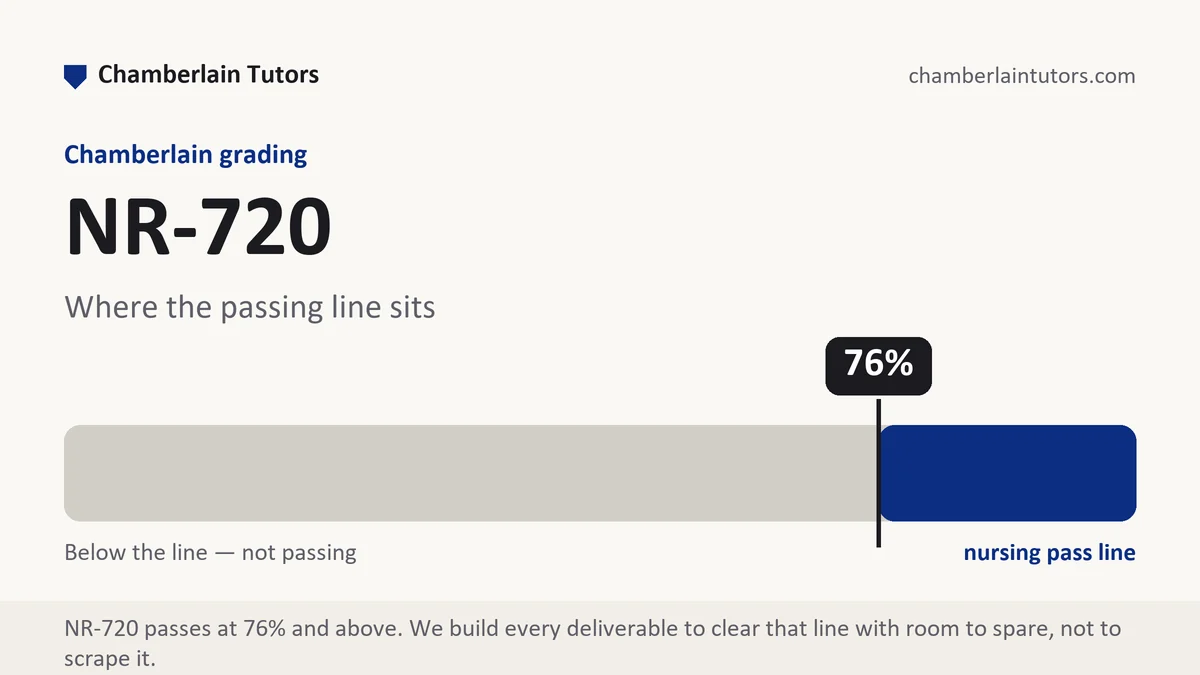
A passing NR-720 paper analyzes a real organization, cites leadership literature and recommends a defensible direction. Its most common weakness is that it reads as a report rather than as a decision document. Chamberlain's core nursing courses pass no lower than 76 percent, and a weakened weighted average cannot be lifted by taking on more submissions, so the difference between reporting and deciding compounds across a session of systems assignments.
Strong papers make the choice visible. They say what the organization gives up, in money, attention or capacity, and they name the group that will object and why. They tie the recommendation to a governance route, because a systems change with no committee, no sponsor and no reporting line does not survive contact with an organization. And they choose few measures rather than many: three that decide whether this was right, with baselines and review dates, beat a dashboard of fifteen that nobody reads. The final test is simple. If a board could act on the paper without asking a question you have not answered, it is a strong one.
Six mistakes that cost points in NR-720
- Writing at unit altitude. A well-executed improvement project on one floor answers a different course's rubric. Systems rows need scope beyond a single team.
- An environmental scan with no sources. Four boxes of assertions is a format, not an analysis.
- Options that are not real alternatives. If two of the three would never be seriously considered, the comparison is decorative.
- Recommending without workforce math. Staffing is usually the binding constraint, and a plan that assumes people are available reads as untested.
- Leadership theory used as decoration. Naming a model in the introduction and never letting it change a decision is visible to any experienced reader.
- Skipping governance. Without an owner, a sponsor and a reporting body, the recommendation has no mechanism, and rubric rows about implementation will show it.
Questions NR-720 students ask
I have never worked at executive level. How do I write with that altitude?
Can I use my own organization, and what if its numbers are confidential?
How many sources does a systems paper need?
Where NR-720 sits in Chamberlain's programs
Open the exact program map for sequence, credit, and option context. The current student schedule and syllabus remain authoritative after transfer evaluation, electives, state rules, and approved plan changes.
The weeks, one by one
Week 1
NR-720 opens a systems leadership sequence, and the first thing that changes is the reader. Read the full Week 1 manual.
Week 2
Senior leadership decisions are made against an environment nobody in the organization controls: payment policy, regulation, workforce supply, competitors, technology and the population's own behaviour. Read the full Week 2 manual.
Week 3
Every organizational problem can be described at several altitudes, and the altitude you choose determines which solutions are even visible. Read the full Week 3 manual.
Week 4
Somewhere in the middle of a systems leadership course the money arrives, and nursing leaders who write well about everything else often write badly about this. Read the full Week 4 manual.
Week 5
The synthesis this course keeps asking for has a specific home, and it is usually here: the paragraph where a workforce constraint changes a quality strategy, or where a quality requirement changes what the workforce has to look like. Read the full Week 5 manual.
Week 6
Nobody at executive level asks whether a proposal is good; they ask whether it is the best available use of a fixed amount of money, attention and workforce. Read the full Week 6 manual.
Week 7
Approval is not implementation, and the difference between them is governance. Read the full Week 7 manual.
Week 8
Closing work in a systems leadership course usually asks for synthesis: the environment read, the systems analysis, the cost build, the workforce position and the governance structure compressed into one argument aimed at people who will decide. Read the full Week 8 manual.