NR-718 Topics in Advanced Practice Leadership I is a three-credit doctoral course on APRN role actualization and the use of translation science to manage populations across the wellness to illness continuum, including internationally. The graded writing sits at the join of two things: what the advanced practice role is authorized and equipped to do, and what a defined panel of patients needs across the whole span from staying well to living with advanced disease. Papers that describe a job rather than analyze a role are the ones that score in the middle.
What NR-718 actually grades
Role actualization is the first scoring idea and it is more specific than it sounds. It means the distance between what the role could do under its regulation and evidence base, and what it currently does in a given setting. That distance is measurable: services not offered, decisions escalated unnecessarily, populations not followed. A paper that names the gap and its cause is doing the analysis; a paper that lists role responsibilities is doing an orientation handout.
The second scoring idea is the continuum. Wellness to illness is not a slogan but a sorting rule: the same panel contains people who need nothing but prevention, people in early disease who need titration and monitoring, people with multiple conditions who need coordination, and people approaching the end of life who need symptom control and planning. A strong paper allocates the role's time and the team's capacity across those segments deliberately, and says what happens to the segment that gets less.
How we help in NR-718
Our doctoral writers build role analysis from regulation outward and population work from the panel inward, so the two meet at a plan that is both legal and deliverable. Drafts come back with the role gap quantified and the care model named, which is where the analysis rows in this course concentrate.
Deliverables run the standard promise: a premium original draft in 24 to 48 hours, targeted at the A band of your course's actual scale, through the eight-person pipeline with both QA passes and the floor check, revised free until it lands.
In NR-718 right now?
Send the week and the rubric from Canvas. First premium sample free, floor-checked, back in 24 to 48 hours.
Read the rubric before the prompt
Role courses generate the widest range of paper lengths in the doctoral sequence, because the topic invites narrative. The rubric is the brake. Copy the rows into a blank document and mark whether each is about the role, the population, the evidence or the system. Rows about the role are the ones most often answered with autobiography, so flag those specifically and plan to write them with external sources rather than personal history.
Then convert weights to words. A 2,000-word paper with four rows at 38, 24, 22 and 16 percent leaves 760, 480, 440 and 320 words. In NR-718 the 760-word row is usually the population management analysis rather than the role description, which tells you that the section about who you serve and how outweighs the section about what you are called. Write the numbers beside the headings and hold to them.
Where the prompt asks for an international or comparative element, plan it as a genuine comparison rather than a paragraph of contrast. Pick one other country, name the workforce and payment arrangements that shape the role there, and use the difference to make a point about your own system. Comparative material that exists only to show breadth reads as filler; comparative material that explains why a constraint at home is a choice rather than a law of nature earns marks.
The shape of a role and population analysis
Whether your week calls for a role paper, a population management plan or a comparative analysis, the parts below carry the score. Each settles one thing about the role or the population it serves.
| Part | What it has to prove | How a thin version looks |
|---|---|---|
| The role as authority defines it | What the role may do in a named jurisdiction, cited from the regulation rather than from custom. | A description of what the writer does at work. |
| The panel or population | Who is attributed to the role, how many, and by what rule membership is decided. | The patients I see, with no count. |
| Distribution across the continuum | How the population divides between prevention, early disease, complex illness and end of life. | A single average patient described for the whole panel. |
| Care model with evidence | A named model of care matched to the largest segment, with the evidence that supports it there. | Team-based care asserted as the approach. |
| The actualization gap | What the role could do but does not in this setting, with the barrier identified as regulatory, structural or cultural. | Frustration expressed about not practicing fully. |
| Team and delegation | Which work moves to which team member, and what that frees the role to do instead. | A statement that collaboration is essential. |
| Role-level outcome measures | Measures attributable to the role and the panel, reported with denominators. | Patient satisfaction offered as the sole indicator. |
Evidence craft in role and population writing
Four habits do most of the work in this course.
Cite regulation from the regulator. Scope of practice, prescriptive authority and supervision requirements are set in state statute and board rule, and they change. Cite the board or the statute with its section and date, not a summary table on a professional site. When you compare jurisdictions, cite each one separately rather than relying on a national map.
Give panel data its rule and its period. Attribution rules decide who counts as yours. Write that 1,120 patients were attributed by two or more visits in the preceding 18 months, then report anything about them. Panel-level percentages without an attribution rule cannot be compared to anything, including your own numbers next year.
Match the verb to the design, especially for role outcome research. Studies comparing outcomes across clinician types are almost always observational and shaped by which patients are assigned to whom. Those buy comparable to and was associated with. Reserve stronger verbs for randomized evidence. Where your guide sets no recency rule, workforce and regulatory sources older than five years need a stated reason, because both change quickly.
Handle international evidence with its context attached. A model that works in a system with universal coverage and salaried primary care may not transfer to fee-for-service financing. Name the financing and workforce context in the same sentence as the finding, then say what would have to be true for it to transfer.
What separates a pass from a strong pass here
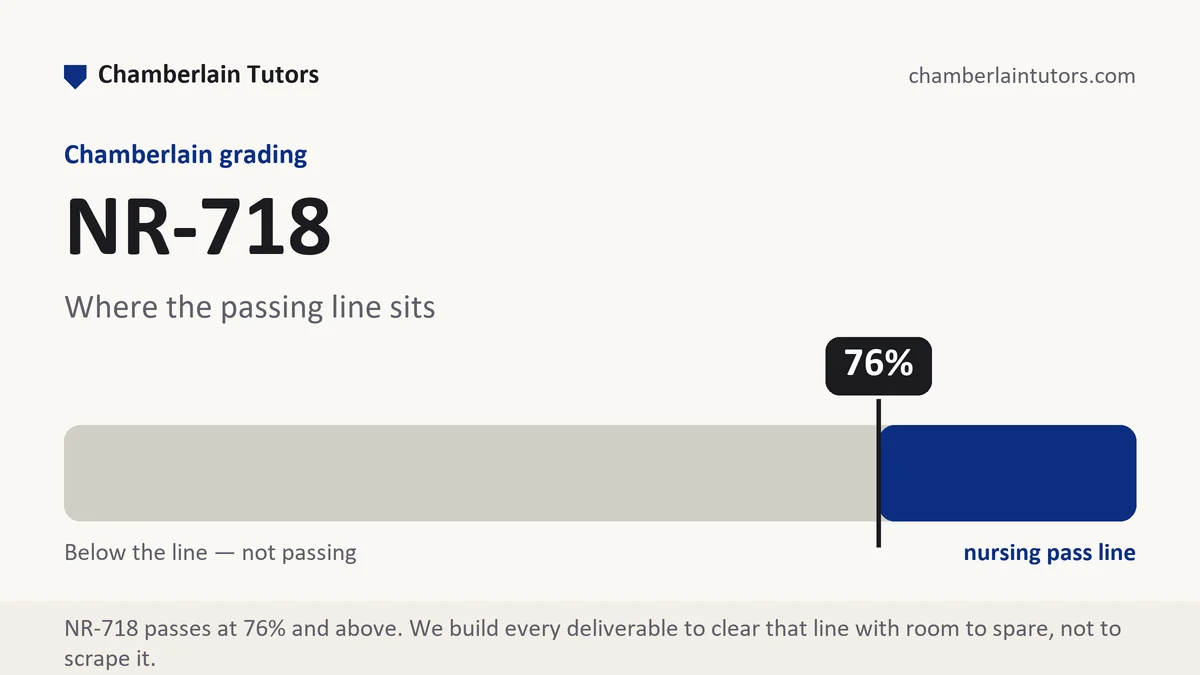
A passing NR-718 paper describes the role accurately, cites the professional literature and argues for practicing to the full extent of preparation. It is fluent and it is familiar. Every core nursing course at Chamberlain rests on a 76 percent floor, and nothing added afterwards rescues an average that has weakened, so the familiar version leaves no margin when a week goes badly later in the session.
Strong papers quantify the role. They put a number on the gap, whether that is visits not offered, conditions escalated that the role could manage, or a segment of the panel that receives no proactive contact at all. They then choose one segment and design for it, rather than describing improvements across the whole continuum at once. And they close with measures attributable to the role, reported with denominators and an interval, so that the argument for the role becomes something a system can verify rather than something the profession asserts.
Six mistakes that cost points in NR-718
- Writing your job description. The role is the object of analysis, not the setting for a memoir. Sources belong in the role section too.
- Ignoring regulation. A plan the role is not authorized to deliver in your state is not a plan, and the rubric row for scope will find it.
- Treating the panel as one kind of patient. Without segmentation there is no population management, only a general description of good care.
- Naming a care model without its evidence. Models have trials behind them, and the trials were run in particular populations. Say which.
- Making a global claim from one country. International comparison needs context, not a single contrasting example.
- Measuring activity instead of outcome. Visit counts show effort. Control rates, avoidable admissions and gaps closed show results.
Questions NR-718 students ask
I work in an inpatient specialty. How do I write a panel when I do not have one?
Does scope of practice law need a section of its own?
What does translation science add to a role paper?
Where NR-718 sits in Chamberlain's programs
Open the exact program map for sequence, credit, and option context. The current student schedule and syllabus remain authoritative after transfer evaluation, electives, state rules, and approved plan changes.
The weeks, one by one
Week 1
NR-718 opens on role actualization, which is the difference between holding a credential and occupying a role. Read the full Week 1 manual.
Week 2
An early stage of NR-718 usually turns to the machinery that defines what an advanced practice role may actually do: licensure, certification, state regulation, organizational credentialing and privileging, and payer recognition. Read the full Week 2 manual.
Week 3
This stage of NR-718 asks you to write about a population rather than a caseload, and to write it across the whole span from well to acutely ill rather than at the single point where you happen to meet people. Read the full Week 3 manual.
Week 4
Translation science is the discipline of getting established evidence into routine practice, and it is the intellectual centre of a practice doctorate. Read the full Week 4 manual.
Week 5
The middle of NR-718 usually asks you to take a national recommendation, guideline or best-practice standard and show precisely what would have to change in one setting for it to become routine. Read the full Week 5 manual.
Week 6
Advanced practice leaders are usually asked to change things they do not control. Read the full Week 6 manual.
Week 7
This course's territory includes managing populations globally, and a late stage typically asks you to look outside your own health system for the first time. Read the full Week 7 manual.
Week 8
The closing stage of NR-718 usually asks you to assemble the session's work into a case somebody would act on, and to say how it would reach the audiences that matter. Read the full Week 8 manual.