NR-717 Concepts in Population Health Outcomes and Health Policy is a three-credit doctoral course that joins two subjects normally taught apart. The catalog frames it around social determinants, health disparities and political skill. What that means for your writing is that a disparity has to be measured before it can be discussed, a determinant has to be traced through a pathway rather than named, and the paper has to end at a lever someone could actually pull. Description of unfairness, however accurate, is the version that scores lowest here.
What NR-717 actually grades
The first row is measurement. A disparity is a difference between two defined groups on a defined measure over a defined period, and it can be expressed in absolute terms, such as a gap of 14 events per 1,000, or in relative terms, such as a rate 1.8 times higher. Those two tell different stories and a doctoral paper reports both, because a large relative difference on a rare outcome can be a small absolute one, and program decisions are usually made on absolute numbers.
The second row is the pathway. Naming a determinant is not analysis. Showing how it operates is: how distance to a clinic becomes missed appointments through transport cost and shift work, how food environment becomes glycemic control through what is purchasable within a fifteen minute walk. Graders in this course reward the intermediate steps because those steps are where an intervention or a policy can attach. Without them the paper reaches its recommendation by assertion.
How we help in NR-717
Our doctoral writers measure the disparity first, in both absolute and relative terms, then build the determinant pathway step by step before any recommendation appears. Policy sections come back with a named instrument and a named decision-maker rather than a call for advocacy.
Deliverables run the standard promise: a premium original draft in 24 to 48 hours, targeted at the A band of your course's actual scale, through the eight-person pipeline with both QA passes and the floor check, revised free until it lands.
In NR-717 right now?
Send the week and the rubric from Canvas. First premium sample free, floor-checked, back in 24 to 48 hours.
Read the rubric before the prompt
Because this course fuses two fields, its rubrics usually carry rows from both, and students tend to write the half they are more comfortable with. Copy the rows into a blank file and tag each as population, policy or both. If your outline has no section under one of those tags, the paper is already losing a row before it is written.
Then price the sections. A 2,000-word paper with four rows at 33, 27, 22 and 18 percent leaves 660, 540, 440 and 360 words. In NR-717 the 660-word row usually belongs to the determinant analysis and the 540 to the policy response, which means the description of the population and the disparity, however striking the numbers are, has to be delivered in 440 words or fewer. Compression there is what makes room for the analysis the course is actually about.
One planning habit pays repeatedly. Before drafting, write the sentence that names the decision-maker: a state legislature, a county board, a health system executive committee, a payer's medical policy group. Everything in the policy half should be aimed at that body. Papers written to no one drift into general advocacy, which is the most common way strong material scores in the middle.
The shape of a disparities and policy analysis
Whether your week asks for an analysis paper, a determinant brief or a policy response, the parts below carry the score. Each supplies a piece the recommendation cannot stand without.
| Part | What it has to prove | How a thin version looks |
|---|---|---|
| Two groups, defined | The affected population and the comparison group, each bounded by person, place and time. | A vulnerable population named with no comparison at all. |
| The disparity measured | Absolute and relative difference on one measure, with denominators and period stated. | A statement that outcomes are worse for the group. |
| Determinant pathway | Three or four linked steps from the social condition to the clinical outcome, each supported. | A determinant named and immediately connected to the outcome. |
| Upstream and downstream separated | Which part of the pathway a clinical service can reach, and which part only policy can. | Every solution placed at the clinic door. |
| The policy lever | A specific instrument, its authority, and the body that would have to act. | A recommendation that policymakers prioritize equity. |
| Feasibility read honestly | Who opposes it, what it costs, and what makes this moment more or less workable. | An assumption that a good idea will be adopted. |
| Equity-sensitive measures | Outcome measures reported by subgroup so improvement cannot hide a widening gap. | A single overall average promised as the evaluation. |
Evidence craft with equity data
Equity writing is unusually easy to get wrong with numbers, and four habits prevent most of it.
Report absolute and relative measures together. A rate ratio without the underlying rates can make a difference of a handful of events sound like a catastrophe, and the reverse is equally possible. Give both, then say which one should drive the decision and why.
Treat social categories as markers of exposure, not as explanations. Race, ethnicity, income bracket and geography are how the data is collected, not why the outcome differs. When you report a difference by category, the following sentences should identify the exposures that category is standing in for: insurance status, clinic density, employment pattern, housing stability, historical policy. This is the single largest quality difference between mid-range and strong papers in this course.
Give every dataset its geography, vintage and method. Census-derived estimates, state surveillance and health system registries differ in how they were produced and how current they are. Write the source, the year and the level in the sentence. Where your guide sets no recency rule, anything past five years old needs a stated reason, and pay attention to whether the data predates a change in eligibility rules or a change in how the measure was defined.
Keep verbs inside what the design bought. Most determinant evidence is cross-sectional or ecological, which buys associated with and patterned by. It does not buy caused. Watch the ecological trap specifically: a correlation between neighborhood characteristics and outcomes does not license a claim about individuals living there, and doctoral graders look for that error by name.
What separates a pass from a strong pass here
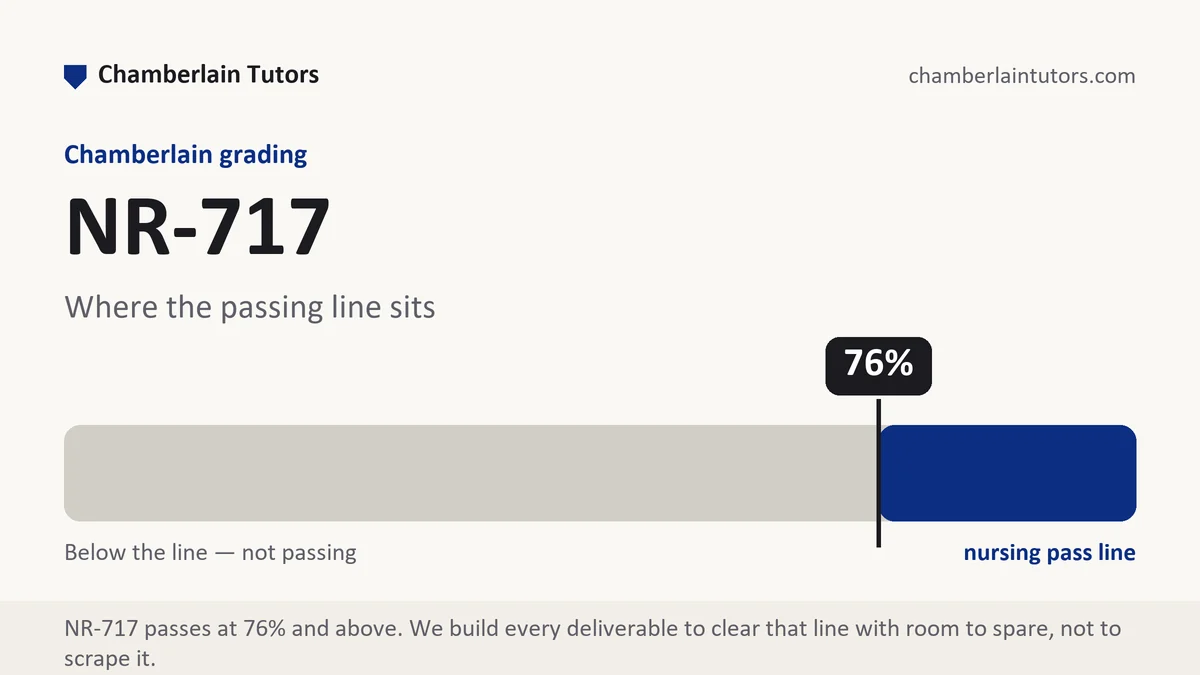
A passing NR-717 paper documents a real inequity with credible sources and calls for it to be addressed. Nothing in it is inaccurate. What is absent is arithmetic and a target. Chamberlain's core nursing courses pass at 76 percent and no lower, and later work will not raise an average that has already fallen, so the gap between sincere and analytic accumulates across the session rather than showing up once.
Strong papers quantify, trace and target. They quantify the gap in both forms and say what closing it would mean in people rather than percentage points. They trace the determinant through steps a reader can check. And they aim at a named body with a named instrument, then say what that body will ask for, usually cost and evidence of effect, and answer it in advance. A final sentence that assigns the first action to a specific role with a date is worth more than a paragraph of conviction.
Six mistakes that cost points in NR-717
- Describing a disparity without measuring it. Worse outcomes is a claim. A rate difference with denominators is a finding.
- Using a demographic category as the explanation. Say what the category exposes people to, or the analysis row stays unanswered.
- Reporting relative differences only. A ratio with no base rate can mislead in either direction and a doctoral reader will ask for the counts.
- Borrowing national equity data for a local claim. The pattern may hold, but you have to argue that it does before you rely on it.
- Ending on advocacy with no target. Advocacy aimed at everyone is aimed at no one. Name the body and the instrument.
- Evaluating with an overall average. A program can improve the mean while widening the gap. Report by subgroup or the equity claim is unverifiable.
Questions NR-717 students ask
How do I write about race and ethnicity in these papers without being clumsy?
What counts as political skill in a written assignment?
My population is small. Can I still report subgroup rates?
Where NR-717 sits in Chamberlain's programs
Open the exact program map for sequence, credit, and option context. The current student schedule and syllabus remain authoritative after transfer evaluation, electives, state rules, and approved plan changes.
The weeks, one by one
Week 1
NR-717 opens where population health and health policy meet, and the first written work usually asks you to convert something you have been treating as a clinical problem into something a policy audience can act on. Read the full Week 1 manual.
Week 2
The second stage of NR-717 usually pushes you from naming a problem to arguing the causal pathway behind it, and in this course that pathway runs through social conditions rather than through individual choices. Read the full Week 2 manual.
Week 3
The third stage of NR-717 typically moves from cause to measurement: showing that an outcome falls unequally across a population and writing that inequality in numbers a policy reader can act on. Read the full Week 3 manual.
Week 4
By the middle of NR-717 the writing usually turns to the policy landscape itself: what rules already govern your problem, at which level they were made, and who holds the authority to change them. Read the full Week 4 manual.
Week 5
Around the midpoint NR-717 usually asks for the analytic core of policy work: several genuine options for the problem you have mapped, weighed against criteria you declared before you weighed anything. Read the full Week 5 manual.
Week 6
Political competency is one of the named capacities in this course's territory, and this stage is usually where you have to write it rather than assert it. Read the full Week 6 manual.
Week 7
Late in NR-717 the writing usually shifts genre. Read the full Week 7 manual.
Week 8
The closing stage of NR-717 usually asks how you would know whether the policy worked and whether it would still be working in three years. Read the full Week 8 manual.