NR-607 sits in Chamberlain's PMHNP management finale, on the MSN-PMHNP path. This is its help page: what the course really grades and how our team carries it, floor check included.
What NR-607 actually grades
Management didactics close here, integrating populations and complexity before the capstone. The writing must now sound like the provider the certification exam will assume.
How we help in this course
Our 607 drafts are written at that assumption, and returning clients typically need only the collision weeks by now, which is the graduation the walkthroughs aim for.
Deliverables run the standard promise: a premium original draft in 24 to 48 hours, targeted at the A band of your course's actual scale, through the eight-person pipeline with both QA passes and the floor check, revised free until it lands.
How a 607 deliverable actually gets built
Chamberlain publishes no NR-607 syllabus outside Canvas, so nothing below is pinned to a week number. It is pinned to the document that actually governs your grade: the scoring guide sitting under the prompt. This course pushes into complex diagnoses and psychiatric emergencies across the lifespan, which means most of its writing is one genre wearing different names. Call it the decision narrative, where a reader has to see not only what you did but why the other option was wrong for this patient.
In NR-607 right now?
Send the week and the rubric from Canvas. First premium sample free, floor-checked, back in 24 to 48 hours.
The last didactic mile before the capstone
NR-607 closes the management sequence, integrating populations and complexity, and its documented position makes the stakes plain: after this comes NR-668, the capstone with board-review intensity, and the certification exam that assumes a finished provider's voice. Our 607 drafts are written at that assumption already. Returning clients typically order only the collision weeks by this point, which is the graduation the walkthrough system was designed to produce. If that is you, the desk flexes to collision-week coverage without ceremony; if you are new, the full machinery runs from the first hand-off.
What the rules still take from an unwatched week
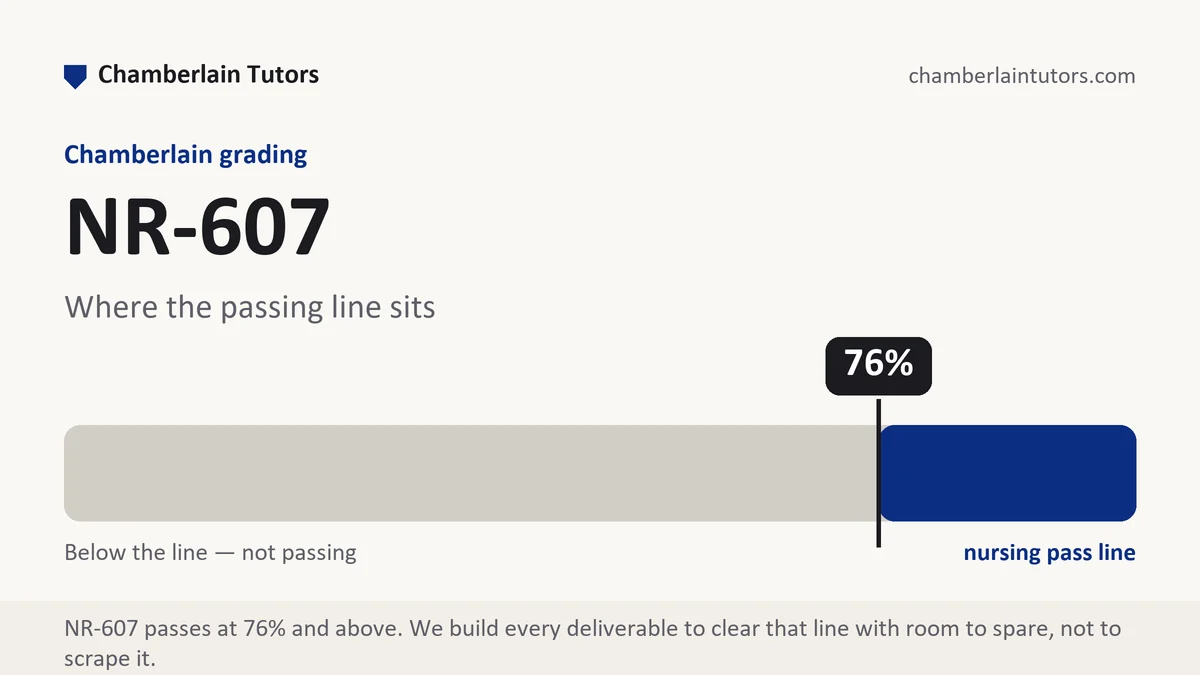
The finale didactic changes nothing about the machinery underneath: the specialty scale still fails everything below 84, boards still post in permanent ink, the Mountain-Time cutoffs still fall at 11:59 p.m., and a failed course still spends a dismissal-rule life. So each draft runs the full sequence, rubric QA, separate APA and originality pass, floor check against the 94-plus band, delivered in 24 to 48 hours with the math shown.
Is it worth starting desk support this late in the track?
Yes, and 607-first clients are common: the capstone ahead is heavier, and starting here lets the team learn your voice one course before it matters most.
What should a first message include?
Week number, rubric, gradebook screenshot. Scope and recovery math come back same day, and the first premium draft is free if you want evidence before commitment. Nothing obligates a second order.
Turn the scoring guide into words per point
Read the guide before the prompt, and read it with a calculator open. Points decide where your hours go, and the arithmetic takes two minutes.
Find your conversion rate first. Divide the word ceiling by the total points on the guide. A 1,600-word paper against a 200-point guide runs at eight words per point, and that one number prices every row on the page. A 60-point row is worth roughly 480 words. A 20-point row is worth 160, which is a long paragraph, not a section, and treating it as a section is how drafts run over while the heavy rows go thin.
Then do the step most students skip: split every conjunction. Rows in this course routinely carry two obligations under one heading, something along the lines of assesses risk and justifies the level of care. That is two jobs scored as one number, and a paper that nails the first and never reaches the second cannot climb past the middle of that row however good the risk section is. Break the row in half, give each half its own labeled paragraph, and divide its points evenly unless the guide says otherwise. On a 30-point row at eight words per point, that is about 120 words each. Apply the same cut to any row containing a list; three named elements means three paragraphs.
Last, set the top band against the one beneath it and mark the verb. In 607 the escalation is almost always from describing a presentation to defending a decision about it. If the top band says justifies, evaluates, or prioritizes, narration caps you a band lower no matter how clean the prose is.
The shape of a decision narrative
Whatever your prompt calls it, the graded artifact here is a complex or emergent presentation carried through to a disposition you can defend. These are its load-bearing parts.
| Section | What it has to prove |
|---|---|
| Presentation and acuity snapshot | How sick, how fast, and how you knew, inside the first paragraph. The reader should be able to picture the room before any analysis begins |
| Objective and mental status findings | Behavior described rather than labeled. "Pacing, pressured speech, would not stay seated" outranks "agitated" every time |
| Medical mimics considered | That you hunted the non-psychiatric explanation before settling on a psychiatric one, and what actually ruled it out |
| Risk assessment with its method named | Which structured approach or criteria you applied, what it returned, and what it changed. Risk is a finding, not an adjective |
| Working diagnosis under uncertainty | What you are treating now, what stays unresolved, and what evidence would change your mind |
| Level-of-care decision | The disposition you chose and, in its own sentences, the alternative you rejected and why it was wrong for this patient |
| Stabilization and prescribing | What was started or held, at what dose, with what monitoring, and how acuity drove that choice |
| Legal and ethical layer | Capacity, consent, hold criteria where relevant, and who was informed. The governing state law is named, not implied |
| Handoff and follow-up | What the receiving clinician or the family needs to know, plus the interval and the conditions for the next contact |
Two of those rows carry most of the weight in practice. If your draft settles the disposition in one clause and spends three paragraphs on the presentation, the budget from the previous section is telling you to rebalance before you polish.
Evidence when the case is an emergency
Work from the current edition, and name it. Emergency psychiatry guidance gets revised, and a claim attached to a superseded version argues against a rule that no longer exists. Put the issuing body and the year into the running text rather than leaving them to the reference list, so a reader knows the vintage while they read.
Put design and sample where the reader hits them first. A retrospective chart review of 4,100 emergency visits and a randomized trial of 90 inpatients support very different sentences, and burying the design at the end invites the grader to assume you never noticed it mattered.
Keep verbs inside what the design can hold. Chart reviews, registries, and cohort studies earn "was associated with," "was more common among," or "preceded." A causal verb attached to an observational finding is the most common evidence-row deduction at this level and the easiest one to avoid.
Give every rate a denominator and a measurement window before you use it. A 12 percent readmission rate is not information. Twelve percent of which population, readmitted where, within how many days: answer those three and the number can carry an argument. Hold your own case to the same rule. If a patient had been seen repeatedly, say how many times over what period, because repeatedly is an impression and four visits in nine days is a finding.
Where a strong 607 paper pulls ahead
A passing paper describes an emergency accurately. It reports what happened, in order, and lands on a defensible diagnosis. That is genuinely hard, and it is also where most drafts stop.
A strong one does three more things. It argues the disposition instead of reporting it, spending real sentences on the option it rejected, because a decision with no alternative on the page is not visibly a decision. It keeps hindsight out of the reasoning, separating what was knowable in the first ten minutes from what only became clear later; readers in this specialty notice when a paper credits itself with information it did not yet have. And it stays inside its own uncertainty, naming what is unresolved and what finding would change the plan, rather than performing a confidence the case never supported. On a scale with no C band, the distance between describing and defending is the distance between passing and repeating work you understood perfectly.
Six things that quietly cost points here
Landing on a psychiatric diagnosis without clearing the mimics
Name what you considered and what excluded it. A differential that never leaves psychiatry reads as a differential that was never really built.
Risk written as an adjective
"High risk" is a conclusion with the work missing. Give the criteria or the structured approach, the findings, and what the finding changed about your plan.
Hindsight dressed up as foresight
If you learned it at hour six, do not let hour zero take credit. Timestamps in the reasoning are cheap and they protect the judgment rows.
A guideline cited with no year and no issuing body
Both belong in the sentence. Without them the reader cannot tell whether you are citing current practice or something retired two revisions ago.
Labeling behavior instead of describing it
Every label you use should be reconstructable from the observations you already wrote. If it is not, the objective section is doing less work than it appears to.
Answering half of a two-part prompt
The split you applied to rubric rows applies to board prompts too. Chamberlain discussions cannot be edited after posting, so the half you forgot stays forgotten.
Three questions students send about 607
The case I want to write about ended badly. Can I still use it?
The disposition was my preceptor's call, not mine. How do I write it?
My draft reads like a story. How do I turn it into an argument without starting over?
The weeks, one by one
Week 1
NR-607 Week 1 opens the last PMHNP management course by raising the bar on the oldest skill in the sequence: the case formulation. Read the full Week 1 manual.
Week 2
NR-607 Week 2 usually turns to the discipline that keeps psychiatric prescribers safe: proving a presentation is psychiatric before treating it as psychiatric. Read the full Week 2 manual.
Week 3
NR-607 Week 3 typically lands on the work that defines the specialty when it matters most: assessing suicide and violence risk in a way that changes what happens next. Read the full Week 3 manual.
Week 4
NR-607 Week 4 sits where the course's catalog language about psychiatric emergencies usually comes due: the acute presentation that must be stabilized, assessed under pressure, and dispatched to a level of care you can defend. Read the full Week 4 manual.
Week 5
NR-607 Week 5 tends to reach the pharmacology of the hardest charts: the patient who has not responded, the regimen that has grown by accretion, and the decision to augment, switch or subtract. Read the full Week 5 manual.
Week 6
NR-607 Week 6 usually takes the course's "across the lifespan" promise literally: the same illness looks different at 9, at 39 and at 79, and management written for the middle decade fails at both ends. Read the full Week 6 manual.
Week 7
NR-607 Week 7 typically confronts the part of psychiatric practice that lives in law as much as medicine: whether a patient can decide, what consent means when insight is impaired, and when care proceeds against a patient's stated wishes. Read the full Week 7 manual.
Week 8
NR-607 Week 8 usually closes the management sequence by asking for everything at once: one complex case carried whole, from first presentation through workup, risk, management and legal texture to handoff, written in the voice of a provider rather than a student. Read the full Week 8 manual.
Where NR-607 sits in Chamberlain's programs
Open the exact program map for sequence, credit, and option context. The current student schedule and syllabus remain authoritative after transfer evaluation, electives, state rules, and approved plan changes.