In the MSN-FNP sequence, NR-602 is FNP primary-care sequence. Students search the code mid-panic more than any title, so this page answers the code: here is the honest read and the service behind it.
What NR-602 actually grades
The sequence's middle course, extending management writing across populations, family and women's health territory in the track's design, with clinical hours typically stacking alongside the didactic load.
How we help in this course
Our 602 drafts keep the case register while the calendar work keeps the collisions away: every written deliverable planned around placement days, drafts ahead of the Mountain-Time cutoffs.
The service terms match the whole site: 24 to 48 hour delivery, A-band targeting on your scale with the floor math shown, two independent QA passes, free revisions until the target is met.
How to write this course's deliverables
A manual built around week numbers would be inventing a schedule Chamberlain does not publish. Course documents live in Canvas, and the scoring guide arrives attached to the assignment, reweighted term by term. What is stable is the craft, so that is what this section covers: how a case written about a child, an infant or a childbearing patient earns its rows, and how to get it built on a week where the rotation takes the daylight hours. Read it once now, then keep it open beside the guide when the next case lands.
In NR-602 right now?
Send the week and the rubric from Canvas. First premium sample free, floor-checked, back in 24 to 48 hours.
The collision course of the FNP calendar
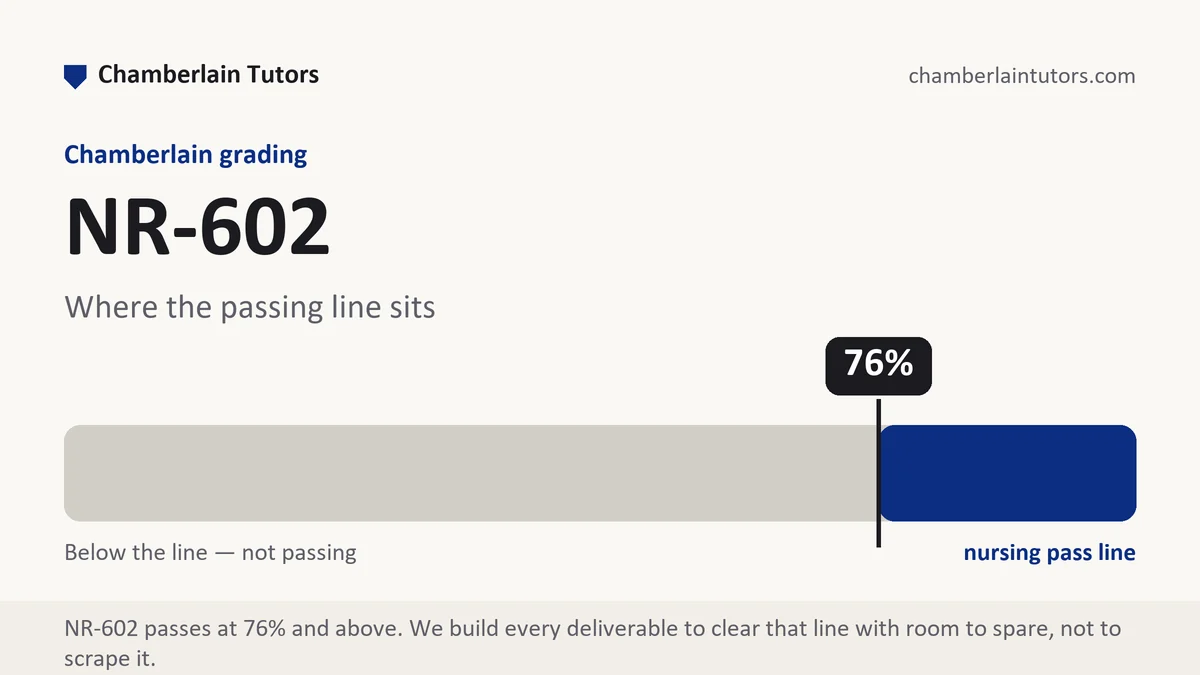
NR-602 extends management writing across family and women's health territory while clinical hours typically stack alongside, which makes it less a writing problem than a scheduling problem with a no-C scale attached. One misjudged week here costs more than it would almost anywhere else, because the specialty ladder fails everything under 84 and the dismissal math counts every failure. The desk answers with calendar work first: session mapped at intake, placement days marked, writing slotted where the hours are not.
What each week's hand-off looks like
You forward the case materials and rubric as the week opens; the draft returns within 24 to 48 hours in case register, workup visible, plans argued from current guidelines, floor-checked before it ships. Boards arrive final-quality for their single permanent post. Nothing waits for deadline night, because the entire point of the arrangement is that 11:59 p.m. Mountain Time stops being a number you think about. Margin also buys revision room: if a graded piece lands under target, the free revision cycle has days to work with instead of hours.
The fastest way to get this course quoted
A single chat message with the week number, the rubric, and your clinical-day pattern gets a same-day scope: cost, delivery slot, and an honest note on which upcoming weeks look heavy. If you want the audition first, the opening sample is free and full-length, like every first order on this site. Send it on a clinic day and read it on your day off; the desk fits around the schedule, never the reverse.
Budget the words before the week disappears
The MSN NP track carries 625 clinical hours, and in this course they typically stack on top of the written deliverables. That makes planning a scoring matter rather than a personality trait. In the first day of the week, open the guide, list its rows, and decide how many words each row is worth before the case has taken any shape in your head.
The conversion is arithmetic. Say the guide runs five rows weighted 40, 20, 20, 10 and 10, and the deliverable is a 1,200 word case. That is roughly 480 words for the heavy row, 240 for each of the two middle rows, and 120 for each of the light ones. Short deliverables are where students overspend on background: two hundred words of general context sit in a row worth a tenth of the grade while the row worth forty percent gets four sentences. Run the multiplication on your own guide, because weights move between sections.
Then schedule against your rotation. Draft the heaviest row on a day you are not in clinic, leave the light rows for a tired evening, and keep the discussion post out of the last hour entirely, since a Chamberlain board post cannot be edited once it is up.
The shape of a case built around a stage of life
Whether the patient is two months old or thirty weeks pregnant, the graded structure rewards the same moves. Stage is data here, and every block below has to use it.
| Block | What goes in | What it must demonstrate |
|---|---|---|
| Concern in context | The presenting problem plus the age band, developmental stage or gestational timing that changes what it means | That you read stage as clinical information rather than as a label at the top of the page. |
| Data against the right reference | Growth parameters with percentiles, vitals compared to age-appropriate ranges, dating and trimester where relevant | That you compared against the correct reference. Adult ranges applied to a toddler are a scored error, not a typo. |
| Differential shaped by the age band | Candidates ordered by what is common at this stage, with the stage-specific finding that moves each one | That your reasoning changed with the population instead of carrying an adult list across. |
| Plan with the arithmetic visible | Weight-based dosing shown as a calculation, or a stated safety rationale for use in pregnancy or lactation with its source | That the number came from a method. An unshown dose reads as recall, and recall does not earn the plan row. |
| Anticipatory guidance and screening | What comes next at this stage, named, with the interval or visit spacing attached | That you are managing a trajectory and not only today's complaint. |
| Caregiver or partner instructions | Plain-language home instructions and the exact findings that mean return now | That the plan survives leaving the office. Graders read this block for safety. |
The two blocks that vanish under time pressure are the reference comparison and the return precautions, and they are usually the two the rubric pays for most directly. Draft both before you polish anything else, because polish is recoverable in a revision and a missing safety block is not.
Evidence craft when the population is not a healthy adult
The evidence base here is thinner and more observational than the one you used in adult courses, so the writing has to be more careful, not less. Trials rarely enroll pregnant or lactating participants, and pediatric work is often confined to narrow age windows, which means much of what you cite was extrapolated to your patient by someone else.
Give design and sample before findings, and include the enrolled age range or gestational range in that sentence. Safety information drawn from registries and cohorts supports was associated with; it does not support is safe, and that single verb swap is a common deduction. Any incidence or prevalence figure needs three companions: the denominator, the measurement window, and the age band or pregnancy stage it describes.
Immunization and screening schedules are versioned documents. Cite the schedule itself in its current version and put the year in your own sentence rather than leaning on a review article that summarizes it, and check the version the week you write, because these documents revise on their own calendar and a superseded one cited as current is an easy row to lose.
Where the top band actually lives here
A passing NR-602 case gives an age-appropriate plan that would harm nobody. A strong one shows its arithmetic: the weight-based calculation written out, the percentile named, the reference identified, the pregnancy or lactation rationale sourced. It writes caregiver instructions a caregiver could follow without a clinician standing there, gives explicit return precautions, dates the next screening or visit, and separates what is urgent from what can wait until then.
The specialty scale gives that difference weight. With no C band, 84 is the first passing number and the grade is a weighted average, so the middle-band case you wrote on a heavy rotation week does not disappear; it sits in the average until the session ends.
Five mistakes that cost points here
- A plan that ignores stage. An adult-shaped plan attached to a child or a pregnancy, with the age band mentioned only in the first line.
- A dose asserted rather than calculated. Show the weight, the per-kilogram figure and the result, then check it against the maximum.
- Instructions written for a clinician. If a caregiver could not act on it at home, the education row is unfinished.
- Return precautions left out. Name the specific findings that mean come back now, not a general instruction to monitor.
- A schedule cited secondhand or out of date. Go to the current version, name its year, and do not let a summary article stand in for it.
Three questions NR-602 students send
A rotation swallowed the week. How do I write a case in what is left?
How much of a pediatric plan should be caregiver instruction?
Do I cite the schedule itself or an article about it?
The weeks, one by one
Week 1
NR-602 Week 1 opens the childbearing and childrearing course where every later case will start: the well visit, growth measurement and developmental surveillance. Read the full Week 1 manual.
Week 2
NR-602 Week 2 typically moves from measuring children to protecting them: the immunization schedule, catch-up logic when doses were missed, and the counseling conversation with a hesitant caregiver. Read the full Week 2 manual.
Week 3
NR-602 Week 3 usually brings the sick child: fever, cough, ear pain, vomiting, the visits that fill a family practice afternoon. Read the full Week 3 manual.
Week 4
NR-602 Week 4 tends to shift from the sick visit to the long game: asthma, atopic disease, obesity and attention concerns, the conditions a family manages between appointments. Read the full Week 4 manual.
Week 5
NR-602 Week 5 usually hands you the patient who answers in shrugs: the adolescent visit, with its split interview, its confidentiality promise and its limits, and the psychosocial territory where the real findings hide. Read the full Week 5 manual.
Week 6
NR-602 Week 6 typically turns to the reproductive side of the catalog title: contraception counseling that starts from the patient's own timeline, medical eligibility checked against her conditions, cervical and infection screening decided by interval rather than by habit, and the menstrual. Read the full Week 6 manual.
Week 7
NR-602 Week 7 usually reaches the childbearing heart of the course: the pregnant and postpartum patient in a primary care frame. Read the full Week 7 manual.
Week 8
NR-602 Week 8 tends to close the course on its own title: the family, treated at last as one unit. Read the full Week 8 manual.
Where NR-602 sits in Chamberlain's programs
Open the exact program map for sequence, credit, and option context. The current student schedule and syllabus remain authoritative after transfer evaluation, electives, state rules, and approved plan changes.