NR-584AT is the quality and safety course inside Chamberlain's accelerated MSN advanced nursing leadership options. Three theory credits, no practicum. The writing is charter writing: define an improvement narrowly enough to test, predict what will happen, and specify the measures that would prove you wrong.
What NR-584AT actually grades
The examinable skill here is restraint. Most students arrive wanting to fix something large, and improvement work is graded on the opposite instinct: shrink the problem until a single change can be tested on a single group inside a short window. Rubric rows that mention scope, feasibility or aim are all scoring that shrinkage, and papers that propose a department-wide overhaul lose those rows even when the idea is good.
The second graded skill is prediction. An improvement charter is a claim about the future, and it has to be specific enough to fail. Which number, moving how far, by when, in which population. Written that way, the rest of the document almost builds itself, because every later section is answering how you would know.
Regulatory and accreditation pressure runs underneath the course as well. Leaders rarely get to choose improvement work in a vacuum; something is being inspected, reported or benchmarked, and a charter that ignores that context reads as naive. One sentence saying which external requirement your aim serves is usually enough, and it converts a classroom exercise into a document with a reason to exist.
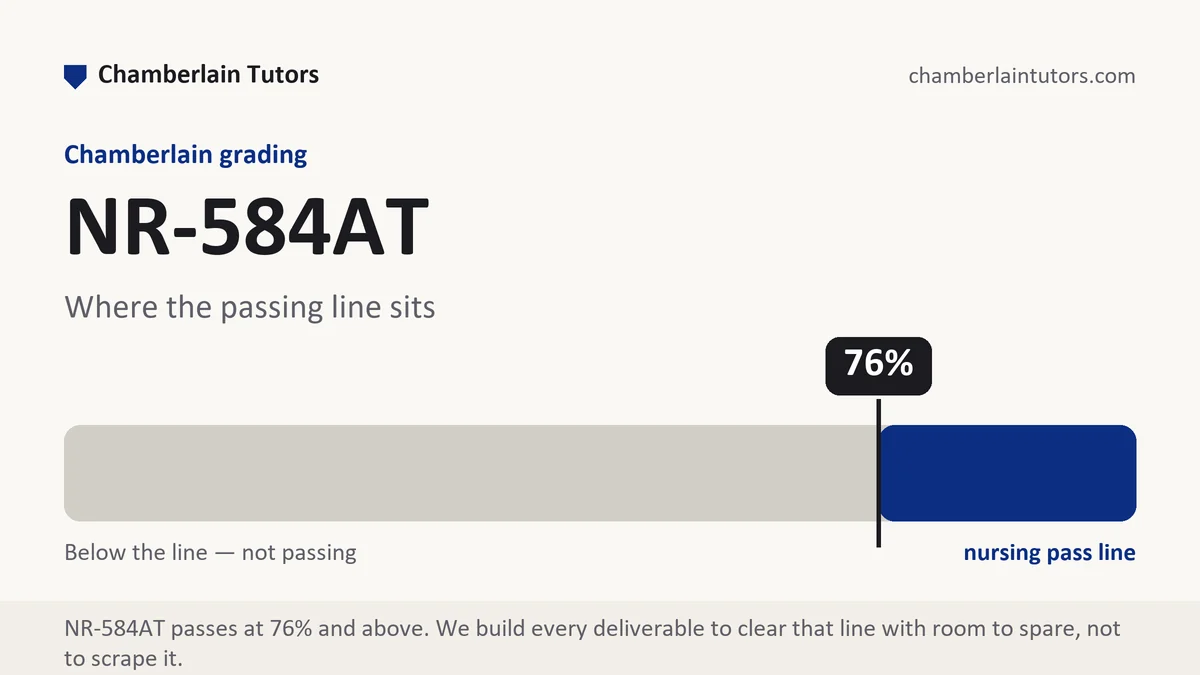
Then there is the leadership overlay. In this option you are not only the person doing the work, you are the person who has to sponsor it, staff it and defend it. That means the paper needs a resource line, an owner and a plan for what happens after the interest fades. Chamberlain's passing floor in core nursing courses is 76, deliverables land weekly through an eight-week session, and supplementary work cannot rescue a weak weighted average.
How we help in this course
Send the prompt and rubric from Canvas plus the process you want to improve, described in a sentence and without identifying your employer. We build the charter around a testable aim, pick measures that include a balancing one, and keep the scope inside what an eight-week session can defend.
If your section wants a process map or a run chart, we build it from the numbers you can actually get and mark clearly which values are observed and which are assumed, since an unlabelled assumption is the fastest way to lose an evidence row.
Writing the improvement charter?
Send the rubric and the process you want to change. We will draft the aim statement and the measure set today.
Read the rubric before the prompt
Improvement rubrics reward objects: an aim, a baseline, a measure set, a test design, a sustainment plan. Copy the rows out of Canvas and turn each into a heading you could put in a document that a director would sign. If a row cannot be turned into a signable section, it is a quality-of-writing row and should be handled at the editing stage rather than the planning stage.
Then convert weights into words, and expect the caps here to be short. A 900-word charter with rows weighted 40, 30, 20 and 10 percent allocates 360, 270, 180 and 90 words. Three hundred and sixty words for the aim and its justification sounds generous until you try to include a baseline, a population and a date in it. Ninety words for the last row means one tight paragraph, so choose which of your good sentences survives before you write six.
Short caps punish throat-clearing more than long ones. In a 900-word document, an introduction explaining that quality matters costs you a fifth of the aim section.
The sections of an improvement charter
The dominant deliverable is a charter: a short document that commits to a change and to how it will be judged.
| Section | What it must contain | The version a sponsor rejects |
|---|---|---|
| Aim statement | A number, a direction, a population and a date, in one sentence. | An aim to improve a process, with no magnitude and no deadline. |
| Scope boundaries | What is in, what is deliberately out, and which shift or unit the test runs on. | An implied scope of everywhere, which cannot be staffed. |
| Baseline | The current level with its source, its period and its variability, not a single recent value. | One month's figure treated as the truth. |
| Where the process breaks | The specific step, identified by walking the process rather than by assuming. | A cause chosen because it matches the solution already in mind. |
| The change and the prediction | What will be done differently and what you expect to happen, stated before the test. | An intervention with no stated expectation, so nothing can be learned. |
| Measure set | An outcome measure, a process measure and a balancing measure that would catch the harm your change causes elsewhere. | A single outcome measure, so side effects stay invisible. |
| Sustainment | Who owns the change after the project ends and what would signal it is slipping. | A closing hope that the change becomes part of the culture. |
Evidence craft in improvement writing
Improvement documents are judged on how carefully they treat their own numbers.
A baseline is a period, not a point. Give several time points where you can, because a change measured against a single unusually bad month will look successful no matter what you do. Say what the range was.
Distinguish ordinary variation from a real shift. Processes fluctuate. Two consecutive points moving in the right direction is noise, and describing it as improvement is the most common analytic error in this course. Say what pattern would persuade you.
Design decides the verb. Before-and-after improvement work supports "was followed by" and "coincided with". Only controlled or well-identified designs support "reduced". Where you cite published improvement studies, name the design in the sentence, since most of them are uncontrolled and the reader needs to know.
Denominator and window travel with every rate. "Eleven of the 143 discharges that month left without a follow-up appointment booked" is a fact. "Follow-up booking is poor" is an impression, and a charter built on impressions cannot be evaluated.
Passing and strong in an improvement course
A passing charter is sensible and vague in exactly one place: the aim. It proposes a good change, cites real sources and promises to monitor results. Because the aim carries no number and no date, none of the later sections can be precise either, and the paper loses points in several rows for a single missing sentence.
Sustainment is the second reliable separator. Most charters end at the point where the test succeeds, as though the interesting part were the pilot. The version that scores well says who inherits the change, what routine work absorbs it, and which signal would show it decaying three months later. Improvement that nobody owns reverts, and a document that has planned for that reads as though its author has watched it happen.
A strong charter is falsifiable. It says the figure will move from this to that, on this unit, by this date, and it names the balancing measure that would tell you the improvement was bought at somebody else's expense. It also says what it will cost in hours and who releases those hours, which is the sentence that separates a student exercise from something a leader could actually take to a meeting. Rows about feasibility exist to reward that sentence.
Six habits that cost marks in NR-584AT
- An aim with no number. Everything downstream inherits the vagueness, and several rows lose marks for it at once.
- No balancing measure. Every change moves work somewhere else. A measure set that cannot see that is incomplete by design.
- Scope the size of a department. Test on one shift, one unit, one clinic session. Scale is a later problem and rubrics know it.
- Reacting to two data points. Calling normal fluctuation a result is the error the course is built to prevent.
- Naming the organization. Setting type and approximate size carry full marks with none of the exposure.
- Composing discussion posts in the box. Posts do not reopen once submitted at Chamberlain, so finish the text elsewhere and paste it once.
Questions NR-584AT students ask
I cannot actually run the test. Does the charter still work?
How ambitious should the aim be?
Do I need statistics for this paper?
Where NR-584AT sits in Chamberlain's programs
Open the exact program map for sequence, credit, and option context. The current student schedule and syllabus remain authoritative after transfer evaluation, electives, state rules, and approved plan changes.
The weeks, one by one
Week 1
NR-584AT Week 1 opens a quality and safety course for professionals who are already carrying a department, and the opening work is definitional and applied at once: the vocabulary of quality and of safety, the distinction between them, and one problem from your own service written precisely enough. Read the full Week 1 manual.
Week 2
NR-584AT Week 2 moves from vocabulary to safety science, and the writing skill it teaches is the one a leadership role uses most often: describing something that went wrong in language that explains the system without implicating the person. Read the full Week 2 manual.
Week 3
NR-584AT Week 3 is the measurement stage, and for a professional who already reads a dashboard every month it is the stage that explains why the dashboard has been green for a year while the process it claims to describe has not improved. Read the full Week 3 manual.
Week 4
NR-584AT Week 4 is where a quality course asks you to write the distance between what your evidence says should happen and what your records show does happen, then convert that distance into an aim somebody could hold you to. Read the full Week 4 manual.
Week 5
NR-584AT Week 5 is where the diagnosis becomes a design. Read the full Week 5 manual.
Week 6
NR-584AT Week 6 covers the two analytic documents that every safety programme runs on: the backward-looking analysis of something that already happened, and the forward-looking analysis of something that has not happened yet. Read the full Week 6 manual.
Week 7
NR-584AT Week 7 is where a tested change has to become something the organization keeps after you stop paying attention to it. Read the full Week 7 manual.
Week 8
NR-584AT Week 8 turns seven stages of separate documents into one case, plus a short version written for people who decide rather than grade. Read the full Week 8 manual.