NR-582AT is the leadership and role development course as it runs in Chamberlain's accelerated MSN advanced nursing leadership options. Three theory credits, no practicum. The written work is about influence: who has to change their behaviour for your idea to survive, what each of those people stands to lose, and how you would sequence the conversation.
What NR-582AT actually grades
Leadership theory is the reading. The graded artifact is nearly always a plan that has to work on real people. That distinction is what students miss in the first two weeks: a paper can recite transformational and transactional models flawlessly and still score in the middle band, because the rubric row was asking what you would say to the night charge nurse who thinks the change is an insult to her judgment.
Two demands sit inside most of the rows. The first is specificity about power, meaning who can approve, who can quietly block, and who nobody consulted last time. The second is honesty about loss. Every change takes something from somebody, usually time, autonomy or status, and analyses that pretend otherwise read as inexperienced no matter how well they are written.
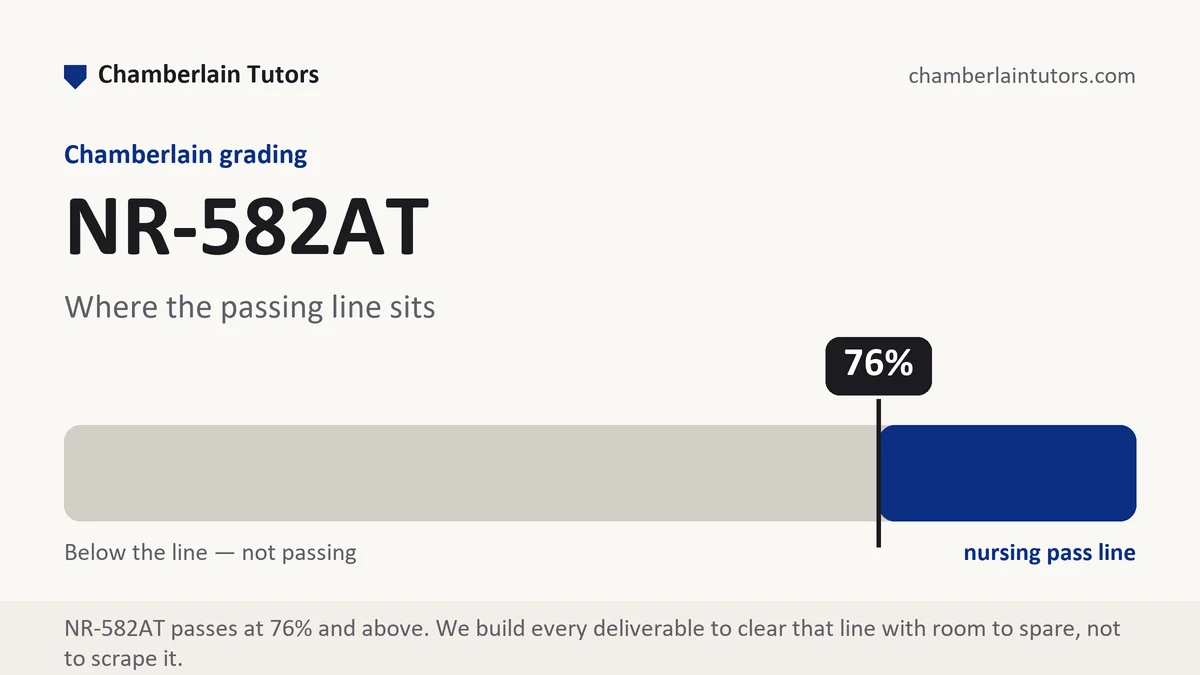
Because this is an accelerated option, the schedule compounds the difficulty. Chamberlain's 16-week semesters split into two eight-week sessions with up to six starts a year, so deliverables land weekly and there is no quiet stretch to recover in. The passing floor in core nursing courses is 76, and supplementary work cannot rescue a weak weighted average.
How we help in this course
Send the prompt and rubric from Canvas along with a de-identified sketch of the change you want to analyze: what it is, roughly how many people it touches, and who has the authority to approve it. From that we build a draft with a real influence map in it rather than a generic list of stakeholders, and we keep every recommendation attached to a person who would have to act.
If you would rather learn it than order it, the walkthrough version of this work is genuinely useful, because the same influence mapping shows up in every later leadership course and in the job itself.
Mapping a change this week?
Send the rubric and a sketch of the setting. We will scope the influence analysis today.
Read the rubric before the prompt
Rubrics in this course tend to hide their weight in a row with a soft name. Copy the rows out of Canvas, then rewrite each as a question you could answer out loud: who is affected, what does the theory predict, what will you actually do, how will you know it worked. Rows that resist being turned into a question are usually formatting rows, and formatting rows are cheap points you should collect first.
Then convert the weights into a word budget. Take a 2,200-word cap with five rows weighted 25, 25, 25, 15 and 10 percent. That is 550 words for each of the first three, 330 for the fourth and 220 for the last. Three sections of 550 words is a different assignment from what most students imagine when they read the prompt, and seeing it in advance stops the analysis from being crushed into the final page.
One refinement specific to this course: if two rows are tied in weight and one of them asks for evaluation, spend the tie-break on the evaluation row. Descriptive rows have a ceiling. Analytic rows are where the top band is decided.
The layers of an influence analysis
The dominant deliverable here is a change proposal with the politics left in. Each layer answers a question a grader will look for.
| Layer | The question it answers | The shallow version |
|---|---|---|
| The change, in one sentence | What will be different on a specific unit next month, phrased as observable behaviour. | A goal statement about improving quality of care. |
| Who is touched | The named roles, with rough numbers, including the ones outside nursing. | A list of job titles copied from an organizational chart. |
| Interests and losses | What each group gains and what each group gives up, stated without euphemism. | An assumption that everyone wants better outcomes. |
| Where power actually sits | Formal authority and informal influence separated, with the veto points identified. | The assumption that the manager's approval settles it. |
| Message per audience | What you would say to each group, in their terms, and what evidence they would find persuasive. | One message repeated to everyone with the job titles swapped. |
| Resistance forecast | The two objections most likely to be raised, and your answer to each. | A note that some staff may be resistant to change. |
| Sequence and first step | The order of conversations and what you would do in week one. | An implementation timeline with no names in it. |
Evidence craft when the data is your own workplace
Leadership deliverables mix published research with things you know from being there. Each carries a different obligation.
De-identify before you draft, not after. Describe the site by type and size. Named employers, units, managers and colleagues have no place in coursework, and a redaction pass at the end always misses something.
Observation is evidence when you label it. "On the two units I work across, handoff regularly runs past shift change" is usable if you say it is your observation. The failure is presenting personal experience in the grammar of research.
Verbs your source can support. Most leadership literature is cross-sectional or observational, so "was associated with", "reported more often" and "predicted" are the honest verbs. Save "reduced" and "improved" for controlled evidence. This is the most frequent overreach in change-management writing.
Any rate needs a denominator and a window. "Nine of the 41 staff on the unit left within 12 months" is a fact a reader can weigh. "Turnover is a serious problem" is a mood. Where you use a published benchmark, say which population it came from, since a national figure and a unit figure are not comparable without that step.
Passing and strong in a role development course
A passing paper describes a sensible change and attaches a recognized model to it. Everything in it is defensible. Nothing in it has any friction, and the person reading it cannot picture the meeting where it would be proposed. That paper scores in the middle every time, and the feedback usually says the analysis could be deeper without saying which part.
There is a quick diagnostic for which one you have written. Count the proper nouns and role names in your analysis section, excluding citations. A paper with three or four concrete actors in it usually has an argument. A paper whose actors are staff, leadership and the organization usually has a summary, because none of those three can be persuaded, blocked or assigned anything.
A strong paper is written as though it will be tested. It names the person most likely to block the change and takes their reasoning seriously. It says what the change costs and who absorbs it. It picks one leadership model and uses it to explain a specific choice, such as why you would open with the skeptic rather than the ally. And it sets a measure that could embarrass you, because a plan with no falsifiable success condition is a wish. That last move alone moves more papers into the top band than any amount of extra reading.
Six habits that cost marks in NR-582AT
- Treating stakeholders as a list. Names without interests attached is an org chart, not an analysis.
- Assuming shared goals. If everyone in your paper wants the same thing, the leadership problem has been written out of the assignment.
- Reciting two models where one would do. Depth in one framework outscores coverage of several in every rubric row that mentions application.
- Vague measurement. Improved satisfaction is not a measure. A number, a source for that number and a date are, and the rubric row that mentions evaluation is scoring exactly that difference.
- Identifying your workplace. Setting type and size are enough. Anything more creates exposure with no grading benefit.
- Drafting a discussion post in the box. Posts do not reopen once submitted at Chamberlain, so compose elsewhere and paste once.
Questions NR-582AT students ask
I do not have access to real numbers from my organization. What can I use?
Can I analyze a change that has not happened yet?
My plan reads like a to-do list. How do I make it analytic?
Where NR-582AT sits in Chamberlain's programs
Open the exact program map for sequence, credit, and option context. The current student schedule and syllabus remain authoritative after transfer evaluation, electives, state rules, and approved plan changes.
The weeks, one by one
Week 1
NR-582AT Week 1 asks an accelerated leadership student to say precisely what an advanced nursing role is authorized to do, where that authorization comes from, and how the answer looks inside the department the reader already runs. Read the full Week 1 manual.
Week 2
Theory matching is the second stage's real task: not summarizing leadership models but choosing one for a situation and defending the choice against a rival. Read the full Week 2 manual.
Week 3
Conflict framing means deciding what a dispute is actually about before deciding how to handle it, and that decision is the graded work in this stage. Read the full Week 3 manual.
Week 4
Delegation design is the middle-session stage where leadership stops being about influence and starts being about the allocation of work under a licence. Read the full Week 4 manual.
Week 5
Systems diagnosis asks you to stop writing about an incident and start writing about the machine that produces incidents of that kind. Read the full Week 5 manual.
Week 6
Implementation sequencing is the stage where a diagnosis becomes a plan somebody could actually run, and the grading turns almost entirely on order and ownership. Read the full Week 6 manual.
Week 7
Policy positioning is the late-session move from running a department to arguing about the rules that constrain it. Read the full Week 7 manual.
Week 8
Portfolio consolidation is the closing stage's real task: reading seven separate submissions as one body of work, stating what it collectively demonstrates about you as a leader, and committing to development steps a witness could verify. Read the full Week 8 manual.