NR-582 is three theory credits on advanced nursing leadership theory, the roles and skills that go with it, and policy and advocacy across system levels. The half students underestimate is the policy half. Writing about leadership is familiar; writing an argument aimed at somebody with the authority to change a rule is not, and that is what the heaviest rubric rows tend to ask for.
What NR-582 actually grades
The course asks you to stop describing what leaders do and start doing one specific thing a leader does: build a case that moves a decision. The leadership theory content gives you vocabulary for influence, motivation and role transition. The policy content gives you the arena. Between them, the graded question is whether your writing could survive contact with someone who has to say yes or no.
Rubric rows in this course tend to reward three things in particular. They want the issue framed as a problem with a size, not as a subject. They want options weighed rather than a single preferred answer announced. And they want the path to change named, meaning who decides, what evidence moves that person, and what happens to your recommendation if they refuse.
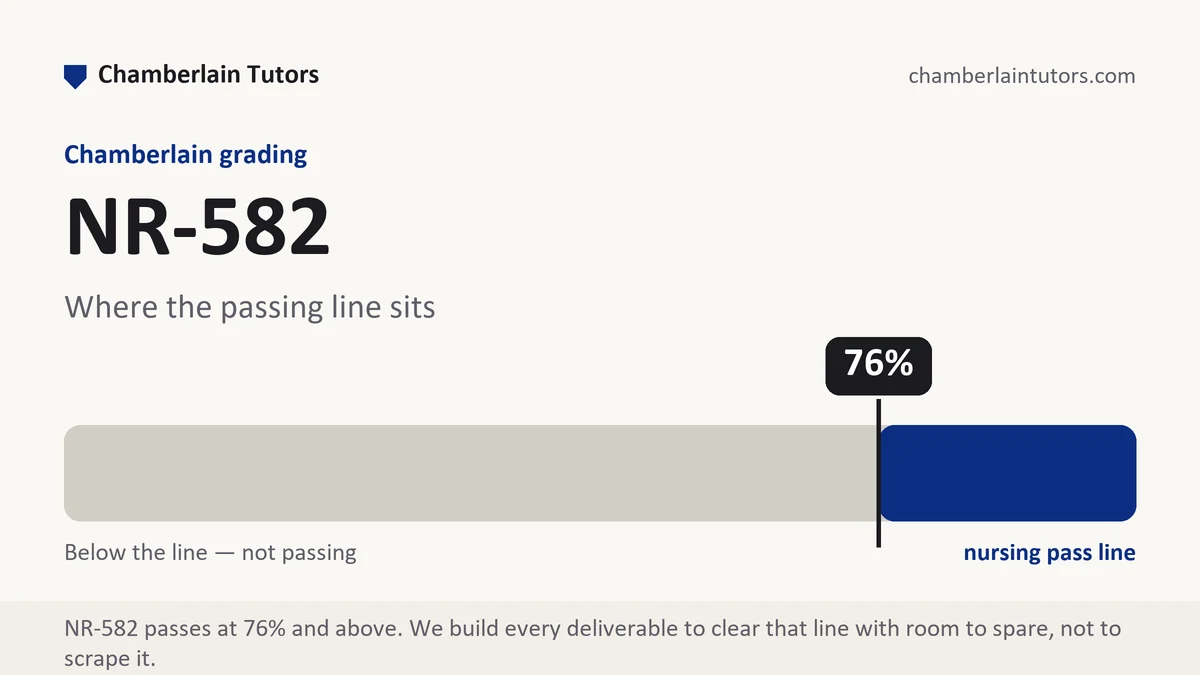
The grading arithmetic is worth knowing early. Chamberlain sets 76 as the passing floor in core nursing courses, and students taking this course inside a nurse practitioner specialty run a scale with no C, where anything under 84 fails. Weekly deliverables in an eight-week session mean an average forms fast and supplementary work cannot rescue it later.
How we help in this course
Send the prompt and rubric from Canvas and tell us which state you practice in. Policy writing without a jurisdiction is guesswork, since scope of practice, licensure and reimbursement rules differ, and a brief that cites the wrong level of government reads as unresearched. We build the draft around a real issue at a real level of the system and keep the recommendation actionable.
Role development work usually needs a different kind of help. There we ask about your actual trajectory, because the sections asking you to assess your own skills only score well when the evidence in them is specific enough to be checkable by you.
Working on the policy piece?
Send the rubric and your state. We will scope the brief and name the decision-maker your argument has to reach.
Read the rubric before the prompt
Policy prompts are usually written loosely on purpose, because the instructor wants to see how you scope a problem. The rubric is the only place where the real requirements are precise. Lift the rows out of Canvas into an empty file and mark each one as either descriptive, analytic or directive. Descriptive rows want the situation reported. Analytic rows want options compared. Directive rows want you to recommend and defend. Most students overfeed the descriptive rows because they are the easiest to fill.
Now do the arithmetic. Assume a 1,800-word cap and four rows weighted 30, 25, 25 and 20 percent. That allocates 540 words, 450, 450 and 360. Write those figures beside the headings. If the descriptive row is the 20 percent one, then 360 words is the entire budget for background, and the 540-word row, usually the analysis or the recommendation, is where the paper actually lives. Students who skip this step routinely spend 800 words on background in a 1,800-word brief and lose two rows to starvation.
Check the budget again at the halfway point rather than at the end. A section that has run 150 words over is still fixable while you are drafting and is a rewrite once the whole thing is built.
The parts of a policy brief
The dominant deliverable here is a brief that asks somebody to do something. Each part has a job, and a grader checks for them individually.
| Part | What it has to deliver | The version that scores low |
|---|---|---|
| The issue, sized | The problem in two sentences, with a number attached so the reader knows its scale. | A topic announced with adjectives instead of magnitude. |
| Who carries the harm | The specific population affected and how the burden falls unevenly across it. | A claim that this affects all patients and nurses. |
| The current rule | What the existing law, regulation or organizational policy actually says now, cited to the level of government that owns it. | A summary of what people believe the rule to be. |
| The gap | The distance between what the rule produces and what the evidence supports, stated so it could be measured. | An assertion that the current approach is inadequate. |
| Options weighed | Two or three realistic alternatives, each with its cost, its feasibility and who would object. | One option presented as the only sensible course. |
| Recommendation | The chosen option in one sentence, then the reasoning that survives the objections you just listed. | A preference expressed with no comparison behind it. |
| The advocacy path | Who has the authority to act, what evidence moves them, and what your first step would be. | A closing paragraph urging nurses to get involved. |
Evidence craft in policy writing
Policy arguments fail on sourcing more often than on reasoning, because the tempting sources are the convenient ones.
Go to the instrument, not the summary. Cite the statute, the regulation or the board rule itself when you describe what the law requires. An advocacy organization's page summarizing a bill is a source for that organization's position, not for the text of the law.
Say which level of government you are in. Licensure and scope sit with states. Payment rules and federal programs sit elsewhere. A paragraph that slides between them without saying so reads as confused even when every individual sentence is true.
Design and sample before any finding. "In a difference-in-differences analysis of 21 states between 2011 and 2019" is the setup that makes the number after it usable. Without it a policy claim is an opinion wearing a citation.
Verbs the evidence can pay for, and rates that can be checked. Observational policy studies support "was associated with" and "coincided with"; only controlled or well-identified designs support "caused" or "reduced". And a rate needs both parts of its meaning attached: "roughly 1 in 7 of the 4,200 rural counties had no practitioner accepting new patients in 2023" is checkable, while "many rural areas lack access" is not.
Passing and strong in a policy course
A passing NR-582 brief is informative. It explains the issue, gets the facts right, and recommends something reasonable. What it does not do is make a decision look difficult, which is the tell that the writer never seriously considered the alternative. Graders read a great many of these, and they all land in the same band.
The gap is usually visible in the verbs. A passing brief says the policy should be expanded, considered or reviewed. A strong one says a named body should amend a named provision by a stated date. Rubric rows that mention feasibility or justification are built to reward the second kind of sentence, and swapping the verbs is often a twenty-minute edit rather than a rewrite.
A strong brief takes the opposition seriously. It states the best argument against its own recommendation in the opponent's own terms, then answers it with evidence rather than with volume. It also puts a name on the lever: a committee, a board, a chief officer, a regulatory comment period. And it accepts a cost. A recommendation that is free for everyone is usually a recommendation that changes nothing, and saying who pays is the fastest way to sound like a leader rather than a student.
Six ways NR-582 papers leak points
- Writing an opinion column. Passion without an instrument, a decision-maker and a cost estimate is not policy analysis.
- Leaving the jurisdiction unnamed. A scope of practice claim with no state attached cannot be verified and will be marked down.
- Choosing an issue the size of a country. Access, cost and burnout are categories. A single rule affecting a definable group is an issue.
- Citing advocacy material for facts. Use it for positions. Use primary research and official documents for numbers.
- Skipping the objection. A brief with no opposition in it reads as if the author has never been in the room where the decision happens.
- Posting a discussion response as a first draft. Posts do not reopen once submitted at Chamberlain, so write it elsewhere and paste the finished version.
Questions NR-582 students ask
How do I pick a policy issue that is small enough to handle in one paper?
Does the bill or regulation I write about have to be real and current?
My draft reads like a research paper instead of a brief. How do I convert it?
Where NR-582 sits in Chamberlain's programs
Open the exact program map for sequence, credit, and option context. The current student schedule and syllabus remain authoritative after transfer evaluation, electives, state rules, and approved plan changes.
The weeks, one by one
Week 1
NR-582 Week 1 opens the course at the edges of an advanced role rather than in the comfortable middle of it, and the written work almost always turns on definition: what an advanced practice role is authorized to do, where that authorization comes from, and how the boundary looks from inside the. Read the full Week 1 manual.
Week 2
Selecting a leadership theory is the graded skill in the second stage of this course, and selection means defending one choice against the alternatives rather than summarizing four models in turn. Read the full Week 2 manual.
Week 3
Conflict is the territory of the third stage in a role development course, and the written work is an analysis of a negotiation rather than a story about a disagreement. Read the full Week 3 manual.
Week 4
Delegation is where role development stops being abstract, because a task handed to someone else carries authority, accountability and risk in different proportions. Read the full Week 4 manual.
Week 5
Systems analysis is the midpoint skill of this course: the ability to look at a recurring problem and describe the structure that keeps producing it rather than the people who were present when it last occurred. Read the full Week 5 manual.
Week 6
Implementation planning is the stage where a diagnosed problem has to become a sequence someone could actually run, and the difference between a strong paper and a weak one is almost entirely specificity: who does what, in what order, with which resources, and how anyone would know within a month. Read the full Week 6 manual.
Week 7
NR-582 Week 7 moves the leadership argument out of the building and into the rules that govern it. Read the full Week 7 manual.
Week 8
NR-582 Week 8 closes the session by asking what the previous seven stages added up to, and the closing work in a role development course is almost always integrative rather than new. Read the full Week 8 manual.