NR-581AT is the foundations course as it runs inside Chamberlain's accelerated MSN advanced nursing leadership options, including the artificial intelligence concentration. Three theory credits, no practicum. Same underpinnings as the standard version, but the graded writing is expected to speak from a leadership vantage point rather than a bedside one, and it arrives faster.
What NR-581AT actually grades
The AT designation tells you where this course sits: an accelerated leadership option rather than a nurse practitioner track. That changes the audience your writing is expected to imagine. In the standard version, application usually lands on a patient encounter. Here it lands on a unit, a policy, a workflow or a group of staff, and the rubric rows reward analysis pitched at that altitude.
What the course grades is the ability to reason from professional standards and established theory to an organizational judgment. A grader is checking whether you can say what a standard requires, notice where practice diverges from it, and propose something that a director could actually authorize. Writing that stops at describing the ideal has answered a different question.
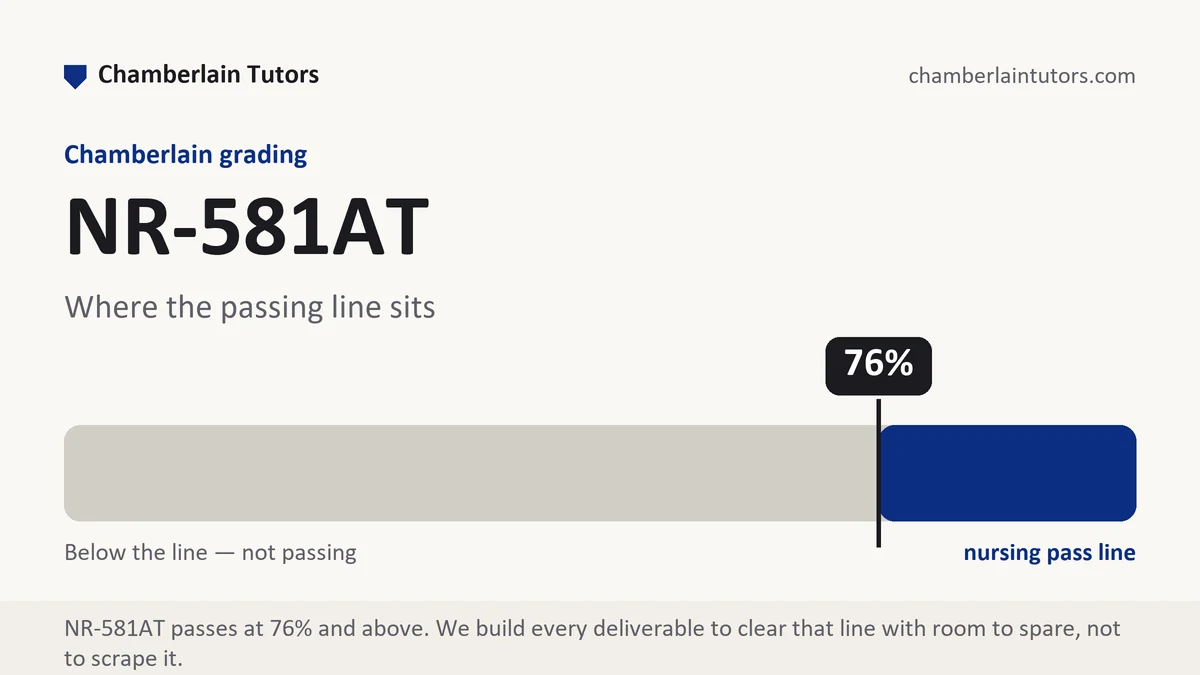
Pace is the second half of the story. Chamberlain runs 16-week semesters split into two eight-week sessions with up to six starts a year, and an accelerated option compresses reading, discussion and written work into that same window. Deliverables land weekly. Chamberlain sets 76 as the passing floor in core nursing courses, and there is no version of that arithmetic where a missed week is a small event in an eight-week course.
How we help in this course
Send the week's prompt and the rubric from Canvas, plus one line about the setting you lead in or hope to lead in. That single detail is what separates a paper that sounds like a textbook from one that sounds like a leader. We build the draft against the rubric rows, keep the leadership altitude consistent, and hand back a walkthrough so the argument is yours to defend.
Students who came into the accelerated option straight from a demanding clinical job usually need the reading triage more than the writing. We are happy to do that first: which sources carry the argument, which are context, and which can be skimmed without cost.
In the accelerated leadership option?
Send the rubric and your setting. We will map the rows to a section plan before you draft.
Read the rubric before the prompt
Accelerated does not mean lighter, it means the same rubric arrives sooner. Work the criterion rows first. Paste them into a blank file, strip each to its instruction verb, and note which rows are asking for exposition and which are asking for judgment. Exposition rows can be drafted from your reading. Judgment rows cannot, and they are almost always worth more.
Convert the weights into words before you write anything. Take a 1,500-word cap with four rows weighted 40, 20, 20 and 20 percent. The 40 percent row earns 600 words and each of the others 300. That single calculation reorders most students' plans, because the 600-word row is usually the one asking you to evaluate or defend, and the reflexive instinct is to spend the first 600 words establishing background instead. Where your guide is silent, assume the title page and the reference list fall outside the counted words.
Keep the targets visible in the margin as you draft. When a section overshoots, the words have to come from somewhere, and the section they usually come from is the one you were most afraid to write.
The moves of a leadership position paper
The dominant deliverable in this course is a position taken and then defended. Each move below has to be visible on the page.
| Move | What it must establish | Where it goes wrong |
|---|---|---|
| The position | A single defensible claim in the opening paragraph, phrased so a reasonable colleague could disagree with it. | An opening that announces a topic instead of taking a side. |
| Grounding in standards | The professional standard or scope statement that makes the claim legitimate, cited by body and edition. | An appeal to what nurses generally believe, with no document behind it. |
| Theoretical frame | One model that organizes the argument, introduced because it explains something, not because it is famous. | Three models named in a row so the reading looks thorough. |
| The organizational reality | What actually happens now, described concretely enough that the gap is measurable. | A general observation that systems are under strain. |
| Ethical stakes | Which principles collide when the gap is closed, and who carries the cost either way. | A paragraph asserting that ethics matter in leadership. |
| The counter-position | The strongest objection to your claim, stated fairly, then answered. | A weak objection built to be knocked down. |
| What you would authorize | The concrete first step, with who does it and what it would cost in time or staffing. | A call for greater awareness and further research. |
Evidence craft for leadership writing
Leadership arguments draw on a wider source pool than clinical ones, which makes source discipline more important rather than less.
Separate the three kinds of authority. A professional standard says what practice should be. A position statement says what an organization advocates. A regulation says what is legally required. Papers that blur these lose points quietly, because a grader can see the claim resting on the wrong kind of document.
Provenance before the finding. No number should reach the reader before its design and sample do. "In a cross-sectional survey of 812 nurse managers across 34 hospitals" is nine seconds of writing that converts an assertion into evidence, and the sentence that omits it stays an assertion.
Match the verb to the design. Survey and cohort data support "was associated with", "reported more often" and "predicted". Controlled trials support "reduced" and "improved". Leadership literature is heavily observational, so causal verbs are the most common overreach in this course.
Every rate carries a denominator and a window. "Turnover among the 96 nurses on the two units ran 21 percent over the calendar year" can be checked. "Turnover was high" cannot, and an organizational argument built on unmeasured claims collapses under the first rubric row that asks for evidence.
Passing and strong in an accelerated foundations course
A passing paper here reads like a well-organized report on the assigned reading. It is accurate, it cites correctly, and it stays at a level of generality where nothing can be wrong because nothing is specific. Under a 76 floor that is survivable, but it produces an average with no cushion in it, and supplementary work cannot rescue a weak weighted average later.
A strong paper commits. It names a real gap in a real setting, takes a position that could be argued against, and carries one framework all the way through instead of touring several. It also handles the objection honestly, which is the move most students skip and the one that most reliably separates the top band. Graders in leadership courses are reading for someone who could stand in front of a committee, and a paper that has never met resistance does not sound like that person.
There is a cheap test for this before you submit. Read only your topic sentences, in order, and ask whether they form an argument or a table of contents. If they read as a list of subjects covered, the paper is a report. If they read as a chain of claims, each one earning the next, the paper is a position, and the rows that ask for evaluation and justification finally have something to score.
Six habits that cost marks in NR-581AT
- Writing at bedside altitude. A single patient story where the row asked for a unit-level analysis answers a question that was not asked.
- Stacking frameworks. Two models named in one paper usually means neither was applied. Choose one and use it hard.
- Recommending awareness. A recommendation that no one could be assigned is not a recommendation. Name the step, the owner and the cost.
- Naming your employer. Describe the setting by size and type. Identifying the organization, the unit or colleagues creates a problem no grade is worth.
- Editing a posted discussion. Posts do not reopen once submitted at Chamberlain, so the draft has to be finished before it is pasted.
- Letting the accelerated pace set the standard. Compression is a scheduling fact, not a grading allowance, and the rubric is the same one the standard version uses.
Questions NR-581AT students ask
I have never held a formal leadership title. What setting do I write about?
How is this different from the version of the course without the AT suffix?
My draft is finished but reads like an essay, not a position paper. What do I change?
Where NR-581AT sits in Chamberlain's programs
Open the exact program map for sequence, credit, and option context. The current student schedule and syllabus remain authoritative after transfer evaluation, electives, state rules, and approved plan changes.
The weeks, one by one
Week 1
You are covering a night shift short two nurses, you have a department meeting at seven and an accelerated session opened on Monday. Read the full Week 1 manual.
Week 2
A competency framework arrives as an attachment on a Friday afternoon and gets filed unread by everyone on the distribution list. Read the full Week 2 manual.
Week 3
At two in the morning a charge nurse asks whether the overnight nurse practitioner can authorize a step-down transfer, and the honest answer is that it depends on a document nobody in the corridor has read. Read the full Week 3 manual.
Week 4
Every improvement project on a busy telemetry floor already runs on a theory. Read the full Week 4 manual.
Week 5
The simulation lab runs a mock rapid response every quarter and the real ones on the floor keep unfolding exactly as they did before. Read the full Week 5 manual.
Week 6
There is one intensive care bed, two patients who could use it, and a phone in your hand. Read the full Week 6 manual.
Week 7
The request form has a five hundred word field and it is due Friday. Read the full Week 7 manual.
Week 8
The final stage of an accelerated session tends to arrive in the same fortnight as annual reviews, a schedule build and somebody's resignation. Read the full Week 8 manual.