NR-572 is the advanced acute care management course built on 100 precepted clinical hours, covering acute and chronic conditions together and adding behavioural health to the picture rather than leaving it to somebody else. The written work is graded on integration: whether a psychiatric or substance-related problem appears in your reasoning as a driver of the medical situation, or arrives as a paragraph at the end because the rubric asked for one.
What NR-572 actually grades
Whether the whole patient survives contact with your plan. Adding behavioural health to acute management changes three concrete things in a write-up, and graders look for all three: the medication list now has interactions across two systems, the assessment now includes risk and decision-making capacity, and the discharge plan now depends on services that may not exist where the patient lives. A paper that manages the acute problem beautifully and mentions the psychiatric history once in the social section has answered a smaller question than the one asked.
The second graded thread is documentation language. Behavioural health writing is scored on precision and on the absence of labelling, so a patient is described by what was observed and reported rather than by an adjective, and a refusal is recorded with the reasoning around it rather than as non-compliance. Students lose points here without knowing why, because the clinical content was correct and the language was not.
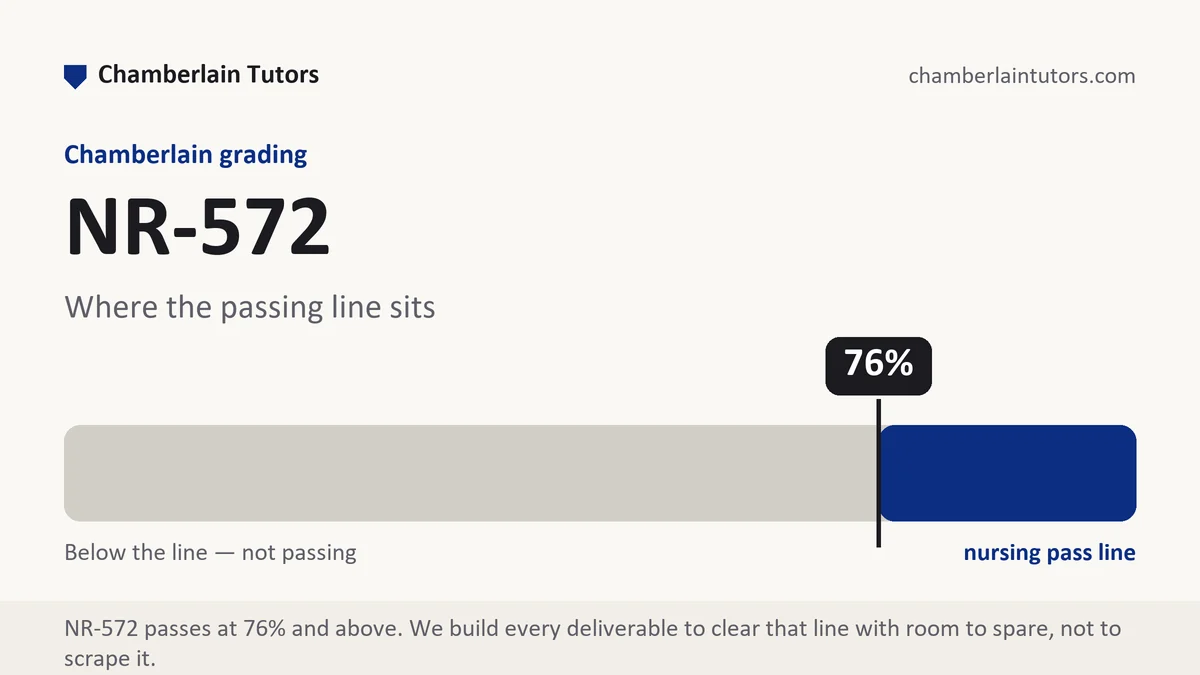
The NP specialty scale has no C, which puts the passing line at 84, and a weighted average that has drifted cannot be repaired by supplementary submissions. In a course with weekly graded pieces around a demanding clinical schedule, the arithmetic is decided in the middle weeks.
How we help in this course
We draft the integrated case write-ups, management papers, behavioural health assessment sections, transitions of care documents, discussion posts and the reflective work attached to your practicum. The drafting habit that matters most in this course is placing the behavioural component in the reasoning rather than in an appendix, so the psychiatric history shows up where it changes the medical decision and the medical picture shows up where it changes the psychiatric one.
Your placement stays untouched by us. We do not work clinical hours, contact preceptors or facilities, complete or sign placement forms, fill hour logs, or sit assessments. The 100 hours here count toward the 625 clinical hours the MSN NP tracks require, and they belong to you. Our work begins when the shift ends and the document has to be written.
In NR-572 right now?
Send the week and the rubric from Canvas. First premium sample free, floor-checked, back in 24 to 48 hours.
Build the section plan from the scoring guide
An integrated case prompt asks for a plan, and the guide asks for four or five separately scored things inside that plan. Open the guide first. Copy the rows into a blank file, reduce each to its verb, assess, integrate, manage, justify, plan, and set them as headings in the guide's order so a grader working down the rows meets each section in turn.
Then divide the word count by weight. Take a 1,600 word case with rows weighted 30, 25, 25 and 20 percent. That works out to roughly 480 words for the integrated assessment, 400 for the management plan, 400 for the evidence and rationale, and 320 for transitions and follow-up. The common failure is spending 600 words on the acute medical problem and 100 on everything behavioural, which leaves the integration row scoring on a paragraph. Writing to a budget forces the uncomfortable ratio, and the uncomfortable ratio is the one the guide priced.
Keep the numbers bracketed beside the headings while you draft. A transitions section that will not reach its share usually means the plan has not named a single service, appointment or contact, and that is a content gap rather than a word shortage.
The shape of an integrated acute and behavioural write-up
Whatever the assignment is called, the graded document usually contains these parts.
| Part | What it has to carry | How the incomplete version looks |
|---|---|---|
| Whole-patient framing | Acute problem, chronic burden and behavioural history in one picture, with baseline function stated. | A medical summary with a psychiatric history listed under past history. |
| Behavioural assessment, documented | Observed behaviour, reported symptoms, risk assessment and capacity, in descriptive language. | An adjective standing in for an assessment. |
| Cross-system interactions | Where psychotropic and medical therapy meet: sedation, QT, serotonergic load, withdrawal timing, renal handling. | Two medication lists that never appear in the same paragraph. |
| Safety and least restriction | The plan for keeping the patient safe using the least restrictive approach that works, with review points. | Restraint or observation named without a review interval or an alternative tried. |
| Team roles, named | Who does what: nursing, pharmacy, social work, psychiatry, and the specific question asked of each. | A multidisciplinary approach will be used. |
| Transitions and access | Where the patient goes, what is booked, what exists locally, and what happens if it does not. | Referral to outpatient services, unnamed and unscheduled. |
| Follow-up decisions | What the next contact decides, and the finding that would bring the patient back sooner. | Follow up as needed. |
Evidence and citation craft across two literatures
This course asks you to cite from acute medicine and behavioural health in one document, and the two fields report evidence differently.
Currency, applied to both sides. Where your guide sets no rule, treat therapeutic recommendations older than five years as needing a stated reason. Behavioural health guidance changes more slowly than acute medicine but its safety information moves quickly, so a monitoring recommendation from an older source is exactly the kind of claim to check before you repeat it.
Screening instruments belong to the population they were validated in. A scale developed in an outpatient psychiatric clinic behaves differently in a medically ill inpatient with delirium in the picture. Say where it was validated and what its result means at this base rate, and where you use a screening result, say explicitly that a positive screen is not a diagnosis.
Verbs matched to the design. Much of the evidence linking behavioural conditions to medical outcomes is observational, so write was associated with longer admission rather than caused longer admission. This matters more here than elsewhere, because causal language about psychiatric conditions slides quickly into blame, which costs points in a course that grades documentation language.
No number without its base and its period. Readmission, self-harm and withdrawal figures are only interpretable with both. Of the 512 admissions screened during the study year, 47 met criteria on the instrument is usable. Nine percent screened positive is not, and in this literature the screening threshold and the period are usually where the disagreement lives.
Where an integrated write-up gains its band
A passing paper in NR-572 manages both problems in the same document. The medical plan is sound, the behavioural history is acknowledged, the tone is respectful. It scores in the middle because the two halves never touch.
The strong version does three things. It makes the behavioural problem load-bearing, showing where it changes a dose, a monitoring interval, a disposition or a teaching plan. It documents capacity as an assessment rather than an assumption, saying what the patient understood, what they could weigh, and what they communicated, which is the paragraph most students skip entirely. And it plans for the system failing, naming what happens when the follow-up appointment is six weeks away and the patient leaves tomorrow. Load-bearing, capacity documented, plan for the gap.
Mistakes that cost points here
- Behavioural health quarantined in one paragraph. If it appears only under social history, the integration row has nothing to score.
- Labels instead of observations. Describe what was said and done. An adjective attached to a patient is a documentation error before it is a style problem.
- Consult without a question. Psychiatry consulted is not a plan. State the question, what you need from the answer, and what you are doing meanwhile.
- Withdrawal risk without a clock. Timing is the whole of withdrawal management, so name the expected window and the monitoring interval rather than the word monitor.
- Capacity asserted. Saying a patient lacks or has capacity without the four elements behind it is the single most common gap in these write-ups.
- Posting before checking. Chamberlain discussion posts do not reopen after submission, so draft the case outside Canvas, read the language once for labelling, then paste.
Questions NR-572 students ask
How do I document capacity properly in a case write-up?
The rubric says integrate behavioural health but my patient's psychiatric history was stable. What do I write?
Can you help with the paperwork my site requires for the practicum?
Where NR-572 sits in Chamberlain's programs
Open the exact program map for sequence, credit, and option context. The current student schedule and syllabus remain authoritative after transfer evaluation, electives, state rules, and approved plan changes.
The weeks, one by one
Week 1
What distinguishes this practicum from a purely acute one is breadth: 100 supervised hours across acute presentations, chronic conditions carried into them, and the behavioral health dimension that travels with both. Read the full Week 1 manual.
Week 2
An acute episode in a person with long-standing disease is a point on a curve, and the written work in this course keeps asking you to draw the curve. Read the full Week 2 manual.
Week 3
Reconciliation is usually taught as a matching exercise and graded, in graduate work, as an argument. Read the full Week 3 manual.
Week 4
The behavioral health line in this course's scope is not a detour into psychiatry; it is a demand that your acute management writing account for the mental and cognitive dimension that travels with almost every complex admission. Read the full Week 4 manual.
Week 5
Risk writing is where confident clinicians produce their vaguest prose. Read the full Week 5 manual.
Week 6
Complex patients do not experience one handoff; they experience a chain of them, and the interesting analysis is about what survives the whole chain rather than any single link. Read the full Week 6 manual.
Week 7
Late in a management practicum the written work usually stops accepting reasonable-sounding plans and starts demanding sourced ones. Read the full Week 7 manual.
Week 8
A portfolio is a curated argument, and curation is the graded act. Read the full Week 8 manual.