NR-569 is the acute care practicum where differential diagnosis becomes the graded skill: 125 precepted clinical hours with critically ill adults, carried by a small theory component that turns into written case work. The hours happen at your site. The grade happens in documents where a list of possible diagnoses has to become a ranked argument, with the features that separate one candidate from the next written down.
What NR-569 actually grades
Ranking, and the reasons behind it. Any student can produce five diagnoses that could explain chest discomfort. The rubric rows are looking for something else: which one you think it is, what in the history and examination moved it to the top, what would have to be true for the second candidate to overtake it, and which dangerous possibility you are actively excluding rather than mentioning in passing.
The written work also grades economy of data. In an acute setting the record is enormous and a differential is built by selection, so a write-up that transcribes everything available scores lower than one that presents ten findings and explains why those ten. The clearest signal of a strong case in this course is a problem representation sentence: one line that compresses the patient into age band, time course, key features and context, and that a reader could act on before seeing anything else.
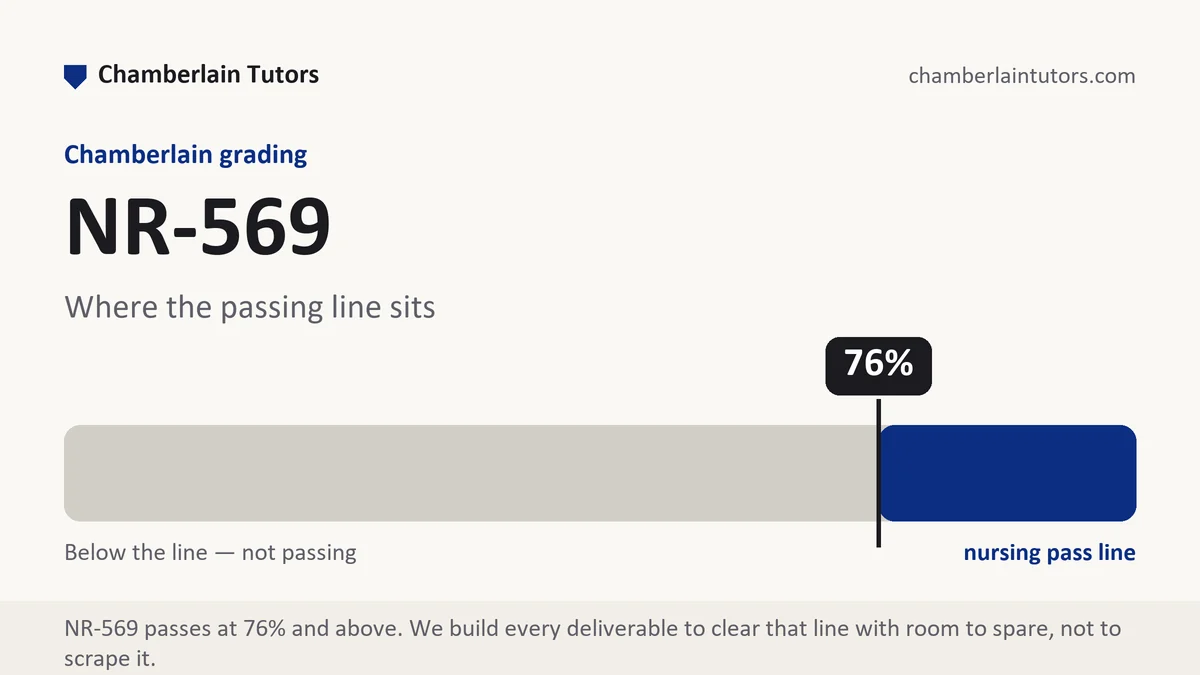
These specialty courses run on a scale with no C, so 84 is the last passing number, and a weighted average cannot be repaired by supplementary work later. Practicum courses feel forgiving because so much time goes into the hours, which is exactly why the writing gets left until the end of a long clinical day and lands in the middle band.
How we help in this course
We build the written side: diagnostic reasoning papers, case analyses, note-format write-ups, discussion posts and the reflective pieces attached to your case work. What our drafts add is a visible argument, so the differential arrives ranked, each candidate carries the discriminating feature that supports or weakens it, and the diagnostic plan is written to separate the list rather than to confirm what you already believe.
The clinical side stays entirely yours. We do not complete clinical hours, contact your preceptor or site, sign or complete placement paperwork, fill in an hour log, or sit any assessment or check-off. The 125 hours in this course belong to the 625 clinical hours your MSN NP track carries, and every one of them has to be worked by you. What we do is the writing that surrounds them.
In NR-569 right now?
Send the week and the rubric from Canvas. First premium sample free, floor-checked, back in 24 to 48 hours.
Start with the scoring guide, not the case
Case prompts in a practicum course are short because the case is supposed to supply the content. That makes the guide the only place where the assignment is fully written down. Copy the rows into a blank file, reduce each to its working verb, present, prioritize, differentiate, justify, plan, and use those as headings in the order the guide lists them so the grader reads down the page in the same sequence they score.
Then set the word budget row by row. Say the write-up is capped at 1,000 words with four rows weighted 40, 25, 20 and 15 percent. That gives about 400 words to the differential and its justification, 250 to the history and examination data supporting it, 200 to the diagnostic plan, and 150 to the working diagnosis and next steps. Almost every student inverts the first two, because reporting the findings feels like the work and choosing between diagnoses feels like a risk. Four hundred words of ranking is a lot of ranking, and writing to that number is what forces the comparisons the rubric is paying for.
Keep the budget visible beside each heading. If the differential section will not fill, you have candidates you cannot distinguish, and the honest repair is to cut the list to the ones you can argue about.
The shape of a diagnostic reasoning write-up
Under whatever name the assignment carries, the graded object usually assembles from these pieces.
| Piece | What it has to do | How the weak version reads |
|---|---|---|
| Problem representation | One sentence: age band, time course, defining features, relevant context, in clinical language. | A paragraph of narrative history with no compression. |
| Selected findings | The positives and the deliberate negatives that move the differential, and nothing that does not. | The entire review of systems reproduced without comment. |
| Ranked differential | Three to five candidates in order, each with the feature that argues for and against it. | An alphabetical list of everything that causes the symptom. |
| Must-not-miss set | The dangerous possibilities named, with what you are doing about each right now. | Mentioned once in the introduction and never resolved. |
| Diagnostics that discriminate | Each study chosen because its result would move the ranking, with the expected finding stated. | A panel ordered because it is what everyone orders. |
| Working diagnosis | The commitment, with the reasoning that closed the gap to the runner-up. | A diagnosis appearing for the first time in the last line. |
| Uncertainty and reassessment | What remains unknown and what finding would change your mind, by when. | Further evaluation is warranted. |
Evidence and citation craft in diagnostic writing
Diagnostic claims are probability claims, and graduate scoring guides in this subject notice how you handle them.
Currency with a reason attached. Where your guide is silent, treat diagnostic criteria and imaging recommendations older than five years as needing justification in the sentence. Classic descriptions of a physical sign survive that test easily. Threshold values, criteria sets and imaging pathways do not, and an outdated cutoff quoted as current is a content error a grader can spot in seconds.
Test characteristics belong to a population. Sensitivity and specificity are not fixed properties of a test, they shift with the spectrum of disease in the group studied. Say where the number came from before you use it: measured in emergency department patients presenting with the symptom, or in a referred population already suspected of having it. That one clause is often the difference between an evidence row in the top band and one in the middle.
Verbs the design can support. Diagnostic accuracy studies support was more frequent among and predicted; they do not support caused. When you write that a finding raises the probability of a diagnosis, that is the correct register, and it is also what your preceptor would say aloud.
Rates carry a base and a period. Prevalence drives interpretation, so any figure you use needs its denominator and its window. Among the 1,410 adults presenting with the complaint over one year, 46 had the condition is usable in an argument about pretest probability. Three percent had it is a decoration.
Where a strong differential separates itself
A passing case in NR-569 has a correct differential in it. Everything plausible appears, the working diagnosis turns out to be right, and no single sentence is wrong. It scores in the middle because nothing in it is decided; a list is not a diagnosis.
Strong cases do three things. They commit early, putting the working diagnosis and the reason at the top rather than saving it for a reveal, because clinical documents are read by people who may stop after the first paragraph. They write the discriminator explicitly, naming the finding that separates the leading candidate from the runner-up instead of leaving the reader to infer it. And they state the falsifier: the result, the time course or the response to treatment that would send them back to the second diagnosis. Commitment, discriminator, falsifier, in that order.
Mistakes that cost points here
- The exhaustive differential. Twelve candidates with no ranking scores lower than four with reasons, because the row is about prioritization rather than recall.
- Tests that confirm rather than separate. If the result would not change your ranking whichever way it came back, the study does not belong in the plan.
- Anchoring on the triage label. Where the write-up accepts the presenting diagnosis and reasons forward from it, the whole differential inherits the assumption.
- No must-not-miss line. In acute care, omitting the dangerous alternative is the error that graders treat most seriously, even when the working diagnosis is right.
- Patient identifiers in the write-up. No initials, room numbers, admission dates, facility names or preceptor names. Age band and clinical picture only.
- Writing the post after a 12 hour shift. Posts do not reopen once submitted at Chamberlain, so draft the case in a document before the shift and paste it when it holds up.
Questions NR-569 students ask
How many diagnoses should a differential contain?
Can you write my case if the patient is real and from my clinical day?
My reasoning is fine out loud but my write-ups score in the low eighties. What changes that?
Where NR-569 sits in Chamberlain's programs
Open the exact program map for sequence, credit, and option context. The current student schedule and syllabus remain authoritative after transfer evaluation, electives, state rules, and approved plan changes.
The weeks, one by one
Week 1
NR-569 Week 1 is where 125 precepted hours in acute care stop being a schedule and become a written plan for how you intend to reason. Read the full Week 1 manual.
Week 2
Early in NR-569 the written work turns to the sentence that governs everything after it: the problem representation, the one-line summary that converts a pile of findings into a diagnostic question. Read the full Week 2 manual.
Week 3
Around this point NR-569 moves from summarizing a presentation to generating and ranking what could be causing it. Read the full Week 3 manual.
Week 4
Midway through NR-569 the written work turns to justification of testing: not what you ordered, but what each test was supposed to change. Read the full Week 4 manual.
Week 5
By the midpoint of NR-569 the pieces get assembled: a full written case analysis of an encounter you genuinely worked through, de-identified, built in a note-style structure but graded as an argument. Read the full Week 5 manual.
Week 6
Late in NR-569 the writing turns to the hardest thing an acute care clinician has to put on a page: what is still unknown, how the plan accounts for it, and when the question gets asked again. Read the full Week 6 manual.
Week 7
The late stages of NR-569 usually raise the scholarly bar: the same diagnostic reasoning, now argued against published evidence rather than clinical impression. Read the full Week 7 manual.
Week 8
The closing stage of NR-569 asks you to evaluate your own diagnostic development across the practicum and to assemble the written work into something that shows it. Read the full Week 8 manual.