NR-567 is the three-credit pharmacology course for the acute care track, covering drug management of critically ill adults and older adults alongside the legal and ethical side of prescribing. The written work asks a harder question than which drug: it asks what the drug is supposed to achieve in a patient whose kidneys, liver, protein binding and volume of distribution have all moved, how you would know it worked, and when you would stop.
What NR-567 actually grades
Reasoning under altered handling. In a stable outpatient, standard dosing is usually defensible without explanation. In a patient with shock, third spacing, acute kidney injury or new renal replacement therapy, the same dose needs an argument, and the rubric rows are built to see whether you can make it. That means writing about clearance and distribution as things happening to this patient today rather than as definitions recalled from a table.
The second graded thread is the endpoint. Acute care prescribing is titrated, so a plan that names an agent without naming the parameter you will watch, the value you are aiming at and the interval at which you will look reads as incomplete no matter how correct the drug choice was. The third thread is the legal and ethical one, and it is not decoration: scope of practice, controlled substance handling, documentation standards and consent in a patient who may not be able to give it are graded content in this course.
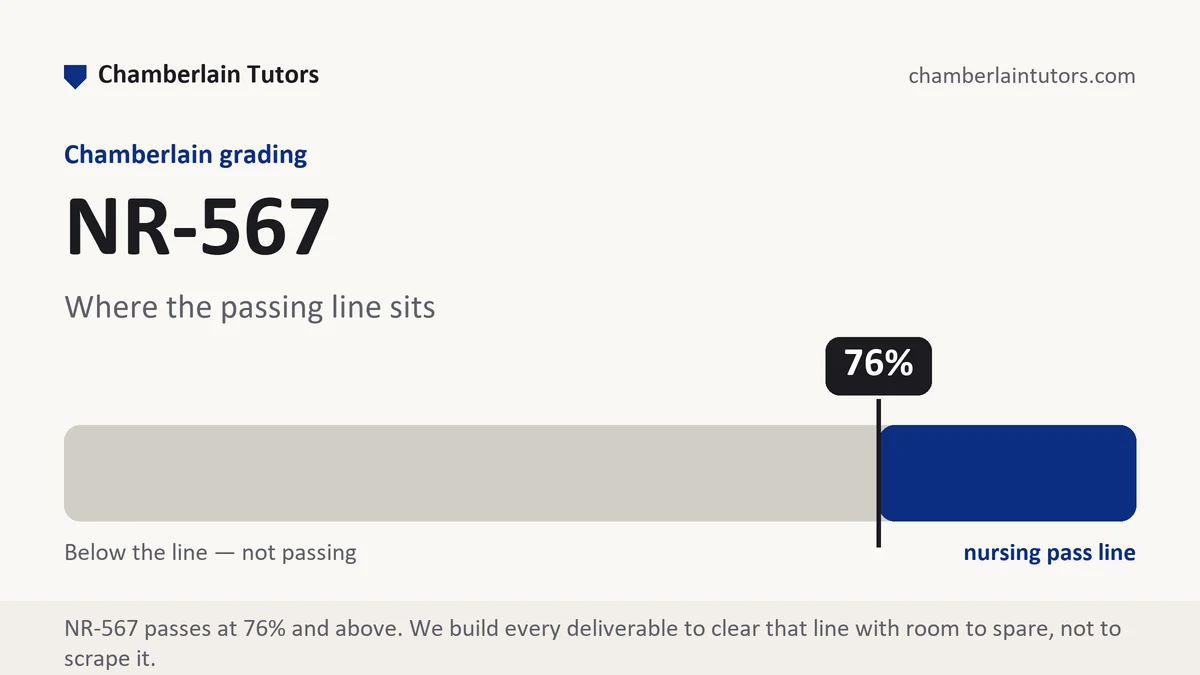
Grading in the NP specialty courses runs on a scale with no C, so below 84 fails, and supplementary work cannot lift a weighted average that is already short. A pharmacology course delivers its verdict in weekly graded pieces, which means the recovery window is narrow by design.
How we help in this course
We draft the pharmacotherapy case write-ups, the drug class analyses, the comparison papers, the prescribing scenarios with their legal and ethical sections, and the weekly posts. Every draft is built so the reasoning is visible: the goal stated before the agent, the dose justified from the patient's organ function, and the monitoring plan written as numbers a nurse could act on at the bedside.
Two boundaries never move. We do not complete clinical hours, contact a preceptor or a site, sign or fill placement documents, or sit any assessment for you. And we do not invent doses for a real patient you are caring for. Course work is model writing built to a scoring guide, which is a different object from a prescription.
In NR-567 right now?
Send the week and the rubric from Canvas. First premium sample free, floor-checked, back in 24 to 48 hours.
Read the rubric before the prompt
Pharmacology prompts tend to be short, which fools students into thinking the assignment is small. The scoring guide is where the real specification lives. Copy the rows out of Canvas, strip each to its verb, explain, select, justify, monitor, evaluate, and turn those verbs into headings in the guide's own order so the grader never has to search for the row they are scoring.
Then price them, because weight is a depth instruction. Take a 1,200 word case write-up with four rows weighted 40, 30, 20 and 10 percent. That is roughly 480 words for the pharmacologic rationale, 360 for agent selection and dosing, 240 for the monitoring and evaluation plan, and 120 for the legal and ethical component. Students routinely invert the first two, spending most of the paper defending the choice of drug and then explaining its mechanism in three sentences, which is the wrong way round in a course whose heaviest row is usually mechanism applied to this patient. References and any drug table sit outside the count unless the guide states otherwise.
Write the budget beside each heading before you draft a word. When the monitoring section will not reach its share, it is almost always because no endpoint was chosen, and the fix is one sentence upstream rather than padding at the end.
The shape of an acute care pharmacotherapy write-up
Under whatever name your assignment carries, the graded object usually contains these parts.
| Part | What it has to establish | The thin version |
|---|---|---|
| Patient state, pharmacologically | Renal and hepatic function, volume status, albumin, and any replacement therapy, because each changes handling. | A demographic sentence with no organ function in it. |
| Therapeutic goal | The endpoint being bought, in a number or an observable state, within a stated period. | To treat the infection, with nothing to measure. |
| Agent selection | Why this class for this problem in this patient, and the alternative you rejected with the reason. | The guideline recommends it, with no patient in the sentence. |
| Dose, route, titration | The starting dose defended from clearance, the route defended from absorption, and how the dose moves. | A textbook dose transplanted into a patient whose clearance has changed. |
| Monitoring parameters | What is watched, at what threshold, how often, and what result triggers a change. | Monitor closely for adverse effects. |
| Interactions and de-escalation | The interactions that matter on this list, plus the stop or narrow rule and its trigger. | An interaction table with no statement of what you would do. |
| Legal and ethical frame | Scope, prescriptive authority limits, documentation, and consent where capacity is impaired. | A closing paragraph on the importance of ethics. |
Evidence and citation craft in acute pharmacology
Drug writing is where sloppy sourcing becomes a patient safety habit, so this course grades it harder than most.
Guidelines age faster than mechanisms. Where your guide sets no rule, five years is the working horizon for therapeutic recommendations, and anything older needs its reason in the sentence. Receptor pharmacology from an older text is fine to cite. A target level, a first-line agent or a duration of therapy from an older cycle is a factual claim that may have been superseded, and graders in this course check.
Say who was studied before you say what happened. A trial in ambulatory adults with preserved renal function is not evidence for a patient on continuous renal replacement, and the sentence should show you know it. Naming design and population first also gives you the honest bridge: the evidence comes from one population, your patient sits outside it, and here is the pharmacokinetic reason you are extrapolating anyway.
Verbs the design can pay for. Observational drug safety work supports was associated with and occurred more often among. Controlled trials support reduced and prevented. Adverse-effect literature in critical care is heavily observational because randomizing harm is not possible, so the associative verb is usually the correct one, and using it is a sign of training rather than hedging.
Rates need a denominator and a window. Acute care numbers are meaningless without both. Bleeding occurred in 14 of the 610 patients treated during the first 30 days is a usable figure. A 2 percent bleeding rate is not, because neither the base nor the period is visible, and in a dosing argument both change the decision.
The three sentences that lift a drug plan
A passing write-up in NR-567 picks the right drug. It is accurate, guideline-consistent and generic, and it would fit any patient carrying that diagnosis. On a scale where 84 is the last passing number, generic accuracy is a thin place to stand.
Strong write-ups add three things. They name the endpoint and the clock, so the plan can be judged at a specific hour rather than admired in general. They carry a stop rule, because knowing when to narrow, de-escalate or discontinue is the part of acute prescribing that separates a practitioner from a protocol. And they handle the patient's other drugs as a system, saying which interaction actually matters at this dose in this organ state instead of listing every theoretical one. Endpoint, stop rule, interaction that matters: three sentences most middle-band papers never write.
Mistakes that cost points here
- Dosing without organ function. If the paragraph does not say what clearance you assumed, the dose is a guess with a decimal point.
- Monitor closely. Two words that score nothing. Name the parameter, the threshold, the frequency and the action.
- Quoting a guideline as though it were the patient. Recommendations are population-level. The graded skill is applying one to a patient the guideline did not study.
- Mechanism reduced to a label. Naming a receptor is not explaining an effect. Get from binding to physiological consequence to the finding you expect at the bedside.
- No exit. A plan with no de-escalation trigger, no duration and no reassessment point reads as a start rather than a plan.
- Drafting the post inside Canvas. Discussion posts cannot be edited once submitted at Chamberlain, so build it in a document, check every dose in it, then paste.
Questions NR-567 students ask
How much pharmacokinetics does a case write-up actually need?
What does the legal and ethical section want beyond a definition?
Can you help with the drug calculations as well as the writing?
Where NR-567 sits in Chamberlain's programs
Open the exact program map for sequence, credit, and option context. The current student schedule and syllabus remain authoritative after transfer evaluation, electives, state rules, and approved plan changes.
The weeks, one by one
Week 1
An opening stage in an acute care pharmacology course is where you stop treating pharmacokinetics as vocabulary and start treating it as a description of what is happening to one unstable patient right now. Read the full Week 1 manual.
Week 2
If the opening stage of this course asked what the body does to the drug, the second stage asks the reverse question: what the drug does to a body that has been aging for eight decades and is now acutely ill. Read the full Week 2 manual.
Week 3
Cardiovascular support is the first place in this course where a drug plan has to be written as a moving target rather than a decision. Read the full Week 3 manual.
Week 4
Anti-infective writing in an acute care course is graded on two decisions most students only make one of. Read the full Week 4 manual.
Week 5
Comfort management is where pharmacology, regulation and ethics arrive in the same paragraph, which is why this territory tends to be graded harder than its point value suggests. Read the full Week 5 manual.
Week 6
Agents that modify hemostasis are the clearest example in this course of a drug decision that has to be written as a two-sided calculation. Read the full Week 6 manual.
Week 7
The catalog for this course names legal and ethical prescribing issues alongside the pharmacology, which means the regulatory material is graded content rather than a closing courtesy. Read the full Week 7 manual.
Week 8
A closing stage in an acute care pharmacology course usually asks for the whole regimen at once, in a patient who is now leaving the setting the plan was built for. Read the full Week 8 manual.