NR-562 Leadership and Management within Complex Healthcare Systems is a three-credit graduate course on leading change at the level of the system rather than the individual, so that care stays safe, high in quality and centred on the person receiving it. The written work is graded on one discipline above all: describing a problem in terms of structures, incentives and handoffs, then proposing a change that acts on those structures instead of asking people to try harder.
What NR-562 actually grades
Whether you can think in systems, and whether you can prove it on paper. A system-level analysis has a signature: it names the parts, shows what flows between them, and identifies the point where the flow breaks. An individual-level analysis has a different signature, and graders spot it in one sentence, because it uses staff behaviour as the explanation. If a paper concludes that nurses need to communicate better, it has described a symptom of a system and called it a cause.
The second thing graded is sequencing. Leadership assignments ask for a change plan, and a change plan is not a wish list with a model bolted on the front. It is an order of operations: what happens first, who has to agree before step two, what data is collected during, and what the team does when the first attempt underperforms. Rubric rows about implementation and evaluation are usually where a strong analysis quietly loses its lead, because students spend their words diagnosing and run out before they schedule anything.
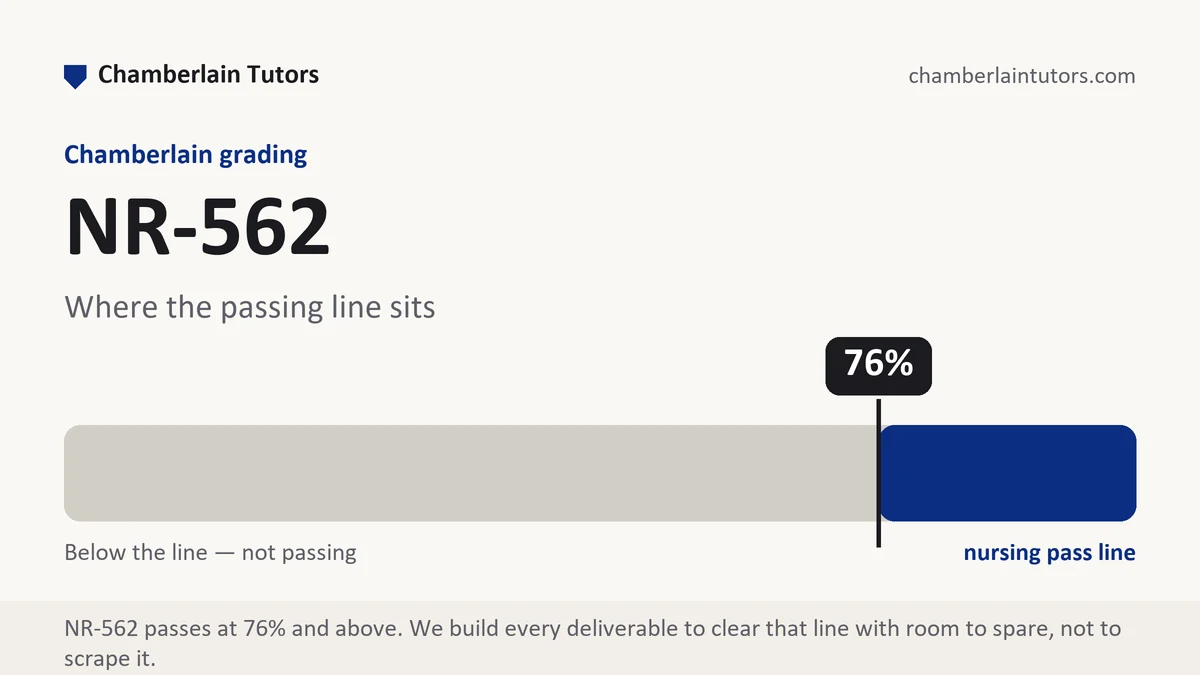
Core nursing courses carry a 76 percent floor, and the arithmetic in a three-credit graduate course is unforgiving in a familiar way. A weighted average built from steady middling submissions cannot be repaired late, because supplementary work does not rescue it. The margin has to come from the graded pieces themselves, which in this course means the sections most students treat as formalities.
How we help in this course
We draft the systems analyses, change plans, leadership self-assessments, conflict and staffing scenarios, executive briefs and the discussion posts that surround them. The pattern we hold to is simple: every claim about people gets rewritten as a claim about the conditions those people work in, which is the move that shifts a paper from the middle band into the top one.
Where a course asks you to write about your own unit, our drafts leave your observations as yours. We do not invent staffing numbers, incident counts or manager quotes for a facility we have never seen, and we mark every place where a real figure from your setting belongs so the finished document is defensible if anyone asks where a number came from.
In NR-562 right now?
Send the week and the rubric from Canvas. First premium sample free, floor-checked, back in 24 to 48 hours.
Read the rubric before the prompt
Leadership prompts read like invitations to reflect, and reflection is the cheapest thing in the scoring guide. Open the guide first and read the rows as a specification. Reduce each row to its verb, analyze, apply, justify, plan, evaluate, and write those as your headings in the guide's order. If one row asks you to apply a leadership theory and another asks you to evaluate outcomes, those are two sections doing two different jobs, and merging them costs points in both.
Then give each row a word allowance. Take a 1,750 word paper with five rows weighted 30, 20, 20, 20 and 10 percent. The arithmetic gives about 525 words to the system analysis, 350 each to the leadership approach, the change strategy and the evaluation plan, and 175 to the final row, often written communication or scholarly format. Compare that with the way these papers usually arrive: 900 words of problem description, 400 words defining a leadership theory out of a textbook, and 150 words of evaluation. The paper is not short on effort. It is spent in rows that were priced at half of what they consumed.
Leave the budget in the draft as bracketed numbers beside each heading. When the evaluation section will not reach 350 words, the honest reading is that the change strategy has no measurable target yet, and the repair belongs upstream rather than in more sentences at the end.
The shape of a systems leadership analysis
Most graded documents in this course assemble from these parts, whatever the assignment is titled.
| Part | What it has to demonstrate | The version that reads as undergraduate |
|---|---|---|
| The system, drawn | The units, roles and handoffs involved, and what moves between them: patients, information, authority, money. | A description of one department with no boundary and no interface. |
| Problem at system level | Where the flow breaks, stated so no individual is the explanation. | Staff are not following the policy, offered as a root cause. |
| Contributing conditions | Workload, layout, scheduling, incentives, information gaps, each tied to the break point. | A generic list of barriers copied from a review article. |
| Leadership approach, applied | An approach chosen for a reason, with its actual behaviours mapped to this situation. | A definition of transformational leadership followed by no transformation. |
| Change strategy, sequenced | Steps in order, with owners, timing and the decision points between them. | Implement, monitor, sustain, listed as three words. |
| Resistance, anticipated | Which group loses time or control, and what they are offered in exchange. | Some staff may resist change, followed by a call for buy-in. |
| Evaluation and governance | Metrics with sources and review intervals, and who reviews them after you leave. | Success will be measured by improved outcomes. |
Evidence and citation craft in leadership writing
Leadership literature is easy to quote and easy to overstate, and graduate rubrics in this subject reward students who handle it carefully.
Currency, with a carve-out for theory. Where your guide sets no rule, treat empirical claims older than five years as needing a reason inside the sentence. Foundational change and leadership models are cited as models and stay legitimate for decades. Turnover figures, cost estimates and workforce projections are not models, and an old one quoted as current is a factual error rather than a stylistic one.
Design and setting before the claim. Much of this evidence is cross-sectional survey work in one hospital system. Say so. A sentence that opens with a survey of 412 staff nurses across three acute hospitals gives the reader the weight to assign, and it protects the paragraph from a grader asking whether the finding transfers to your setting.
Match the verb to the design. Survey correlations support was associated with and predicted. They do not support improved or caused, however strongly the abstract phrases it. Leadership writing is the place where causal verbs get borrowed most often, because the sentence is trying to sound decisive about a decision you want to make.
Every rate carries its base and its window. Turnover, vacancy, incident and satisfaction figures are all fractions. Twenty-two of the 96 nurses employed on the unit left during the twelve months to March is usable evidence. A 23 percent turnover rate is a headline, and in a systems paper the denominator is the part that tells your reader whether the problem is worth a project.
Where a systems analysis earns its extra points
A passing paper here names a theory, describes a problem accurately and proposes something sensible. It reads as informed and it commits to nothing, which is why it lands where accurate work without a position always lands.
The strong version differs in three visible ways. It chooses one lever and defends the choice against the alternatives it rejected, because a change plan that could have been anything reads as a plan for nothing. It states the tradeoff out loud, naming the department whose work increases and what it gains in return, since every real system change moves effort somewhere. And it plans for the change failing: what data would show it, at what review point, and what the team does then. A paper that can describe its own failure mode is a paper written by somebody who has run something.
Mistakes that cost points here
- Diagnosing individuals. The moment a paper explains a system failure by naming a behaviour, the systems row is capped. Rewrite the behaviour as an output of the conditions that produce it.
- A theory that never gets used. Defining a leadership model and then writing a plan that ignores its steps scores worse than not naming a model at all, because the rubric row asks for application.
- Buy-in as a strategy. Buy-in is a result. What you plan is the sequence of conversations, the pilot scale, the data shown and the concession offered.
- Metrics with no source. Name the system the number comes from and the interval at which somebody pulls it. A metric nobody can retrieve is a sentence, not a measure.
- Person-centred care asserted rather than designed. If the plan does not change what a patient experiences or decides, saying it is person-centred does not make it so.
- Treating the discussion board as a draft space. Posts at Chamberlain cannot be edited after submission, so compose the systems argument outside Canvas and paste it once it holds together.
Questions NR-562 students ask
How do I write about my own workplace without breaching confidentiality?
Which leadership theory should I pick for the assignment?
My change plans keep getting marked as unrealistic. What fixes that?
Where NR-562 sits in Chamberlain's programs
Open the exact program map for sequence, credit, and option context. The current student schedule and syllabus remain authoritative after transfer evaluation, electives, state rules, and approved plan changes.
The weeks, one by one
Week 1
NR-562 opens by asking you to see a workplace as a system rather than as a set of people trying hard. Read the full Week 1 manual.
Week 2
The second stage of NR-562 usually moves from the system to the leader inside it, and the graded distinction is between defining a leadership approach and applying one. Read the full Week 2 manual.
Week 3
Around the third stage NR-562 usually turns to safety, and the graded discipline is analyzing an adverse event or near miss without stopping at the person closest to the patient. Read the full Week 3 manual.
Week 4
Midway through NR-562 the course usually asks what quality and person-centeredness actually mean when they have to be measured. Read the full Week 4 manual.
Week 5
The fifth stage of NR-562 usually puts you on the management side of the role, where a case for resources has to be made in the language the person holding the budget uses. Read the full Week 5 manual.
Week 6
The sixth stage of NR-562 usually takes up conflict, and the graded move is diagnosing it before resolving it. Read the full Week 6 manual.
Week 7
The seventh stage of NR-562 usually asks for a change plan, and a change plan is an order of operations rather than a list of good ideas with a model attached. Read the full Week 7 manual.
Week 8
The closing stage of NR-562 asks for two things at once: an evaluation plan rigorous enough to tell whether a change actually worked, and a document compressed enough that a decision-maker reads it. Read the full Week 8 manual.