NR-561 Addressing Global Health Disparities is a three-credit graduate course on health inequities between and inside populations, how globalization moves disease, and what a nurse acting as a change agent can actually do about either. It is graded entirely in writing, and the writing lives or dies on one skill: quantifying a gap honestly, then explaining the mechanism that produces it rather than the sympathy it provokes.
What NR-561 actually grades
Two things, repeatedly. First, whether you can measure a disparity in a way somebody could check: which two populations, which indicator, which year, which source, and what the gap is in units rather than adjectives. Second, whether you can trace that gap to determinants that operate at a level a nurse or a policy can reach, and stop before the analysis becomes a list of everything wrong in the world.
The trap in a global health course is that the subject is emotionally easy and analytically hard. Any student can produce a moving paragraph about a preventable death. The rubric rows are not paying for that paragraph. They are paying for the sentence that says the under-five mortality rate in one country was measured at a stated value per 1,000 live births in a stated year against a stated comparator, and for the paragraph after it that explains which parts of that number come from water and sanitation, which from access to skilled birth attendance, and which from the way the data was collected in the first place.
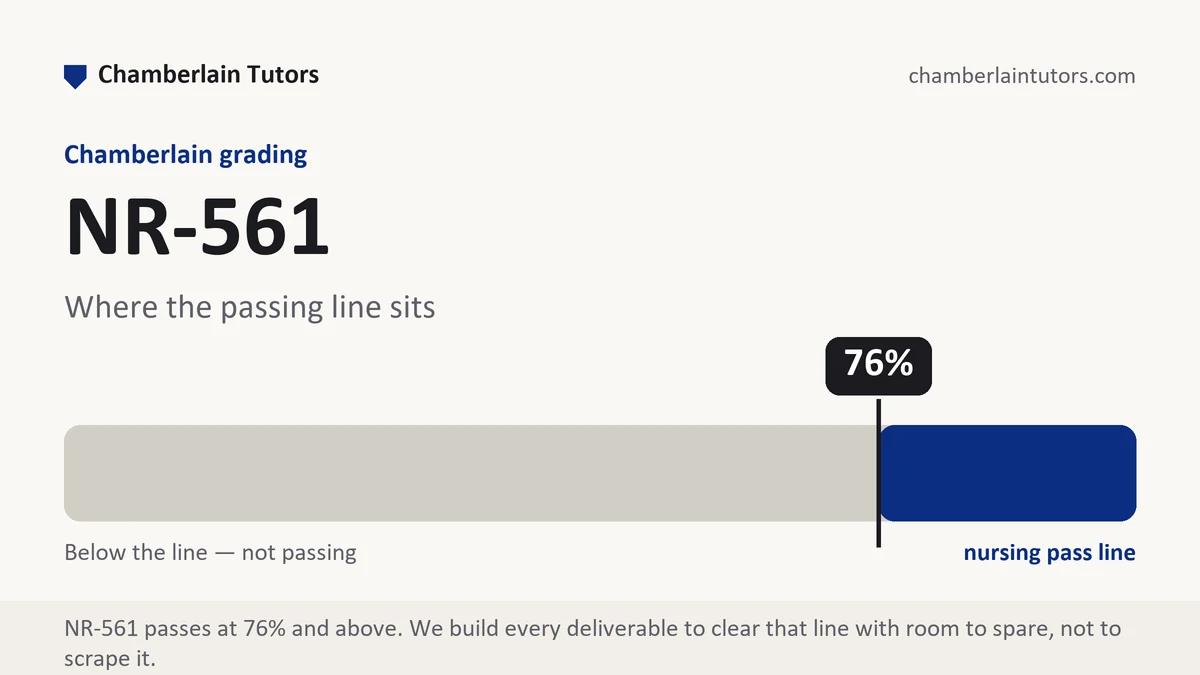
The 76 percent floor applies in core nursing coursework and it punishes the same weakness this subject invites: an assignment full of true statements that never becomes an argument. Weekly deliverables here are usually discussion posts plus a longer analysis, and posts cannot be edited once submitted at Chamberlain, so a half-formed comparison stays on the board where the grader reads it.
How we help in this course
We draft the analyses, the country or population comparisons, the determinant sections, the policy responses and the change-agent proposals, and we build them with the sources named in the sentence so you can check every figure before it goes anywhere near Canvas. Where the assignment asks for a stance, the draft argues one rather than surveying five politely.
We also do the unglamorous part, which is checking that the two numbers you are comparing are actually comparable: same indicator definition, same age standardization, same reporting year where possible, and a stated note when they are not. Most of the points lost in this course are lost inside comparisons that quietly do not hold.
In NR-561 right now?
Send the week and the rubric from Canvas. First premium sample free, floor-checked, back in 24 to 48 hours.
Read the rubric before the prompt
Global health prompts are broad on purpose, and breadth is where grades go to die. The scoring guide is the narrow version of the same assignment, so open it first. Copy the criterion rows into a blank file, cut each down to its working verb, describe, quantify, analyze, evaluate, propose, and use those as headings in the guide's own sequence. If a row asks you to evaluate an existing response, that is a section, not a sentence inside your conclusion.
Now price the rows. Suppose the analysis is capped at 2,000 words and the guide carries five rows weighted 25, 25, 20, 20 and 10 percent. That gives roughly 500 words to the disparity described and quantified, 500 to the determinants, 400 to the analysis of existing responses, 400 to your proposal for nursing action, and 200 to whatever the last row asks, often organization or scholarly voice. The reason to do this arithmetic before writing is that the determinant section is the one students compress. It is harder than describing the problem and less satisfying than proposing a solution, so it ends up at 200 words in a paper where the guide priced it at 500.
Write each target next to its heading and strike it when the section lands. A determinant section that will not fill its budget usually means you chose a disparity you cannot explain, and the cheapest fix is to narrow the population until the explanation becomes possible.
The shape of a global health disparity analysis
Whatever the assignment is called, the graded object usually contains these pieces, and a grader will look for each of them in this order.
| Piece | What has to be provable in it | What the middle band writes instead |
|---|---|---|
| Population and place, bounded | Exactly who is being compared to whom, at what geographic or social level. | Africa, or the developing world, treated as one population. |
| The gap, in units | One indicator, both values, the year, the source, and the size of the difference. | Rates are much higher, with no number and no comparator. |
| Determinants, ranked | The structural, environmental and health-system causes, with the largest contributor argued rather than assumed. | A list of every social determinant, none connected to this indicator. |
| Globalization mechanism | How movement of people, goods, capital or pathogens changes this specific risk. | A general observation that the world is interconnected. |
| Existing responses, appraised | What agencies, governments or programs already do here, and what the evaluation evidence says about it. | A description of an organization's mission statement. |
| Nursing action, scoped | What a nurse in a named role could change, at what level, with what limits. | Nurses should advocate, addressed to nobody in particular. |
| Ethical frame | Whose voice decides priorities, and what the proposal risks imposing. | A closing sentence about cultural sensitivity. |
Evidence and citation craft with global data
Global health data is the most quotable and least comparable material a nursing student handles, so the craft rules matter more here than in almost any other course.
Vintage matters twice. A source published this year may report a survey collected six years ago, which is the year that belongs in your sentence. Where your guide sets no limit, treat data past five years as needing a stated reason, and always cite the collection year rather than the publication year when the two differ. Reviewers in this subject check that.
Design and sample before the finding. Household surveys, surveillance systems and modeled estimates are three different animals wearing the same decimal point. Say which one produced your number. A modeled estimate for a country with weak vital registration is still usable, but only if the sentence admits it is modeled.
Verbs the design can support. Nearly all comparative global health evidence is observational, so write that improved sanitation coverage was associated with lower diarrheal mortality across the studied districts, and keep reduced or prevented for controlled trials. Causal verbs attached to ecological comparisons are the single most common evidence error in this course.
A rate is a fraction, so show both parts and the window. Per 1,000 live births, per 100,000 population, per person-year: the denominator is what makes cross-country comparison legitimate, and the period is what makes it honest. Two countries reporting different age structures also need age-standardized figures or a sentence acknowledging they are not standardized, because a young population and an old one cannot be compared on crude rates without comment.
Why an accurate paper still lands mid-band
A passing paper in NR-561 describes. It picks a real disparity, cites real agencies, lists real determinants, and closes by saying nurses have a role to play. It is accurate and it is unmemorable, which on a graduate scale reads as effort without analysis.
Strong papers do three things differently. They argue a ranking, saying which determinant carries most of this particular gap and why the evidence supports that order, which is a claim somebody could contest. They separate the disparity from the measurement of the disparity, noting where weak registration or differing case definitions inflate or hide the gap. And they scope the nursing proposal to a level a nurse occupies, a clinic protocol, a training cascade, a data practice, a piece of local advocacy, rather than addressing a recommendation to national governments who are not reading it.
Mistakes that cost points here
- Comparing a country to a global average. Averages hide the comparison that matters. Choose a neighbouring country, a regional value, or the same country's other quintile, and say why that comparator is fair.
- Treating a continent or an income band as a population. Inequity inside a country is often larger than the gap between countries, and the rubric rewards the student who noticed.
- Rescue framing. Writing as though expertise arrives from outside reads badly in a course built on the global nurse as partner. Name who already works there and what your proposal adds to them.
- Mismatched years in one comparison. A 2019 value against a 2013 value is not a gap, it is a gap plus six years of change, and a grader who checks will treat the whole section as unreliable.
- Determinants listed rather than connected. Every determinant you raise has to be tied to the specific indicator you quantified, or it is background reading in the middle of an argument.
- Posting a first draft to the board. Discussion posts at Chamberlain are permanent once submitted. Draft the comparison elsewhere, check both figures and their years, then paste.
Questions NR-561 students ask
How do I choose a topic narrow enough to analyze but big enough to matter?
Can I use data from an advocacy organization or does it have to be from an agency?
What does the change agent section actually want from me?
Where NR-561 sits in Chamberlain's programs
Open the exact program map for sequence, credit, and option context. The current student schedule and syllabus remain authoritative after transfer evaluation, electives, state rules, and approved plan changes.
The weeks, one by one
Week 1
NR-561 opens by making you define a health disparity precisely enough that somebody else could check it. Read the full Week 1 manual.
Week 2
Once a gap is measured, the second stage of NR-561 asks why it exists, and the graded skill is ranking rather than listing. Read the full Week 2 manual.
Week 3
The third stage of NR-561 turns from why a gap exists to how the wider world moves risk into and out of the population you chose. Read the full Week 3 manual.
Week 4
Midway through NR-561 the course usually turns on its own evidence and asks where global health figures actually come from. Read the full Week 4 manual.
Week 5
By the fifth stage NR-561 usually stops asking what is wrong and starts asking what has been tried. Read the full Week 5 manual.
Week 6
The sixth stage of NR-561 typically narrows onto the populations that sit at the sharp end of every gap the session has measured: people who move, people who are displaced, people whose legal status limits what care they can reach, and people whose culture or language the system was not built for. Read the full Week 6 manual.
Week 7
The seventh stage of NR-561 usually asks the uncomfortable question underneath the whole subject: who decides, who benefits and who bears the cost when one health system acts on another population's problem. Read the full Week 7 manual.
Week 8
The final stage of NR-561 asks you to stop analyzing and start proposing: a specific action, at a scale a nurse could actually influence, aimed at the reachable link you identified earlier in the session, with a way to tell whether it worked. Read the full Week 8 manual.