NR-559 Research Methods and Evidence-Based Practice carries three theory credits with a practicum value of zero, so nothing here is clinical hours. It covers research design, data collection, analysis, dissemination and research ethics, applied to evidence-based practice. The written work asks for one thing students consistently avoid: judgment about a published study. Summarizing an article is the default response and it is the reliable way to sit in the low eighties all session.
What NR-559 actually grades
Appraisal rather than description. A critique rubric asks whether the design answers the question, whether the sample supports the conclusion, whether the measurement was adequate and whether the authors claimed more than their data allows. Every one of those is a verdict with a reason attached. Students write a paragraph per article section, faithfully reporting what the authors did, and never say whether it was any good, which leaves most rows unearned no matter how accurate the summary.
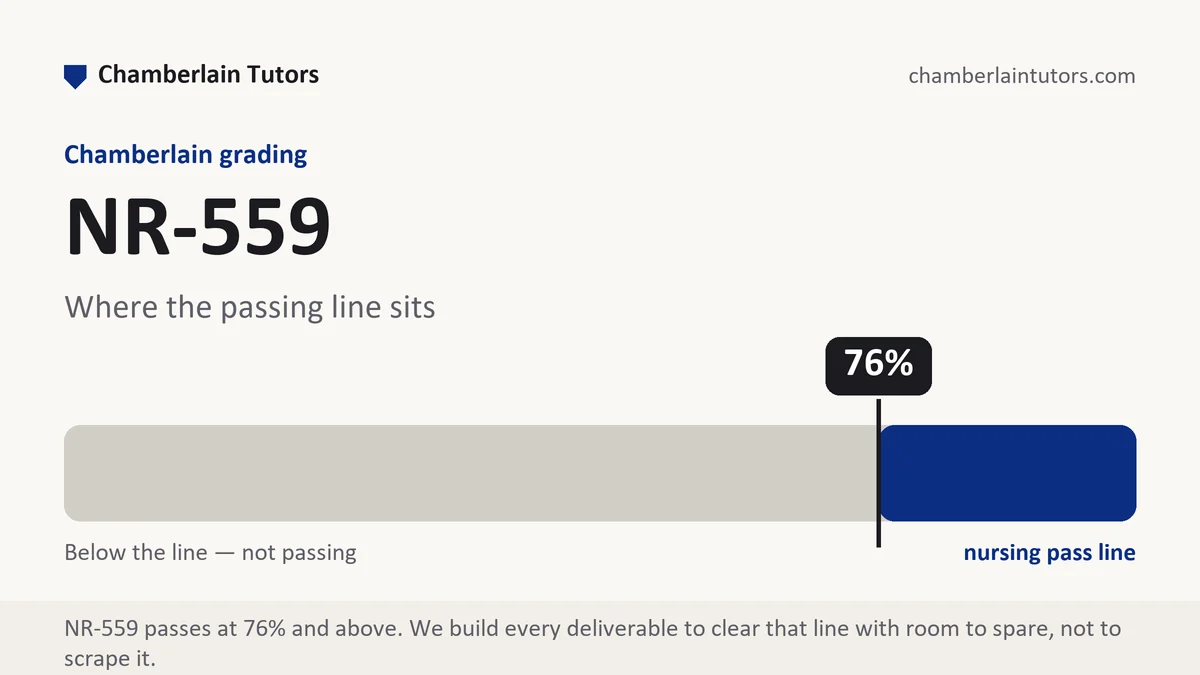
The second axis is the line between research and practice change. Evidence-based practice takes existing findings and applies them locally; research produces new generalizable knowledge and carries formal ethical review before data collection. Papers that blur the two make claims neither activity can support. Chamberlain's 76 percent floor for core nursing courses applies here, and the accelerated route runs eight-week sessions with weekly deliverables, so appraisal habits have to arrive in the first two weeks. Supplementary work cannot lift a weighted average that has already formed.
How we help in this course
We draft article critiques, literature matrices written up as prose, PICOT development papers, evidence-based practice change proposals, research ethics analyses, dissemination plans, discussion responses and the session project. Our drafts state a verdict in the first sentence of every appraisal section, then support it, which is the structure these rubrics are built to reward.
We work from articles you supply or from published literature you can access, and from the scenario your prompt sets. We do not collect data, recruit participants, distribute surveys, or submit anything to a review board. Where your section involves a proposal for a real setting, the proposal stays a written exercise unless your institution approves it through its own process.
In NR-559 right now?
Send the article or the practice question plus the rubric from Canvas. First premium sample free, floor-checked, back in 24 to 48 hours.
Read the rubric before the prompt
Critique guides usually reveal their intent in one word. Copy the criterion rows into a blank file and reduce each to its verb: describe, appraise, evaluate, synthesize, apply. Then count how many rows use a judgment verb. If four of five do, then a paper made of accurate descriptions has answered one row out of five, which is exactly how a well-written summary ends up scoring in the seventies.
Now convert weights into words. Take a 2,400 word critique with four rows at 30, 30, 30 and 10 percent. Multiply through and you get 720 words for each of the first three rows and 240 for the last. Three equal heavy rows is a deliberate instruction: the guide wants appraisal, synthesis and application treated as three full sections rather than one long summary with two short reflections attached. At 720 words each, a section cannot survive on restatement, which is the point. Title page, references and any evidence table sit outside the count unless your guide says otherwise.
Write the four numbers beside your headings and audit them once the first appraisal section is finished. If it reads as a description of what the authors did, rewrite the opening sentence of each paragraph as a claim and let the description follow it.
The shape of an article critique
Whatever your section calls the deliverable, it takes one study apart and says what it is worth. These are the parts a grader looks for.
| Part | What it must deliver | What a weak version does |
|---|---|---|
| The question, in its parts | Population, intervention or exposure, comparison, outcome and time frame, drawn from the article. | Repeats the article title as the question. |
| Design, matched to question | The design named, and a verdict on whether it can answer what was asked. | Names the design and moves on. |
| Sample | How many enrolled, how they were recruited, who was excluded, how many remained at analysis. | Reports the starting number only. |
| Measurement | The instruments used and what the authors reported about their reliability and validity. | Accepts any named scale as adequate. |
| Analysis | What was tested, what was reported, and what a reader would expect that is missing. | Repeats the p-values in the abstract. |
| Findings inside their limits | The result with its effect size and interval, restated no more strongly than the data allows. | Adopts the authors' most confident sentence. |
| Threats | Attrition, blinding, confounding, setting, funding source and conflicts, each with its likely direction. | A generic paragraph noting limitations exist. |
| Applicability | Whether your population resembles the sample closely enough to act on the finding. | Assumes results transfer to any setting. |
| Practice recommendation | What should change, or an explicit statement that the evidence does not yet support change. | Recommends further research and stops. |
Evidence and citation craft at this level
This is the course where citation habits are the subject rather than the packaging, so four of them matter more than usual.
Currency, judged against the question rather than the calendar. Where your guide sets no rule, five years is the working line for clinical evidence. Methodological sources are the deliberate exception, and a landmark trial cited as the origin of a practice is legitimate at any age provided you say why you are reaching back for it. What fails is a recent-looking reference list in which the actual clinical claims rest on studies from a decade ago.
Design and sample before the finding, without exception. No result should reach your reader before its provenance. Twelve words of setup, such as in a randomized trial of 214 adults followed for six months, does more to establish your credibility than any adjective. In a critique the setup is also the argument, because the reader is being told in advance how much the number can carry.
Verbs the design can pay for. Randomized and controlled evidence buys caused and reduced. Cohort and case-control work buys was associated with and predicted. Qualitative work buys participants described and themes included, and never buys a claim about frequency in a population. Borrowing a stronger verb than the design supports is the error this course exists to eliminate, and graders mark it as a reasoning failure rather than a wording slip.
Denominators, intervals and windows. Report the number analyzed rather than the number enrolled, since attrition is where many studies quietly weaken. Give effect sizes with their confidence intervals rather than p-values alone, because significance says a difference is unlikely to be chance while the interval says how large it might be. And convert relative claims into absolute ones where you can: a 40 percent relative reduction on an outcome that affects 5 in 1,000 moves 2 people per 1,000, and only one of those two sentences tells a practitioner anything.
What separates a passing critique from a strong one
A passing critique reports the study accurately, notes that the sample was small, and concludes that more research is needed. It scores in the high seventies to low eighties because it is a summary with two hedges attached, and the appraisal rows have nothing to grade.
Strong critiques do three things. They open each section with the verdict and use the description as evidence for it, so the reader always knows what is being argued. They say which direction a flaw pushes the result, since a limitation with a direction is analysis and a limitation without one is a disclaimer: attrition concentrated in the sicker arm inflates the apparent benefit, and saying so is worth more than a page of cautious language. And they answer the applicability question honestly, comparing the study population with the one in front of them on age, acuity, setting and baseline risk, then stating what would have to be true before the finding could be used locally. A critique that recommends against changing practice, with reasons, is a strong critique.
Mistakes that cost points here
- Summary wearing a critique heading. If every paragraph could have been written by the authors, no appraisal row has been earned.
- Praising the writing. Clear organization and thorough literature review are not findings about validity. Judge the design, the sample and the analysis.
- The p-value as the result. Significance is not size. Report the effect and its interval, then say whether the size matters clinically.
- Relative risk with no absolute figures. Percentage reductions sound decisive and can represent a handful of events. Give both.
- Ignoring who dropped out. Attrition and its pattern change what a trial shows, and most student critiques never mention it.
- Treating a practice change as research. Applying published evidence locally is not the same activity as generating new knowledge, and the ethical obligations differ. Say which one you are proposing.
Questions NR-559 students ask
How do I write a PICOT question that actually works?
I do not follow the statistics in my article. Can I still critique it?
How many articles do I need and what kind counts?
Where NR-559 sits in Chamberlain's programs
Open the exact program map for sequence, credit, and option context. The current student schedule and syllabus remain authoritative after transfer evaluation, electives, state rules, and approved plan changes.
The weeks, one by one
Week 1
A chart audit is where most NR-559 papers should start, because an audit produces the one thing an opening research paper cannot fake: a countable gap between what the record says happened and what the standard says should have happened. Read the full Week 1 manual.
Week 2
A search is a documented procedure, not a shopping trip, and the second stage of a research methods course is where students learn to write it down the way an auditor would want it: which databases, which terms, which limits, how many hits, how many survived screening, and why the rest did not. Read the full Week 2 manual.
Week 3
Two documents can report the same intervention and support entirely different claims, and NR-559 Week 3 is the stage where you learn to tell which is which from the methods section rather than the title. Read the full Week 3 manual.
Week 4
Hand hygiene observation is the clearest teaching case in nursing measurement: the same behaviour produces one number when a known auditor stands in the corridor with a clipboard and a very different number when nobody knows the audit is running. Read the full Week 4 manual.
Week 5
A monthly quality report showing a documentation compliance rate climbing from the sixties to the eighties looks like proof until you notice the denominator changed halfway through, and NR-559 Week 5 exists to build that reflex. Read the full Week 5 manual.
Week 6
Most ethical failures in nursing scholarship do not look like scandals; they look like a chart review that quietly grew into a study, a spreadsheet of extracted data sitting on a personal drive, and a plan to publish that nobody submitted for review before the first record was opened. Read the full Week 6 manual.
Week 7
Bundle compliance audits are full of interventions that worked in the literature and died on a unit, and the reason is almost never the evidence. Read the full Week 7 manual.
Week 8
Findings that never leave a folder change nothing, and the closing stage of a research methods course is about the last hundred yards: writing the same evidence for a shared governance council, for a nursing journal and for the staff who will carry the change, without letting any of the three. Read the full Week 8 manual.