NR-556 The Nurse Leader and Health Policy carries three theory credits and applies leadership skill to advocating for health equity across complex organizational systems and communities. The word doing the work is advocate. This course is not about analyzing a policy; it is about moving one, which means the graded writing is judged on whether a specific person would be persuaded to do a specific thing.
What NR-556 actually grades
The ask. Every advocacy deliverable is scored, directly or indirectly, on whether it contains a sentence naming who should do what by when. Students write eloquently about an issue and never issue an instruction, and the persuasion rows then have nothing to evaluate. An ask is testable: a reader can say yes, no, or not my authority, and all three responses tell you the ask was real.
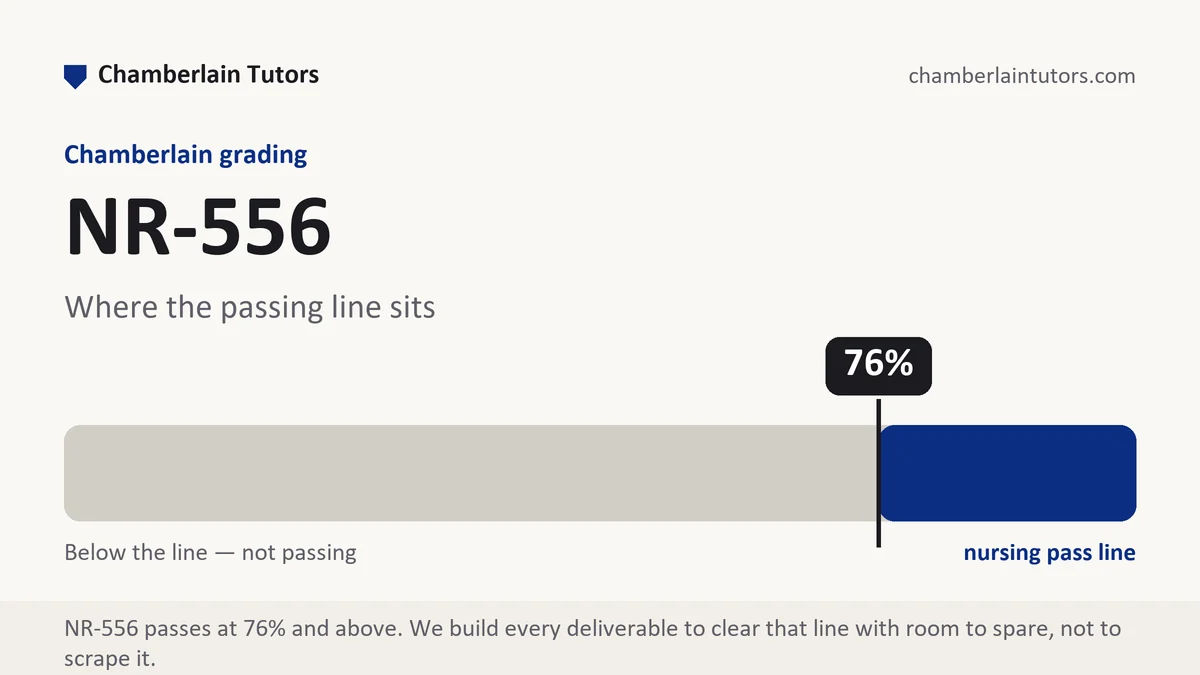
The second axis is strategy over sentiment. Leadership advocacy is scored on target selection, message discipline, coalition and timing, which are strategic choices rather than expressions of conviction. Chamberlain's 76 percent floor for core nursing courses applies, and the eight-week session gives you very little room to find the register: weekly deliverables mean the average is largely set by the middle of the term, and supplementary work cannot repair a weighted average that has already settled.
How we help in this course
We draft advocacy plans, position papers, letters and testimony written as coursework, coalition and opposition analyses, communication strategies, discussion responses and the session project. Our drafts start from the ask and work backwards, so the evidence you cite is the evidence your target actually needs rather than everything you found.
We do not send anything anywhere. No letter, comment, petition, testimony or email leaves our desk to a legislator, agency, board or employer, and we do not contact anyone in your name. You decide what, if anything, gets sent, and you send it yourself.
In NR-556 right now?
Send the issue, the decision maker you are targeting and the rubric from Canvas. First premium sample free, floor-checked, back in 24 to 48 hours.
Read the rubric before the prompt
Advocacy guides hide their heaviest row in the middle, which catches people who allocate effort by section order. Copy the criterion rows into a blank file and reduce each to its verb: identify, analyze, develop, persuade, evaluate. Then find the largest weight before you write a word, because in this course it is frequently the strategy row rather than the issue row, and the issue is what students want to write about.
Now price them. Take a 1,600 word plan with four rows weighted 20, 30, 35 and 15 percent. Multiplying gives 320 words for the first row, 480 for the second, 560 for the third and 240 for the fourth. Notice where the money is: the third row, not the first. If that row is your strategy and message plan, then more than a third of the document belongs to decisions about targeting and framing, and the issue description gets 320 words whether or not you find it interesting. Title page and references sit outside the count unless your guide says otherwise.
Write the four numbers beside your headings and check them once the issue section is done. Overrunning the first row is the classic failure here, because the issue is the part you already know.
The shape of an advocacy plan
Whatever your section calls it, the dominant deliverable here is a plan to change somebody's mind. These are the parts that carry marks.
| Part | What it must contain | What a weak version does |
|---|---|---|
| The ask | One sentence: who, does what, by when, at what cost. | Calls for greater attention to an issue. |
| Target with authority | The individual or body that can grant the ask, named, with their current position on it. | Addresses stakeholders collectively. |
| Message and three supports | One sentence a busy person would repeat, backed by an outcome figure, a cost figure and one human account. | Six arguments of equal weight and no ranking. |
| Messenger and standing | Why a nurse is the credible voice here, stated in one line without a resume. | Leaves credibility implied. |
| Coalition | Two or three allies with their own reasons for wanting the same outcome. | A list of professional organizations assumed to agree. |
| Opposition, taken seriously | Who loses if you win, their strongest argument, and your honest response to it. | Describes opponents as uninformed. |
| Channel and timing | The meeting, comment period, board agenda or session calendar you are aiming at. | Proposes a campaign with no date attached. |
| Progress measures | Meetings secured, language adopted, votes moved, a decision made by a stated date. | Counts flyers, posts and attendance. |
Evidence and citation craft at this level
Advocacy writing is where weak sourcing does the most damage, because the reader is looking for a reason to say no. Four habits protect you.
Currency, including the target's current position. Where your guide sets no rule, five years is the line for evidence, and for anything about your target the requirement is now: which committee they sit on, how they voted last time, what they have said publicly this session. Advocacy built on an outdated position statement collapses in one sentence from a staffer, and graders in this course know it.
Say what kind of source each claim comes from. Advocacy documents mix three source types that must not be blurred: analytic evidence about effects, official records such as votes and rules, and position statements expressing what an organization wants. Introduce each with its type, as in a professional body's position statement, so the reader can weigh it correctly. Presenting a position as though it were a finding is the fastest way to lose credibility with an informed reader.
Verbs the evidence can pay for. Advocacy tempts overstatement more than any other genre. Where the evidence is observational, write was associated with fewer avoidable admissions rather than will prevent admissions, and where you are projecting, mark it as a projection with its assumptions in view. One overstated verb hands the opposition their whole rebuttal, and graders treat it as an analysis failure rather than a stylistic one.
Denominator and window on every figure you put in front of a decision maker. Write 3,700 of the 41,000 residents in the district went without a primary care visit in the last year rather than thousands lack access. Decision makers think in constituencies and budget cycles, so give them the affected count, the population it comes from and the period, and give the cost figure the same treatment.
What separates a passing plan from a strong one
A passing plan describes a genuine inequity, cites the literature, and proposes education, awareness and collaboration with stakeholders. It scores in the high seventies to low eighties because nobody in it is ever asked to do anything, and therefore nothing in it can succeed or fail.
Strong plans do three things. They put a single ask in the first paragraph and repeat it in the last, so the document has an obvious purpose and a reader can act without rereading. They engage the opposition at full strength, stating the best version of the objection and answering it, which is what separates leadership writing from campaigning and reliably lifts the analysis row. And they define success in terms a calendar can hold: a hearing date, an agenda item, specific language in a draft, a vote, rather than sentiment shifted. Add a sentence saying what you would do if the target says no, and the plan reads as strategy rather than hope.
Mistakes that cost points here
- An ask with no verb. Support for this issue is not an action. Write the vote, the signature, the budget line, the rule change.
- Wrong target. Asking someone without jurisdiction is an analysis error, and it usually means the level of the problem was never settled.
- Story without numbers, or numbers without a story. The first is dismissed as anecdote, the second is forgotten. Lead with the figure and anchor it with one short account.
- Opposition dismissed. If nobody in your plan has a reasonable objection, you have not identified who pays for your proposal.
- Activity counted as progress. Posts, flyers and attendance measure effort. Measure decisions.
- Posting a first attempt to the board. Discussion responses do not reopen once submitted at Chamberlain, so an overstated claim stays visible all week. Draft it elsewhere, check the verbs, then paste.
Questions NR-556 students ask
The assignment mentions contacting a real official. Do I have to send anything?
How do I write an ask that sounds professional rather than demanding?
Can I identify my employer when I write as a nurse leader?
Where NR-556 sits in Chamberlain's programs
Open the exact program map for sequence, credit, and option context. The current student schedule and syllabus remain authoritative after transfer evaluation, electives, state rules, and approved plan changes.
The weeks, one by one
Week 1
A director of nursing at a 120-bed skilled nursing facility gets asked to sit on a county aging services coalition and immediately discovers the two kinds of authority she holds are not the same size. Read the full Week 1 manual.
Week 2
Most changes a nurse leader wants are decided in rooms that are not on any org chart. Read the full Week 2 manual.
Week 3
Nobody advocates alone at the level this course is aiming at, and the partners who matter most are usually the ones a hospital-trained leader has never sat with: an area agency on aging that already runs a volunteer driver roster, a tenant association in a building where four of your discharged. Read the full Week 3 manual.
Week 4
The hard problems in leadership are not the ones where somebody is behaving badly. Read the full Week 4 manual.
Week 5
The same proposal has to survive three rooms, and it needs three documents. Read the full Week 5 manual.
Week 6
Asking for a transitional care position is not asking for money; it is asking someone to move money from something else. Read the full Week 6 manual.
Week 7
A policy that has been approved has not yet happened. Read the full Week 7 manual.
Week 8
Changes carried by one determined person end when that person takes another job, and every experienced nurse in long-term care has watched it happen: a transfer process that worked beautifully for fourteen months, then a director leaves and within a quarter the old form is back in the fax tray. Read the full Week 8 manual.