NR-549 Foundational Concepts for Professional Nursing Practice carries three theory credits with a practicum value of zero, so nothing here is clinical hours. It covers professional standards and the historical, theoretical and ethical underpinnings of professional nursing practice, and it sits in the Accelerated RN to MSN leadership options. The graded writing is the first place your work is read as graduate work, and the shift students underestimate is that description now has to become argument.
What NR-549 actually grades
Application, in a course that looks like it is about definitions. Rubric rows ask you to use a theory, apply a standard, examine an ethical situation. The verb is always transitive and it always has an object, which means a paper that explains a theory beautifully and never puts a practice situation underneath it has answered a question nobody asked. The most reliable way to lose a band here is to write about nursing rather than about a nurse doing something.
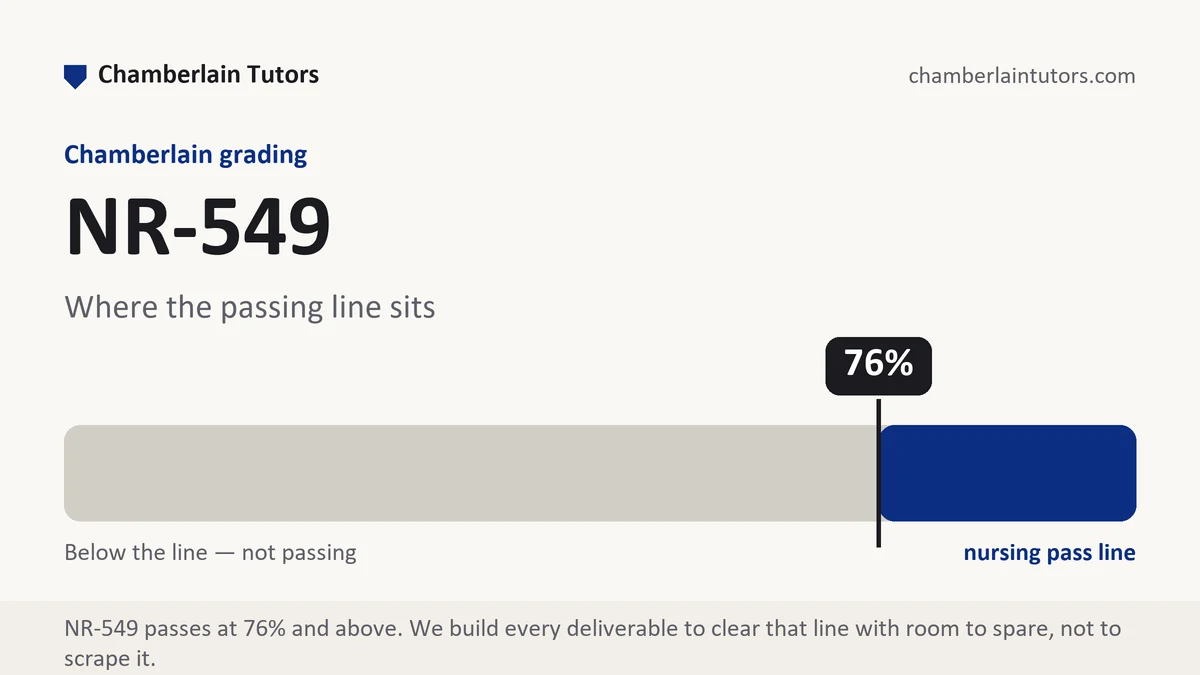
The second axis is register. Graduate writing in a foundations course is expected to sound like someone building a case, not someone honoring a profession. Chamberlain's 76 percent floor for core nursing courses applies here, and because the accelerated route moves through eight-week sessions with weekly deliverables, an early week spent finding your voice is already on the average by the time the feedback lands. Supplementary work cannot rescue a weak weighted average, so the habits have to arrive in week one.
How we help in this course
We draft theory application papers, professional standards analyses, ethical case write-ups, historical influence papers, philosophy of practice statements, discussion responses and the session project. The drafts model the move students find hardest at this level: putting a real situation on the page first, then letting the framework explain it.
Since the practicum value is zero, nothing in this course involves hours, sites or preceptors, and nothing in our service touches those anywhere. We write from your prompt, your situation and published sources you can cite.
In NR-549 right now?
Send the prompt and the rubric from Canvas, plus the situation you want used. First premium sample free, floor-checked, back in 24 to 48 hours.
Read the rubric before the prompt
Foundations prompts are broad on purpose and the guide is where the actual assignment lives. Copy the criterion rows into an empty file and reduce each to its verb: describe, apply, analyze, evaluate, reflect. Keep the printed order, turn the verbs into headings, and notice which rows are transitive. Apply a theory to a practice situation is two objects, and a section that supplies only the first has half-answered its heaviest row.
Then convert the weights into a word budget. Take a 1,000 word paper with four rows at 25, 25, 30 and 20 percent. Multiply through and you get 250 words for the first row, 250 for the second, 300 for the third and 200 for the fourth. At this length the arithmetic is brutal in a useful way: a 200 word introduction about the importance of nursing theory has consumed the entire fourth row before the paper starts. Short assignments punish preamble more than long ones do, and foundations assignments are frequently short. Title page and references sit outside the count unless your guide says otherwise.
Keep the four numbers beside your headings and check them at the halfway mark. If the 300 word row is the analysis and you have written 90 words under it, the fix is a more specific situation rather than more adjectives.
The shape of a theory to practice paper
Whatever the section calls it, the dominant deliverable here puts a framework and a real situation in the same document. These are the parts that carry marks.
| Part | What it must do | What a weak version does |
|---|---|---|
| The situation, first | One concrete practice event in three or four sentences, with enough detail to be examined. | Opens with the history of the profession. |
| Framework named | The theory, model or standard you will use, cited to its own source. | Names a theorist and summarizes a biography. |
| Elements defined briefly | Only the parts of the framework you are about to use, in two or three sentences each. | Defines every concept in the theory whether used or not. |
| The mapping | Each element placed against a specific detail of the situation, one at a time. | A general claim that the theory applies well. |
| What it made visible | Something the framework showed that plain description would have missed. | A restatement of the situation in theory vocabulary. |
| The ethical dimension | The principle actually in tension, and what was traded for what. | A list of four principles with no conflict between them. |
| Limits | Where the framework stops explaining your situation. | Claims the theory accounts for everything. |
| Implication | What you would do differently, stated as an action rather than an intention. | Promises to be more mindful in future practice. |
Evidence and citation craft at this level
Foundations papers cite differently from clinical ones, and four habits carry the difference.
Currency, with an exception you state. Where your guide sets no rule, five years is the working line for empirical claims about practice. Theory and history are the deliberate exception: a founding work is cited at its own age because that is the point, and you make the exception visible by saying in the sentence that you are citing the original formulation. What you cannot do is use a twenty year old workforce statistic without comment.
Go to the source rather than the summary. Citing a textbook's paraphrase of a theorist is the most common evidence weakness in this course. Cite the theorist, or a scholarly account that engages with the theory, and reserve the course text for orientation. The same rule applies to standards and codes: cite the document itself, not an article describing it.
Verbs the evidence can pay for. A theory explains and organizes; it does not prove. Studies of professional practice are almost always observational, so was associated with and reported more often are honest where improved outcomes is not. Ethical writing has its own version of this: a principle can justify a choice, but it cannot establish that the choice worked.
Denominator and window on any number about the profession. Workforce and attitude figures get quoted loosely in foundations papers. Write in a national survey of 29,000 licensed nurses responding in one year rather than nurses report high burnout, and give the year, because the same question asked in different years produces very different headlines.
What separates a passing paper from a strong one
A passing paper explains a theory correctly, mentions a practice setting, and closes with a sincere paragraph about growth. It scores in the high seventies or low eighties because the theory and the practice never actually meet: each is described in its own section and the reader has to do the joining.
Strong papers do three things. They open with the situation rather than the framework, which forces every later paragraph to earn its place against something concrete. They map element by element, so the reader can see the theory doing work, and they are willing to say where the mapping fails, which is the sentence that most reliably signals graduate thinking. And they treat ethics as a conflict rather than a list: two principles pulling in different directions, a choice made, a cost accepted. A paper that names what was given up has analyzed something. A paper that says all four principles were upheld has not.
Mistakes that cost points here
- Biography instead of application. Where the theorist trained and when she published is background. The rows are scored on what her framework did to your situation.
- A theory named and dropped. If the framework does not reappear after its definition section, the application row has nothing in it.
- Ethical principles as decoration. Four definitions with no tension between them is a glossary. Find the case where two of them cannot both be satisfied.
- Ceremonial openings. Nursing has always been a noble calling costs you 40 words at a length where 40 words is a fifth of a section.
- Block quoting a code or standard. Paraphrase, cite, then apply. Long quotations spend your budget on someone else's sentences.
- Reflection that replaces analysis. Personal history is fine where the prompt asks for it, but it cannot occupy the rows that asked you to examine a situation with a framework.
Questions NR-549 students ask
How do I choose a theory when the prompt lets me pick any of them?
Should I cite the original theorist or the course textbook?
The assignment asks for my philosophy of practice. How personal should that be?
Where NR-549 sits in Chamberlain's programs
Open the exact program map for sequence, credit, and option context. The current student schedule and syllabus remain authoritative after transfer evaluation, electives, state rules, and approved plan changes.
The weeks, one by one
Week 1
NR-549 Week 1 is where a working registered nurse stops writing as a practitioner and starts writing as a graduate student in a leadership option, and an opening foundations stage almost always turns on professional identity: what nursing claims to be as a profession, where your own practice sits. Read the full Week 1 manual.
Week 2
NR-549 Week 2 sits in the historical underpinnings named in the catalog description, and the written work at this depth is not a timeline. Read the full Week 2 manual.
Week 3
NR-549 Week 3 works the theoretical underpinnings named in the catalog description, and the written task at this stage is applied rather than encyclopedic: choose a nursing theory, explain what it actually claims, and then show it doing work on a real situation in your practice. Read the full Week 3 manual.
Week 4
NR-549 Week 4 is where the professional standards half of the catalog description becomes concrete: what governs your practice, in what order of authority, and what happens where the layers disagree. Read the full Week 4 manual.
Week 5
NR-549 Week 5 works the ethical underpinnings named in the catalog description, and a stage in this territory asks for reasoning rather than reaction. Read the full Week 5 manual.
Week 6
NR-549 Week 6 moves the course from what the profession is to how it acts alongside other professions, and the writing at this depth is about communication as a system property rather than a personality trait. Read the full Week 6 manual.
Week 7
NR-549 Week 7 takes the professional obligations built in earlier stages and points them outward at policy, which for a leadership option means both public policy and the internal policy of an organization. Read the full Week 7 manual.
Week 8
NR-549 Week 8 closes an eight-week foundations course, and closing stages in this territory almost always ask for synthesis: one document in which the historical, theoretical, ethical, regulatory and policy layers you have worked separately are assembled into a single account of how you intend to. Read the full Week 8 manual.