NR-533 is the three theory hour course on budgeting, revenue and reimbursement, cost containment and marketing, at both nurse manager and executive levels. It is the numbers course of the leadership sequence, and the writing it grades is unusual for nursing: short, specific, and built around a figure you can defend line by line.
What NR-533 actually grades
The first scored skill is reading a budget rather than describing one. A variance is a difference between what was planned and what happened, and the graded work is explaining it: whether the department used more hours than planned, whether it cared for more patients than planned, and whether the two move together. A variance report with no volume adjustment tells you almost nothing, and saying so is the analytic move the rubric rows are built on.
The second is following the money into the organization. Reimbursement arrangements determine which activities generate revenue, which are absorbed as cost, and which shift a payment from one setting to another, and a proposal that ignores that is a proposal to spend money with no source.
The third is arguing in the register finance uses. A business case succeeds when it names the cost, the benefit, the time to recover the cost and the assumptions underneath, and it fails when it argues from importance. Both versions can be true. Only one is scored well here.
How we help in this course
NR-533 has no clinical hours, so nothing on our side touches placement, preceptors, site paperwork or logs.
Send the prompt and the scoring guide from Canvas and a premium original draft comes back in 24 to 48 hours, planned against the criterion rows, with every figure carrying its assumption and its arithmetic visible rather than asserted. Both quality reviews and the floor check run before delivery, the arithmetic gets checked twice, and revision is free until it lands.
Writing this course's deliverables from the rubric
Rubric, numbers, then narrative. Financial writing that starts as narrative almost always ends up defending a conclusion the arithmetic does not support.
In NR-533 right now?
Send the week and the rubric from Canvas. First premium sample free, floor-checked, back in 24 to 48 hours.
The floor in a numbers course
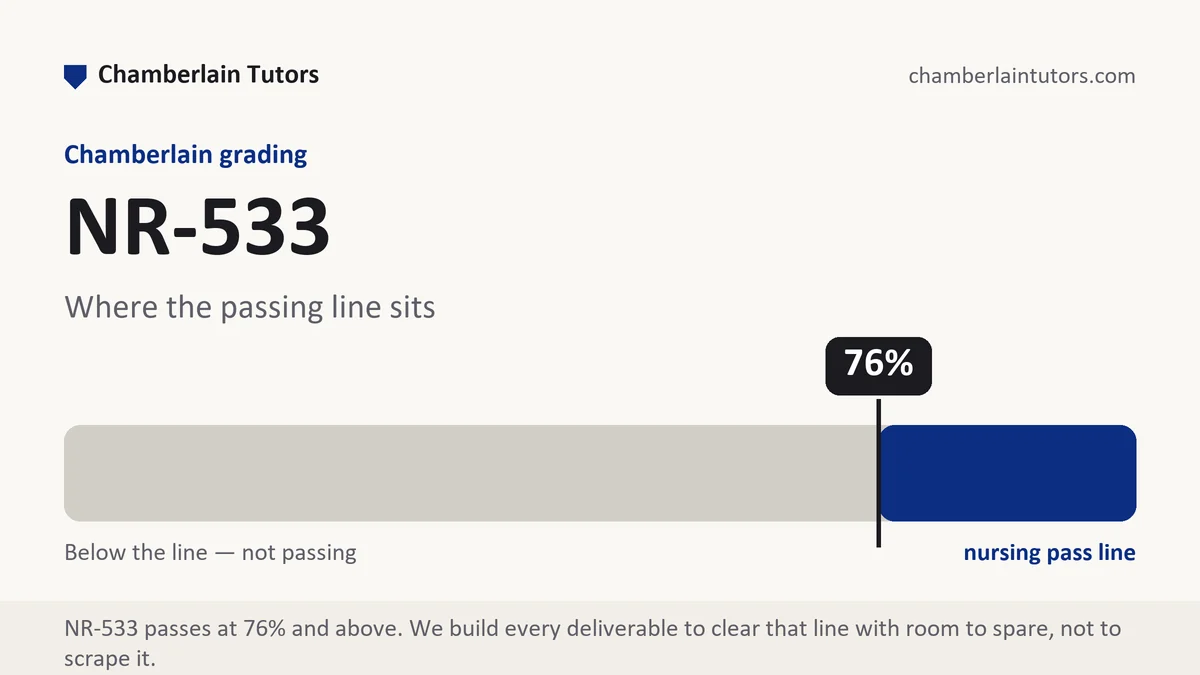
Core nursing courses pass at 76 percent, and where a track uses the nurse practitioner specialty scale, which carries no C band, the last passing number is 84. A finance course is unusual in the sequence because part of the grade is right or wrong rather than a matter of quality, and an arithmetic error propagates through every section that depends on it.
The schedule is the standard compressed one: sixteen week semesters split into two eight week sessions, up to six starts a year, deliverables weekly, and supplementary work unable to rescue a weak weighted average. Check the arithmetic before the prose, because a well written paragraph explaining a wrong number costs more than a plain one explaining a right one.
Turn the criterion rows into a section plan
Copy the rows into a blank file in printed order and reduce each to its verb: calculate, analyze, explain, justify, recommend. Headings follow the verbs in the guide's own sequence, and in a finance assignment this discipline also protects you from writing three pages of context before the first number appears.
Then convert weights into words. Suppose the assignment caps you at 1,400 words across four rows weighted 50, 20, 20 and 10 percent, giving roughly 700 words, 280, 280 and 140. A row worth half the assignment is unusual and it is almost always the analysis of the figures, which means seven hundred words explaining what the numbers show, why the variance occurred and what follows. The 140 word row is one paragraph. Students routinely invert this, writing a long introduction about healthcare costs and a short analysis, which is the single most reliable way to lose a finance assignment.
Keep the target beside each heading while drafting. Title page and references sit outside the count unless your guide says otherwise, and budget tables, variance tables and calculation appendices usually do as well, which is exactly where the arithmetic belongs.
The shape of a budget analysis or business case
Most graded writing here is a variance analysis or a business case for a proposed expenditure. Each part below is a question a finance reader asks in this order.
| Part | What it has to establish | How the thin version reads |
|---|---|---|
| The question, in one line | Whether to spend, or what explains a gap, stated before any context. | Three paragraphs on the cost of healthcare before the topic appears. |
| The figures, with their source | Planned against actual, or cost against benefit, each labelled and dated. | Numbers presented with no indication of where they came from. |
| Volume adjustment | Whether the difference survives once activity is accounted for, since more patients means more hours legitimately. | A raw overspend treated as overspending. |
| The explanation | Which line drove the variance and what happened operationally to cause it. | A restatement of the numbers in sentence form. |
| Assumptions, listed | Every estimate the case depends on, stated so a reader can disagree with one and see what breaks. | A confident total with no visible inputs. |
| The recommendation and its risk | What to do, what it costs, when it pays back, and what would make the case fail. | A recommendation to invest because the initiative is important. |
Evidence and citation craft with financial sources
Financial figures decay faster than almost any other evidence in this degree, and they are quoted without provenance constantly.
- Every figure needs a year, and old figures need adjusting or excusing. Costs move with inflation and with payment policy. A five year old cost estimate used unadjusted is wrong rather than merely dated, and the sentence should say which year the dollars are in.
- Cite the payer or the agency, not the summary. Payment rules, fee schedules and reporting requirements come from the bodies that set them. Secondary accounts drop the conditions that decide whether a service is payable at all.
- Design and setting before any cost finding. Write that a cost analysis at three community hospitals compared total costs per case before and after a staffing change over two years, then the result. Cost studies rarely transfer, because case mix and wage rates differ everywhere.
- Verbs the design can pay for. Hospitals that adopted the model reported lower costs per case is defensible. The model lowers costs is a claim that observational cost comparisons cannot support, and finance readers are particularly unforgiving about it.
- Denominator and window on every rate and every average. Write that the unit used 6,840 worked hours across 1,140 patient days in one month, rather than quoting hours per patient day alone. A ratio with no base hides the two numbers that actually explain it, and comparing months with different volumes without saying so is the most common error in variance writing.
The gap between a passing paper and a strong one
A passing NR-533 paper reports the numbers accurately, describes the variance, and recommends monitoring costs and educating staff about resource use. Nothing is incorrect and nothing is decided, which is where the middle band sits in a course whose whole subject is deciding with numbers.
Strong papers adjust for volume before they judge anything, so the reader knows whether there is a problem at all. They expose their assumptions in a short list, which paradoxically strengthens the case because a reader can test it. And they state what would make the recommendation wrong, naming the volume, the rate or the payment change that would break the argument, because a business case with no failure condition reads as advocacy rather than analysis.
Six mistakes that cost points here
- Judging a variance without volume. More hours for more patients is not overspending. Adjust first, conclude second.
- Mixing fixed and variable costs. A cost that does not move with activity behaves differently in every calculation. Separate them explicitly.
- Hidden assumptions. A total nobody can decompose cannot be defended. List the inputs.
- Arguing from importance. Valuable and fundable are different claims. Make the second one.
- Using undated dollars. A cost with no year attached is not a cost. Say which year, and adjust where you compare across time.
- Posting to the board from the text box. Chamberlain posts do not reopen once submitted, and a mistyped figure is permanent. Check the arithmetic in a document first.
Questions NR-533 students ask
I have never seen a budget. Where do I start?
Where do I get numbers if my employer will not share them?
How does the marketing part fit with the finance part?
Where NR-533 sits in Chamberlain's programs
Open the exact program map for sequence, credit, and option context. The current student schedule and syllabus remain authoritative after transfer evaluation, electives, state rules, and approved plan changes.
The weeks, one by one
Week 1
A federally qualified health center runs three exam pods, a behavioral health suite and a mobile van, and the nurse manager who keeps all four staffed has never been shown the document that decides whether any of them survive the next fiscal year. Read the full Week 1 manual.
Week 2
Two women arrive at the same county clinic on the same morning with the same diagnosis and receive the same forty minutes of nursing time, and the clinic is paid three different ways for the encounter depending on which card each one hands over and whether either has one at all. Read the full Week 2 manual.
Week 3
A rural health clinic opens a Saturday immunization session and the director asks what it costs to run. Read the full Week 3 manual.
Week 4
Halfway through an eight-week finance course the abstraction ends and you are asked to build something. Read the full Week 4 manual.
Week 5
Labour is where most of the money goes in a care organization, and it is the only large line a nurse manager genuinely controls day to day. Read the full Week 5 manual.
Week 6
Every clinic manager has watched a good idea die in a hallway. Read the full Week 6 manual.
Week 7
The monthly report lands in a manager's inbox with one line highlighted in red and a request for an explanation by Friday. Read the full Week 7 manual.
Week 8
Closing week gathers everything the session built and puts it in front of a decision maker. Read the full Week 8 manual.