NR-532 is the three theory hour course that synthesizes organizational and management theory for strategic planning, resource management and accreditation standards. The deliverables are plans rather than essays, and a plan is graded on whether it could be executed: does it name the resource, the sequence, the owner, the timeline and the standard it has to satisfy.
What NR-532 actually grades
The first scored ability is separating strategy from operations without losing the link between them. Strategy answers what the organization is trying to become and why. Operations answers who does what next Tuesday with which resources. A paper that stays entirely in one register misses rows either way, and the strongest writing shows a single strategic goal descending into an operational sequence that a manager could actually run.
The second is resource realism. Every plan consumes staff hours, space, equipment, supplies and money, and a plan that names an initiative without naming what it consumes is an intention. Where a rubric row asks about resource management, it wants the resource identified, quantified where possible, and sourced from somewhere specific.
The third is accreditation used as a design constraint. Standards are not a compliance paragraph at the end of a plan. They shape what the plan has to include, what has to be documented, and what evidence will exist afterwards, and building that in from the start is what a top band answer looks like.
How we help in this course
NR-532 carries no clinical hours, so nothing on our side touches placement, preceptors, site paperwork or logs.
Send the prompt and the scoring guide from Canvas and a premium original draft comes back in 24 to 48 hours, structured against the criterion rows, with the plan carrying owners, sequence and resources rather than intentions. Both quality passes and the floor check run before it ships, and revising is free until the plan lands.
Writing this course's deliverables from the rubric
Rubric, goal, constraints, sequence, evidence. Writing the vision before checking the constraints is how an operational plan turns into a strategy essay with a timeline pasted on the end.
In NR-532 right now?
Send the week and the rubric from Canvas. First premium sample free, floor-checked, back in 24 to 48 hours.
The floor under an executive track course
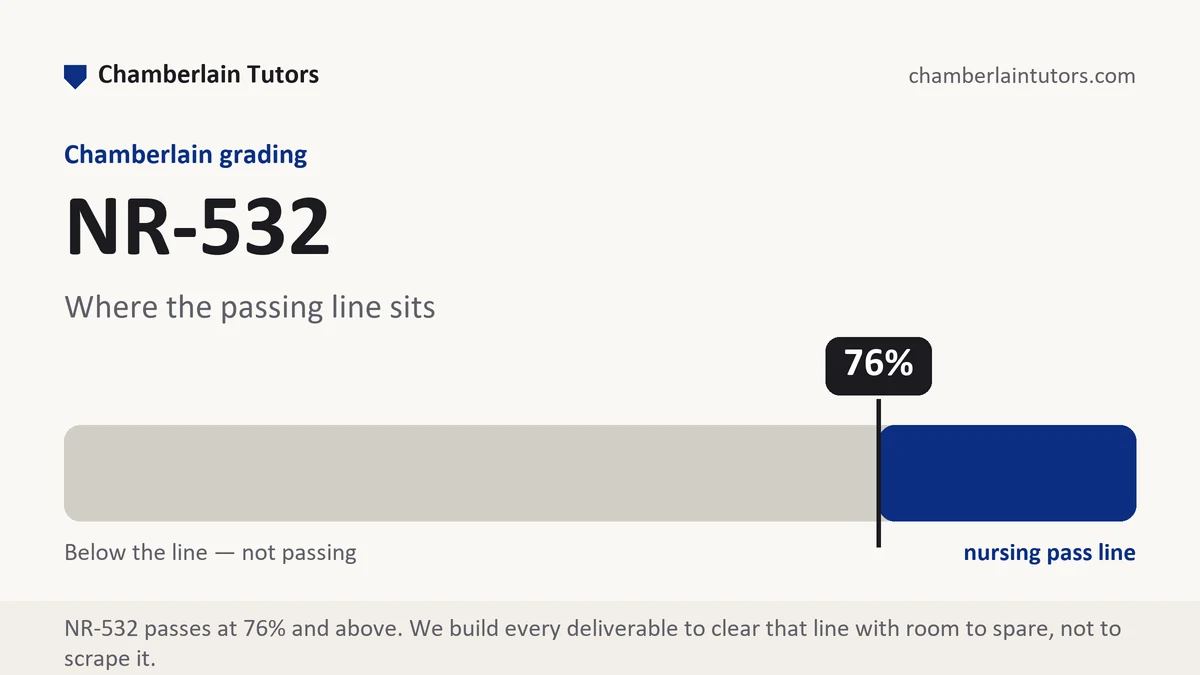
Core nursing courses pass at 76 percent, and where a track uses the nurse practitioner specialty scale, which has no C band, the last passing number is 84. Planning courses carry a specific risk: the deliverables are long and structured, so a weak plan still looks like a finished document and the deficiency only appears in the feedback.
Each sixteen week semester holds two eight week sessions, up to six starts run in a year, deliverables arrive weekly, and supplementary work will not repair a weighted average. Where a plan builds across the session, a vague goal chosen in week one costs points every week afterwards, so spend the first week making the goal specific enough to be scheduled.
Turn the criterion rows into a section plan
Copy the criterion rows into a blank file in printed order and reduce each to its verb: analyze, plan, allocate, align, evaluate. Those verbs become your section headings in the guide's own order, which matters here because operational plans have a conventional shape that rarely matches a rubric's sequence, and the rubric wins.
Then convert weight into words. Suppose the assignment caps you at 1,900 words across four rows weighted 35, 30, 25 and 10 percent, giving roughly 665 words, 570, 475 and 190. Read that as an instruction about depth. If the 35 percent row is the operational plan itself, 665 words is a sequence with owners and dependencies rather than a bulleted list of activities. The 190 word row is one paragraph, usually the conclusion or a short reflection, and expanding it is how students run out of room for the resource section that carries a quarter of the marks.
Keep the target beside each heading while drafting. Title page and references sit outside the count unless your guide says otherwise, and timelines, resource tables and standards matrices usually do too, which makes them the efficient place for detail.
The shape of an operational plan
Most graded writing here is a plan: a service line, a unit initiative, a readiness project, an expansion. Each part below is something a person asked to run the plan would need.
| Part | What it has to establish | How the thin version reads |
|---|---|---|
| The goal, in operational terms | What will be different, by when, expressed so that success or failure is visible. | An aspiration such as becoming a center of excellence. |
| The environment scan | Internal capability and external pressure, each with evidence rather than assertion. | A generic list of strengths and weaknesses. |
| Resources named and counted | Staff hours, roles, space, equipment, supplies and money, with where each comes from. | A plan that consumes nothing. |
| Sequence with dependencies | What happens first, what cannot start until something else finishes, and who owns each step. | Activities listed with no order and no owners. |
| Standards built in | The accreditation or regulatory requirements the plan must satisfy, and the evidence trail they need. | A compliance paragraph appended at the end. |
| Control and contingency | Checkpoints, the measures reviewed at each, and what the plan does if a milestone slips. | A promise to monitor and adjust. |
Evidence and citation craft in planning documents
Planning writing leans on standards, market data and management research, and each carries a different obligation.
- Accreditation and regulatory sources must be current, with the version named. Standards are revised on published cycles, and a plan built to a superseded edition is a plan built to nothing. Say which edition and which year.
- Separate market reports from research. Industry forecasts and consultancy analyses are useful context and are not peer reviewed evidence. Name what each is so your load bearing claims rest on the stronger source.
- Design and setting before any operational finding. Write that a multisite observational study across 22 hospitals compared throughput before and after a bed management change, then the result. Operations research is highly setting dependent and rarely transfers cleanly.
- Verbs the design can pay for. Organizations adopting the model reported shorter waits is honest. The model shortens waits claims a counterfactual that observational comparisons across differing institutions cannot supply.
- Denominator and window on every operational rate. Write that 148 of the 1,900 admissions in a quarter waited more than four hours for a bed, rather than that 8 percent did. Throughput figures depend entirely on which admissions were counted and over what period, and comparing quarters with different volumes without saying so is a common error.
The gap between a passing plan and a strong one
A passing NR-532 plan states a sensible goal, describes the environment, lists actions and closes with a promise to evaluate. It reads like a document and it is not executable, because nothing in it says who does what, when, with what, or what happens if a step slips.
Strong plans name the binding constraint. Every real plan is limited by one thing more than the others, usually staff hours, space or a capital approval, and saying which one it is shapes everything downstream. They put dependencies in the sequence, so the reader sees why training cannot begin before a build finishes. And they design the evidence trail alongside the work, because a plan that satisfies a standard but leaves nothing to show for it fails the only test an accreditation visit applies.
Six mistakes that cost points here
- A goal that cannot fail. Improve quality of care is not a goal. Say what changes, by how much, by when.
- Costless plans. If nothing is consumed, the resource row is empty. Name the hours, the roles and the money.
- Activities without owners. A step with no named role is a step nobody does. Assign every one.
- Standards bolted on at the end. Requirements shape the design. Build them into the sequence and the documentation.
- No contingency. Plans slip. A plan with no response to slippage misses the control row entirely.
- Posting to the board from the text box. Chamberlain posts do not reopen once submitted. Draft elsewhere, check the citation, then paste.
Questions NR-532 students ask
I have no access to budget or capacity data. Can I still write a real plan?
How do I show accreditation readiness without listing standards?
What is the difference between this plan and the change proposal in a leadership course?
Where NR-532 sits in Chamberlain's programs
Open the exact program map for sequence, credit, and option context. The current student schedule and syllabus remain authoritative after transfer evaluation, electives, state rules, and approved plan changes.
The weeks, one by one
Week 1
Operational planning starts outside the building. Read the full Week 1 manual.
Week 2
Strategy is a set of choices about what a service will and will not do, and the second stage of NR-532 asks you to make those choices in writing. Read the full Week 2 manual.
Week 3
Staffing is where operational planning stops being abstract, because it is the largest cost in almost any nursing service and the one most closely tied to outcomes. Read the full Week 3 manual.
Week 4
A budget is a plan expressed in money, and a variance report is the plan arguing with reality. Read the full Week 4 manual.
Week 5
A business case is a written argument for spending money, and the fifth stage of NR-532 asks you to build one properly: the problem in numbers, the options including doing nothing, the full cost of the recommended option, the benefit expressed in dollars or in avoided harm, the payback period, and. Read the full Week 5 manual.
Week 6
Accreditation is a compliance system with an evidence requirement, and the sixth stage of NR-532 asks you to write about it as an operational manager rather than as a nurse who dreads survey week. Read the full Week 6 manual.
Week 7
Capacity problems are almost never capacity problems. Read the full Week 7 manual.
Week 8
The closing stage of NR-532 asks for a document rather than an essay. Read the full Week 8 manual.