NR-530 is the three theory hour foundations course in population health: the models, the determinants, health literacy, and the frameworks used to reduce disparities. It is the course where the vocabulary is set for everything that follows, and the fastest way to lose points is to use determinant, disparity and risk factor as though they meant the same thing.
What NR-530 actually grades
The first scored ability is placing a cause at the right level. A risk factor sits with an individual. A determinant sits upstream of many individuals, in housing, income, education, transport or the conditions of work. A disparity is a difference in outcome between groups that could have been otherwise. A paper that treats a determinant as a personal choice, or a disparity as an unfortunate statistic, has missed the analytic move the course is built on.
The second is health literacy handled as a design problem rather than a patient attribute. The graded version of this is not that patients struggle to understand instructions. It is that the instruction was written at a reading level nobody chose deliberately, delivered through a channel that excludes part of the population, and never checked for comprehension.
The third is framework use. Where a rubric row asks for a model or a framework for reducing disparities, it wants the framework to organize your analysis and select your intervention level, not to appear once as a citation.
How we help in this course
NR-530 is theory only, so nothing on our side touches placement, preceptors, site paperwork or logs.
Send the prompt and the scoring guide from Canvas and a premium original draft comes back in 24 to 48 hours, planned against the criterion rows, with causes placed at the correct level and every population figure carrying its base and its period. Both quality passes and the floor check come first, and revision is free for as long as the paper needs.
Writing this course's deliverables from the rubric
Rubric, population, determinant level, framework, then prose. The most expensive habit in this course is writing about a health problem in general and only afterwards discovering that the rubric wanted a specific group and a specific upstream cause.
In NR-530 right now?
Send the week and the rubric from Canvas. First premium sample free, floor-checked, back in 24 to 48 hours.
The floor in a vocabulary heavy course
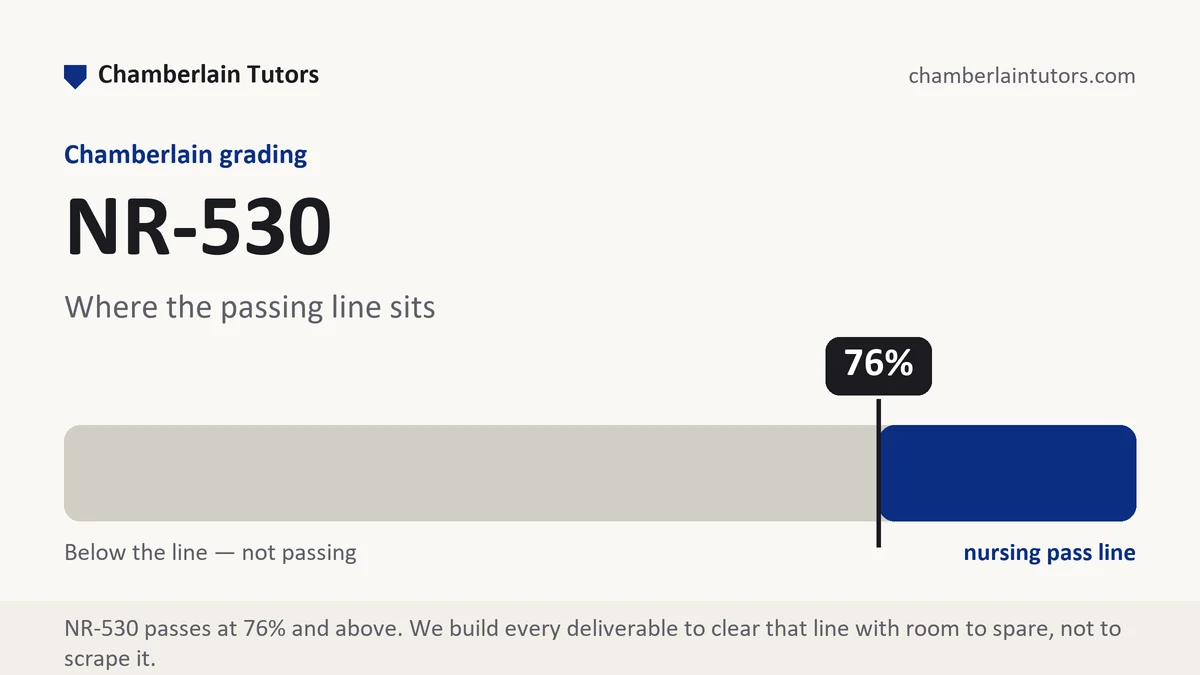
Core nursing courses pass at 76 percent, and where a track uses the nurse practitioner specialty scale there is no C band, which sets the last passing number at 84. Foundations courses are where a small vocabulary error becomes a pattern, because the same misused term reappears in every deliverable until someone corrects it.
The schedule is the usual compressed one: sixteen week semesters divided into two eight week sessions, up to six starts a year, deliverables weekly, and supplementary work unable to rescue a weak weighted average. Read the first set of grader comments closely for terminology corrections and apply them the same week, because they are worth more than the points on that one assignment.
Turn the criterion rows into a section plan
Copy the rows into a blank file in printed order and reduce each to its verb: define, analyze, apply, propose, evaluate. Those verbs become headings, held in the guide's sequence so a grader working down the rows always meets the matching section.
Then convert weight into words. Suppose the paper is capped at 1,550 words with four rows weighted 40, 30, 20 and 10 percent, giving roughly 620 words, 465, 310 and 155. Six hundred and twenty words on the heaviest row is usually the determinants analysis, which means several paragraphs tracing a specific upstream condition to a specific outcome in a specific group, not a list of social factors. The 155 word row is one paragraph, often a definition or a personal application, and giving it a page is the classic way a determinants section ends up thin.
Keep each target beside its heading while drafting. Title page and references sit outside the count unless your guide says otherwise, and where you use a table of population indicators, that usually does too.
The shape of a determinants and health literacy brief
Most graded writing here is a brief on a population, a determinant and a disparity, with a literacy or access dimension attached. Each part below is something the scoring guide is looking to credit somewhere.
| Part | What it has to establish | How the thin version reads |
|---|---|---|
| The group, named exactly | Who they are, where, and how many, so every later comparison has a reference point. | An undefined group such as underserved communities. |
| The outcome gap | The difference between this group and a comparison group, with both figures, both bases and the period. | A single statistic about the group with nothing to compare it to. |
| Determinants, placed upstream | The conditions producing the gap, at the level they actually operate, with sources. | Individual behaviours listed as though they were causes. |
| The literacy and access layer | How information reaches this group, at what reading level, through which channel, and who is missed. | A statement that education should be provided. |
| Framework applied | A named model organizing the analysis and pointing at the level where an intervention would act. | A framework cited and then set aside. |
| What would change and how you would know | An intervention at the right level, with a measurable indicator attached. | A call for greater awareness of the issue. |
Evidence and citation craft for population writing
Population figures are quoted more loosely than any other kind of health statistic, and this course grades the handling.
- Date the estimate and the publication separately. A report published this year may describe a survey collected three years ago. Both dates matter, and where the underlying data is older than five years, say why it still stands.
- Go to the statistical source. National surveys, census products and health department reports publish their own methods and their own bases. Secondary summaries drop exactly the details that let a reader evaluate the number.
- Design and sample before the finding. Write that a nationally representative survey of 38,000 households measured food security over a twelve month recall period, then the estimate. Recall periods and sampling frames determine what a population number means.
- Match the verb to the design. Determinants research is observational by necessity. Neighbourhoods with fewer grocery outlets had higher rates of the outcome is defensible. Food access causes the outcome is a claim the design cannot support, and in a course about upstream causes the temptation to overstate is constant.
- Denominator and window on every rate, and the same base on both sides of a comparison. Write that 340 of the 4,200 residents in one area and 190 of the 4,600 residents in another experienced the outcome during the same two year period. A disparity built from two figures with different bases or different years is not a disparity, it is an artifact.
The gap between a passing paper and a strong one
A passing NR-530 paper picks a real population, cites real statistics, lists social determinants and recommends education and outreach. It is sympathetic and accurate and it stays at the level of description, which is where the middle band of every scoring guide in this course lives.
Strong papers keep the cause upstream even when the downstream explanation is easier to write. They compare two groups with matched bases and periods, so the gap is real rather than assumed. They treat health literacy as something the system produces, examining the actual reading level and channel of a real message. And they place the intervention at the level the framework points to, which sometimes means proposing a change to a schedule, a location or a transport arrangement rather than to a teaching plan.
Six mistakes that cost points here
- Calling a behaviour a determinant. Smoking is a risk factor. What makes smoking more common in one group is the determinant, and that is the level the rubric wants.
- A disparity with one number. A gap needs two figures, matched bases and a shared period. One statistic is a description of a group.
- Treating health literacy as a patient deficit. Examine the message, its reading level and its channel before concluding anything about the reader.
- Framework as garnish. If the model does not select your intervention level, the framework row scores in the middle.
- Writing about a group in the abstract. Name the population, the place and the period, or the analysis has nothing to be true about.
- Posting to the board from the text box. Chamberlain posts cannot be edited after submission, and a mistyped statistic is permanent. Draft elsewhere and verify the numbers first.
Questions NR-530 students ask
How do I write about a disadvantaged group respectfully and still analytically?
What does a health literacy analysis actually involve?
Which framework should I use for reducing disparities?
The weeks, one by one
Week 1
NR-530 Week 1 opens the foundations course by setting its vocabulary, and the vocabulary is the course: population health against public health against community health, and risk factor against determinant against disparity. Read the full Week 1 manual.
Week 2
NR-530 Week 2 puts numbers under the vocabulary: a population described with data, which means rates built correctly, sources chosen for their methods, and every figure carrying its base and its window. Read the full Week 2 manual.
Week 3
NR-530 Week 3 goes upstream: the social determinants of health, the conditions of living and working that shape outcomes before any individual choice is made. Read the full Week 3 manual.
Week 4
NR-530 Week 4 is comparison week: health disparities measured properly between two named groups, and the equity reasoning that says which differences could have been otherwise. Read the full Week 4 manual.
Week 5
NR-530 Week 5 examines how health information actually reaches a population, and mostly fails to: health literacy treated as a property of messages, channels and systems rather than a deficit in patients. Read the full Week 5 manual.
Week 6
NR-530 Week 6 is where the course hands you its machinery: the frameworks and models used to organize disparity reduction, and the discipline of making one actually run. Read the full Week 6 manual.
Week 7
NR-530 Week 7 asks for the thing the whole course has been building toward: an intervention designed for a population, placed at the level the analysis selected, with delivery, partners, barriers and a measurable indicator attached. Read the full Week 7 manual.
Week 8
NR-530 Week 8 closes the foundations course by asking the accountability question: how would you know your intervention worked, and what does the whole arc, population, data, determinants, disparity, literacy, framework, intervention, add up to? Read the full Week 8 manual.