NR-524 is the three theory hour course on the processes of curriculum and program development, analyzed inside a theoretical framework. The deliverables are design documents rather than essays, and they are graded on alignment: whether the objectives, the content, the teaching methods and the assessment all point at the same thing. A beautifully written curriculum that assesses something its objectives never promised is the standard way to lose points here.
What NR-524 actually grades
Alignment is the spine of every rubric in this course. A grader reads your objectives, then reads your assessment plan, and checks whether the second could possibly measure the first. An objective written with a verb like understand cannot be assessed, which is why the verb choice in an objective is a scored decision rather than a stylistic one.
The second graded strand is justification from framework. Curriculum decisions in this course are supposed to follow from something: a design model, a learning theory, a set of professional standards, an accreditation requirement. A sequence of topics presented because it seems sensible is the middle band. The same sequence presented as following from a named model, with the model's logic applied to your content, is the top.
The third strand is context. Programs are built for a particular learner group in a particular setting with particular constraints, and a curriculum that ignores who is taking it, what they already know and how much time exists reads as a wish list.
How we help in this course
NR-524 has no clinical hours, so nothing on our side touches placement, preceptors, site paperwork or logs.
Send the prompt and the scoring guide from Canvas and a premium original draft comes back in 24 to 48 hours, structured against the criterion rows, with objectives written in assessable verbs and each design choice traced to the framework it came from. Two quality reviews and the floor check run before delivery, and revising is free until the document lands.
Writing this course's deliverables from the rubric
Rubric, learners, outcomes, then everything else. Curriculum documents drafted from the topic list outward almost always end with objectives written to fit content that was chosen first, which is the reverse of how the design is graded.
In NR-524 right now?
Send the week and the rubric from Canvas. First premium sample free, floor-checked, back in 24 to 48 hours.
The floor under a design document
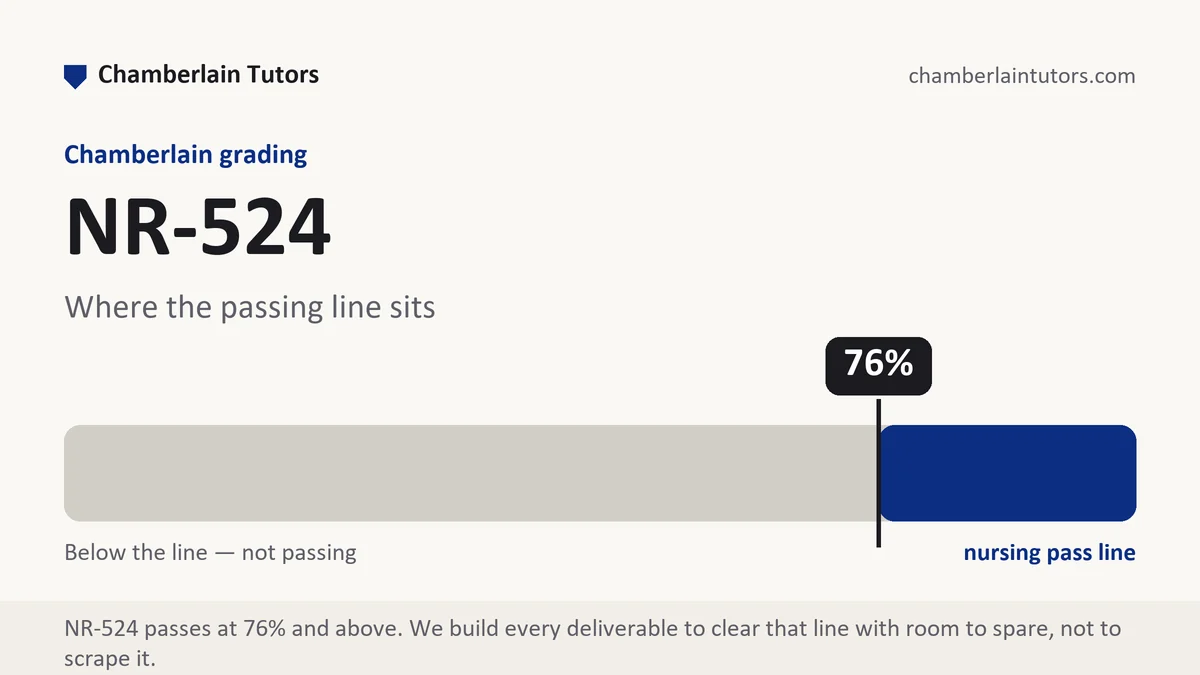
Core nursing courses pass at 76 percent, and where a track uses the nurse practitioner specialty scale there is no C band, which makes 84 the last passing number. Design documents carry a particular risk: they are long, they look finished, and a structural flaw such as misaligned objectives runs through every section at once rather than costing a single row.
The schedule gives no recovery room. Sixteen week semesters split into two eight week sessions, up to six starts a year, with something due each week, and supplementary work cannot rescue a weak weighted average. If a curriculum project builds across the session, an error in the objectives set in week two is still costing points in week seven unless you go back and fix it.
Turn the criterion rows into a section plan
Copy the rows into a blank file in printed order and reduce each to its verb: analyze, design, align, justify, evaluate. Those verbs become your section headings, kept in the guide's sequence so a grader can move down the rows without searching. In design assignments this matters more than usual, because a curriculum document has a conventional shape that may not match your rubric's order, and the rubric wins.
Then convert weights into a word budget. Suppose the assignment caps you at 2,000 words with four rows weighted 35, 25, 25 and 15 percent. That is roughly 700 words, 500, 500 and 300. Seven hundred words is a real design section with objectives, sequence and rationale rather than a table with a paragraph under it. The 300 word row is often the evaluation plan, which students shrink to two sentences even though it is a fifth of the assignment and the easiest section to write well once you have decided what alignment means for your objectives.
Keep each target beside its heading. Title page and references sit outside the count unless your guide says otherwise, and curriculum matrices or objective tables usually do too, which makes a table the efficient home for detail that would otherwise eat your prose budget.
The shape of a curriculum design document
Most graded work here is a design document for a course, a unit or a program. These parts recur, and a grader is checking for each.
| Part | What it has to establish | How the thin version reads |
|---|---|---|
| Learner and setting analysis | Who these students are, what they already hold, and the real constraints of time, sequence and setting. | A generic reference to nursing students. |
| The driving framework | The design model or learning theory chosen, cited, with one line on why it fits this program. | A model named in the introduction and never used. |
| Outcomes and objectives | Statements written in observable verbs at the right level, with program and course levels distinguished. | Objectives beginning with understand, know or appreciate. |
| Content and sequence | What is taught, in what order, with the reason the order is that way rather than another. | A topic list following the chapters of a textbook. |
| Teaching methods, justified | The strategies chosen and why each suits its objective and its learner group. | Lecture and discussion assigned to everything. |
| Assessment aligned | How each objective is measured, with the map from objective to assessment visible. | An examination and a paper, unattached to specific objectives. |
Evidence and citation craft in curriculum work
Your sources here are a mixture of standards, education research and professional guidance, and each behaves differently.
- Accreditation and professional standards must be current. These documents are revised on published schedules, and a curriculum aligned to a superseded edition is aligned to nothing. Name the version year in the sentence.
- Cite the model's own literature. Design and learning frameworks have primary sources. A textbook summary is a secondary account and should be labelled as one where the original is out of reach.
- Design and sample before any education finding. Write that a quasi experimental study across two cohorts of 118 prelicensure students compared examination performance under two teaching methods, then the result. Education research is small and local far more often than it appears when quoted.
- Match the verb to the design. Most teaching research is observational or quasi experimental with self selected groups. Students taught with the method scored higher is defensible. The method improves learning is a causal claim that very few education studies can support.
- Denominator and window on every rate. Write that 41 of the 118 students in one cohort failed the first attempt, rather than that 35 percent did. Pass rates are cohort specific and meaningless without the base and the period.
The gap between a passing document and a strong one
A passing NR-524 document is complete, organized and plausible. It has objectives, content, methods and assessments, and each section is reasonable on its own. The reason it sits mid band is almost always that nothing in it is traceable: the reader cannot tell why this order, this method or this assessment rather than another.
Strong documents make every choice traceable to two things, the framework and the learner. They keep the alignment visible, often with a simple map from each objective to its teaching strategy and its assessment, so the grader can check the spine in one glance. And they name the constraint they designed around, because a curriculum written as though time, faculty and clinical placements were unlimited is an argument nobody in education finds persuasive.
Six mistakes that cost points here
- Unassessable objective verbs. Understand and appreciate cannot be measured. Use verbs describing something a learner does that you could observe.
- Assessments that measure something else. A multiple choice examination assessing an objective about performing a skill is a misalignment a grader spots instantly.
- Framework named and abandoned. If the model does not shape your sequence or your methods, the justification row is unfed.
- Mixing program and course level outcomes. They operate at different grain sizes. Keep them separate and show how the smaller ones roll up.
- Sequencing from a textbook. Chapter order is a publishing decision, not a curricular argument. Say why the learner needs this before that.
- Pasting a board post into the text box. Chamberlain posts do not reopen once submitted. Write it in a document, verify the citation, then paste it once.
Questions NR-524 students ask
I have never taught. Can I still write a credible curriculum?
How do I show alignment without padding the paper?
Can I build my project around my own workplace program?
The weeks, one by one
Week 1
NR-524 Week 1 asks where a curriculum comes from before it asks what goes in one. Read the full Week 1 manual.
Week 2
NR-524 Week 2 establishes the gap a curriculum exists to close. Read the full Week 2 manual.
Week 3
NR-524 Week 3 is the week where a single word decides whether a design can be graded. Read the full Week 3 manual.
Week 4
NR-524 Week 4 makes two decisions that look like one. Read the full Week 4 manual.
Week 5
NR-524 Week 5 chooses how the content will be delivered, and the choice is graded on fit rather than on fashion. Read the full Week 5 manual.
Week 6
NR-524 Week 6 closes the loop the whole course has been building. Read the full Week 6 manual.
Week 7
A curriculum has to satisfy bodies that never see the classroom, and it has to produce evidence about itself on a schedule, which means the evaluation plan is part of the design rather than an afterthought attached to it. Read the full Week 7 manual.
Week 8
NR-524 Week 8 closes the session with the part of curriculum work that defeats good designs. Read the full Week 8 manual.
Where NR-524 sits in Chamberlain's programs
Open the exact program map for sequence, credit, and option context. The current student schedule and syllabus remain authoritative after transfer evaluation, electives, state rules, and approved plan changes.