NR-519 compresses three advanced sciences into one three theory hour course: assessment, pathophysiology and pharmacology, taught as a foundation for holistic care across the lifespan. The compression is the difficulty. Elsewhere those subjects get a course each, and here the rubric rows expect you to run all three inside a single piece of writing without dropping one.
What NR-519 actually grades
The graded move is a chain that crosses all three subjects in order. Something is found on assessment. That finding is explained by a mechanism. The mechanism suggests a drug class, and the drug class works on that mechanism in a way you can state. Then the monitoring parameter follows from the drug's effect, and the patient teaching follows from the monitoring.
Papers lose marks by breaking the chain rather than by getting a fact wrong. A draft that describes an examination well, explains a disease process well, and then names a medication without connecting it to the mechanism has produced three correct paragraphs and no reasoning, and reasoning is what the heaviest rubric row is paying for.
Across the lifespan is not decorative in the catalog line either. Where an assignment names an age group, the physiology of that group has to change something you say: dosing, monitoring interval, expected presentation, or the teaching you give a caregiver rather than a patient.
How we help in this course
NR-519 is theory only, so nothing on our side touches placement, preceptors, site paperwork or logs, and we do not sit assessments or perform examinations for anyone.
Send the prompt and the scoring guide from Canvas and a premium original draft comes back in 24 to 48 hours with the assessment to mechanism to drug to monitoring chain explicit in every paragraph, sourced current, in clinician register. Both quality passes and the floor check run before it ships, and revising is free until the grade lands. The walkthrough that comes with each draft doubles as the sciences review a working nurse rarely has time to schedule.
Writing this course's deliverables from the rubric
Rubric first, then the chain, then the prose. Drafting straight into prose in a three subject course reliably produces a paper that is two thirds assessment because assessment is the part you already write at work.
In NR-519 right now?
Send the week and the rubric from Canvas. First premium sample free, floor-checked, back in 24 to 48 hours.
Three subjects, one grade
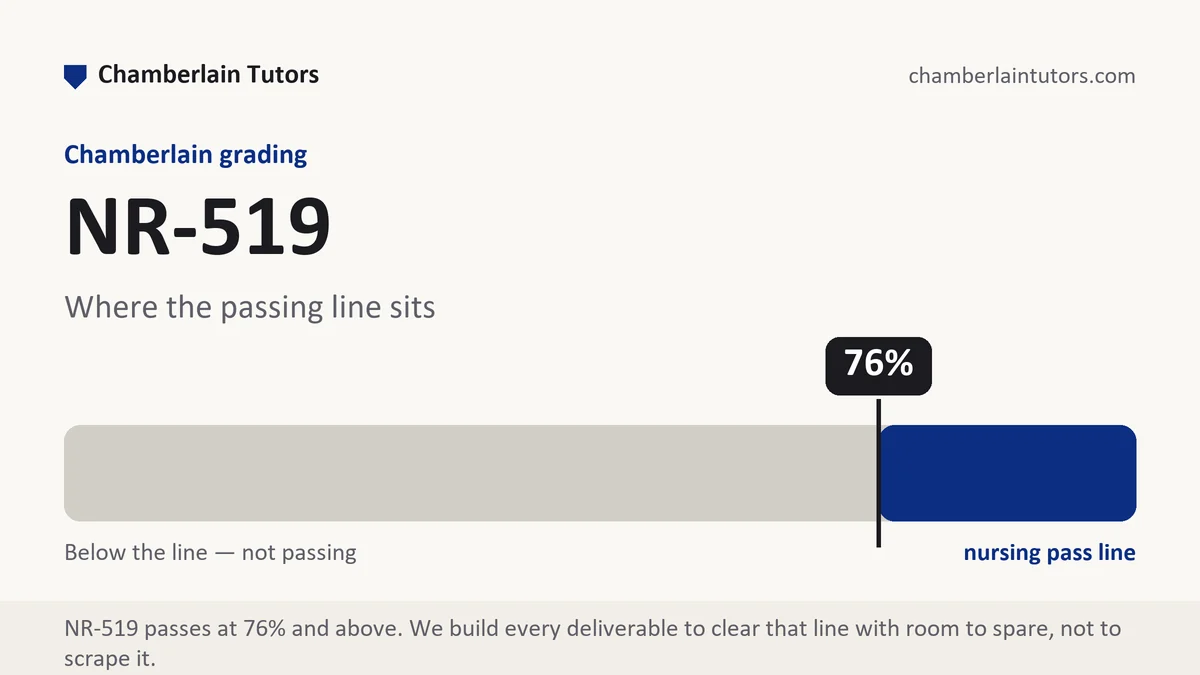
Core nursing courses pass at 76 percent, and on the nurse practitioner specialty scale there is no C band, so 84 becomes the last passing number. A combined sciences course concentrates risk: a weakness in any one of the three subjects appears in every deliverable rather than in one course you could isolate and repair.
The schedule adds pressure. Sixteen week semesters split into two eight week sessions, up to six starts a year, and weekly deliverables, with supplementary work unable to rescue a weak weighted average. Find the weakest of your three subjects in week one and give it the extra hours immediately, because it will be present in every week that follows.
Turn the criterion rows into a section plan
Copy the rows into a blank file in printed order and strip each to its verb: assess, explain, select, monitor, teach. Those become your headings in the guide's own order, so a grader moving down the rows never has to search for the matching section.
Then convert weight into words. Say the paper is capped at 1,600 words with four rows weighted 35, 30, 20 and 15 percent, giving roughly 560 words, 480, 320 and 240. Read what that says about proportion. If the 35 percent row is pathophysiological explanation, then 560 words is four or five paragraphs of mechanism, which is more than most drafts spend and far more than the single paragraph students give it before hurrying to the drug. The 240 word row is usually patient teaching, and it is one disciplined paragraph rather than the page that gets written because teaching is comfortable material.
Keep the budget beside each heading and clear it as the section fills. Title page and references sit outside the count unless your guide says otherwise, and a medication table, where you use one, usually does too.
The shape of an integrated case response
Most graded writing here is an integrated case: a presentation to work up, explain, treat and monitor. The six parts below chain together, and a grader follows the chain rather than the list.
| Part | What it has to establish | How the thin version reads |
|---|---|---|
| Presentation, tightly stated | Age, relevant history and the findings that matter, in one short paragraph with nothing decorative. | A full head to toe reproduced before the analysis starts. |
| Pertinent positives and negatives | What you found and what you deliberately looked for and did not find, with the reason each mattered. | Positives only, so the reasoning looks like a guess that landed. |
| The mechanism | Where normal function fails, named at receptor, mediator, pathway or organ level, and how that produces the findings above. | The disease named again in place of the failing step. |
| Pharmacologic reasoning | The class chosen, the site it acts on, and why that site is the right one given the mechanism you just described. | A drug name with a dose and no link back to the pathophysiology. |
| Monitoring that follows | The parameter, the interval and the value that would make you change course, each traceable to the drug's action. | A generic instruction to monitor for side effects. |
| Teaching across the lifespan | What the patient or caregiver must understand, adjusted for age, development and who administers the medication. | Advice that would fit any patient of any age. |
Evidence and citation craft across three sciences
Each of the three subjects has its own source conventions, and a paper that uses one convention for all three looks unread.
- Drug information must be current, and current is short. Indications, warnings and monitoring guidance change. Use a current drug reference or prescribing information and say which, because a five year old dosing statement is a clinical error rather than a citation problem.
- Mechanism can be older; the reason has to be visible. A foundational account of a physiological pathway survives past five years, and the sentence should carry the justification. A prevalence or an outcome figure of the same age does not.
- Design and sample before any clinical finding. Write that a randomized trial of 1,480 adults compared two agents over 12 months, then the result. In a course that mixes three literatures, provenance is what tells a reader which one they are in.
- Verbs the design can pay for. Observational pharmacoepidemiology supports was associated with. Controlled trials support reduced. Adverse effect claims especially attract causal verbs they cannot afford, so check each one.
- Denominator and window on every rate. Write that 62 of the 1,480 participants discontinued the drug for adverse effects within a year, rather than that 4 percent did. Discontinuation and adverse event rates are uninterpretable without the base and the follow up period.
The gap between a passing paper and a strong one
A passing NR-519 paper is accurate in all three subjects and connected in none. It documents, it explains, it prescribes, and each section could be lifted out and dropped into a different paper without anyone noticing.
Strong papers are welded together. Every sentence in the pharmacology section refers back to something stated in the mechanism section, and every monitoring parameter names the drug effect it is watching. They commit to one problem in depth instead of touching three politely, which is the temptation a three subject course creates. And they let the lifespan detail change something concrete, so that an age is a reason for a decision rather than a demographic line at the top.
Six mistakes that cost points here
- Three parallel essays in one document. The chain is the assignment. Sections that never refer to one another lose the heaviest row however accurate they are.
- Dosing without reasoning. A dose copied from a reference proves you can look things up. Say why this class, at this site, for this mechanism.
- Monitoring described in general. Watch for adverse effects earns nothing. Name the parameter, the interval and the threshold.
- Skipping pertinent negatives. What you ruled out is half the assessment reasoning, and its absence makes the conclusion look assumed.
- Ignoring the age you were given. If the case names a child or an older adult, something in your plan has to change because of it.
- Posting to the board from the text box. Chamberlain posts do not reopen once submitted, and a wrong dose posted publicly is permanent. Draft elsewhere, check the reference, then paste.
Questions NR-519 students ask
How do I fit three subjects into one short paper?
My pharmacology is weaker than my assessment. Where do I start?
Should I write the assessment section first?
The weeks, one by one
Week 1
NR-519 Week 1 sets up the one habit the rest of the session is built on. Read the full Week 1 manual.
Week 2
NR-519 Week 2 runs the course's reasoning chain through the circulation, where the physical findings are unusually generous and the mechanisms are unusually easy to name. Read the full Week 2 manual.
Week 3
NR-519 Week 3 asks a question with only a few possible answers: when a patient cannot breathe comfortably, is the problem getting air in and out, getting oxygen across, or getting blood to the surface where the exchange happens. Read the full Week 3 manual.
Week 4
NR-519 Week 4 adds a question the other systems do not ask. Read the full Week 4 manual.
Week 5
NR-519 Week 5 works on systems that regulate themselves, which changes the shape of the reasoning. Read the full Week 5 manual.
Week 6
NR-519 Week 6 is where the pharmacokinetic vocabulary from the opening stage finally decides something. Read the full Week 6 manual.
Week 7
NR-519 Week 7 is the stage where two things have to be explained at once: what the invading organism is doing and what the patient's own defenses are doing about it. Read the full Week 7 manual.
Week 8
NR-519 Week 8 collects the phrase that has been sitting in this course's catalog line all session and finally makes it the subject. Read the full Week 8 manual.
Where NR-519 sits in Chamberlain's programs
Open the exact program map for sequence, credit, and option context. The current student schedule and syllabus remain authoritative after transfer evaluation, electives, state rules, and approved plan changes.