NR-514 is the three theory hour graduate course in comprehensive health assessment, and the catalog line that decides how it is graded is the one about linking physical findings to psychological, socio-cultural and spiritual determinants. Physical findings alone will not carry a paper here. The marks live in the connection between what you found on examination and the circumstances of the person you found it in.
What NR-514 actually grades
The graded skill is integration. A student who can list twelve normal findings and three abnormal ones has done the easy half. The rubric rows are looking for the second half: this finding, in this person, given their housing, their work, their beliefs about illness, their family structure and their mood, means something different than it would in someone else, and here is what a clinician therefore does differently.
That structure catches experienced nurses out in a particular way. Clinical practice trains you to report findings efficiently and to keep interpretation short. Graduate assessment writing wants the opposite proportion. The finding is a sentence. The interpretation, the alternatives you considered, and the determinants that shift the picture are paragraphs.
If your track is a nurse practitioner track, note that the advanced assessment course that pairs written work with a video recorded physical examination check off is NR-509, and failing that check off reverts the entire course grade to F. NR-514 is graded on its written deliverables, which is a different kind of pressure and a more forgiving one.
How we help in this course
There are no clinical hours in NR-514, so nothing on our side touches placement, preceptors, site paperwork or logs, and we do not perform or record examinations for anyone.
What we do is the writing. Send the prompt and the scoring guide from Canvas and a premium original draft comes back in 24 to 48 hours, organized against the actual criterion rows, written in clinician register with the interpretation carried all the way through instead of stopping at the finding. Two quality passes and a floor check sit between the writer and your inbox, and revision is free for as long as it takes.
Writing this course's deliverables from the rubric
Read the scoring guide before the case. It sounds backwards and it is the single change that moves grades most in assessment courses, because the rubric tells you how much of the paper is examination and how much is reasoning, and students almost always guess that proportion wrong.
In NR-514 right now?
Send the week and the rubric from Canvas. First premium sample free, floor-checked, back in 24 to 48 hours.
The grading floor, and why it bites here
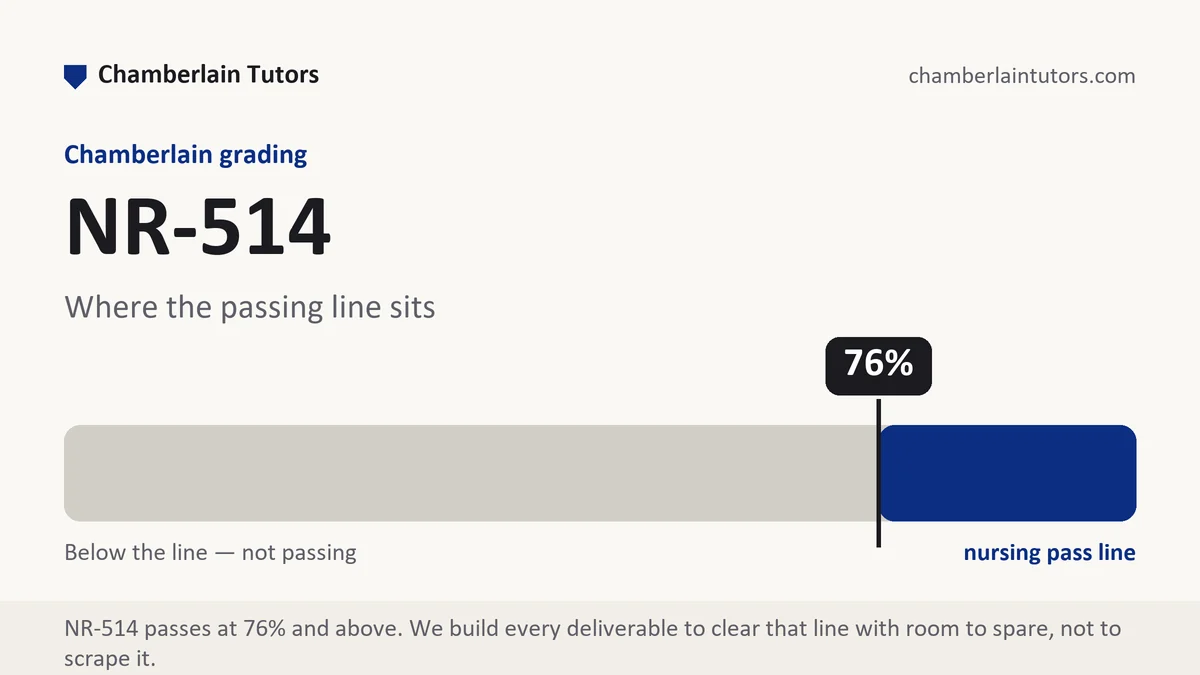
Core nursing courses pass at 76 percent. On the nurse practitioner specialty scale there is no C band, so 84 is the last passing number, and assessment writing is where that difference shows first because the work looks familiar and is graded unfamiliarly.
The schedule is unforgiving too. Sixteen week semesters divide into two eight week sessions, up to six starts a year, deliverables due weekly. Supplementary work cannot rescue a weak weighted average, so the correction has to happen inside the graded pieces themselves rather than afterwards.
Turn the criterion rows into a section plan
Copy the rows out of Canvas into a blank document in the order they are printed, and reduce each to the verb it is built on: obtain, document, interpret, integrate, prioritize. Those verbs become your headings. Holding the guide's order means a grader working down the rows keeps meeting the section they were about to look for, which is worth more than any turn of phrase.
Then price the rows in words. Say the assignment caps you at 1,800 words with four rows weighted 30, 25, 25 and 20 percent. That is roughly 540 words, 450, 450 and 360. Look at what the arithmetic says: the documentation row is not the biggest, yet documentation is where most students spend two thirds of the paper because transcribing an examination is easy. If the interpretation and integration rows are worth 900 words between them, they need genuine paragraphs about alternatives considered and determinants weighed, not two sentences apiece.
Write each budget beside its heading and clear it as the section fills. Where a guide excludes title page and references from the count, note it, and remember that an appendix holding a full examination record usually sits outside the count as well.
The shape of a comprehensive assessment write up
Most graded writing here is a comprehensive assessment in one form or another: a full write up, a focused case, a discussion post on a single system. These parts recur, and each is something a grader is looking to find.
| Part | What it has to establish | How the thin version reads |
|---|---|---|
| Who this is | Age, situation, why they came, and the two or three life facts that will matter later, in a short paragraph. | A demographic line with no context. |
| The subjective account | The history in the person's own terms, including what they think is wrong and what worries them. | A symptom checklist with the person removed. |
| The objective findings | What examination showed, organized by system, pertinent negatives included rather than only positives. | Normal findings listed exhaustively to show effort. |
| Determinants layered in | Psychological, socio-cultural and spiritual factors named and tied to specific findings, not listed separately. | A standalone paragraph about culture that touches nothing else. |
| Interpretation | What the pattern suggests, what else it could be, and which finding decides between them. | A single conclusion stated with no alternatives. |
| Priorities and plan | What you would pursue first at your level, what you would teach, and what would change your thinking. | A generic health promotion paragraph. |
Evidence and citation craft in assessment writing
Assessment papers cite differently from theory papers, because much of the evidence is about how well an examination technique or a screening tool performs.
- Screening tools change; cite the current version. Instruments are revised and re-validated, and the scoring cut points move with them. Say which version and which year you are describing, and where a source is older than five years, put its justification into the sentence.
- Cite the validation study, not the textbook mention. When you claim a tool performs well in a population, the evidence for that is a study with a sample, not a chapter that names the tool. Reviews are for framing, primary sources are for numbers.
- Sample and setting before the statistic. Write that a validation study in 480 community dwelling adults over 65 compared the instrument against a structured interview, then the sensitivity. A performance figure detached from the population it was measured in is not transferable.
- Verbs the design can pay for. Assessment literature is mostly observational. Patients reporting food insecurity had higher rates of uncontrolled disease is defensible. Food insecurity worsens control is a causal claim needing a design that supports it.
- Denominator and window on every rate. Write that 214 of the 1,600 adults screened during one year scored above the cut point, rather than that 13 percent did. Screening yields depend entirely on who was screened and when.
The gap between a passing paper and a strong one
A passing NR-514 write up is complete and tidy. Every system is documented, the history is thorough, the conclusion is plausible. It reads like a good chart note, and a good chart note is the ceiling it hits.
Strong write ups do three things a chart note does not. They show the differential thinking, naming what else the pattern could be and which single finding tips it. They make the determinants do work, so that a mention of shift work or of a religious fasting practice changes an interpretation rather than sitting in its own paragraph. And they prioritize honestly, saying what they would pursue first and what would make them change their mind, which is the sentence that separates a clinician from a recorder.
Six mistakes that cost points here
- Documenting everything and interpreting nothing. A complete head to toe with a two sentence assessment inverts the rubric's own proportions.
- Leaving out pertinent negatives. What you looked for and did not find is part of the reasoning. Its absence makes the conclusion look lucky.
- Treating culture as a paragraph. A determinants section that never touches a specific finding is decoration. Attach each factor to something you observed.
- Naming one diagnosis and stopping. Without alternatives there is nothing to grade. Two or three plausible explanations, then the discriminating finding.
- Using real patient detail. Keep cases unidentifiable. Change details that are not clinically load bearing and say you have done so.
- Pasting a board post straight into the box. Chamberlain posts cannot be edited after submission. Write it elsewhere, read it once out loud, then paste.
Questions NR-514 students ask
How do I write the socio-cultural part without stereotyping?
My write ups are long and still score in the middle. Why?
Can I use a patient from my own practice?
The weeks, one by one
Week 1
NR-514 Week 1 almost always opens where the discipline opens: with the health history, the subjective account that every later finding will be read against. Read the full Week 1 manual.
Week 2
NR-514 Week 2 is where the objective record enters: after the history, the discipline turns to examination findings and the exacting craft of writing them down. Read the full Week 2 manual.
Week 3
NR-514 Week 3 turns to the first determinant the catalog names: the psychological layer, assessed through mental status observation and validated screening. Read the full Week 3 manual.
Week 4
NR-514 Week 4 reaches the determinants the catalog names last and weighs heaviest: the socio-cultural and spiritual layers, assessed by asking rather than assuming. Read the full Week 4 manual.
Week 5
NR-514 Week 5 moves the assessment into daily life: nutrition, activity, sleep and function, the domains where health is actually lived and where vague answers hide. Read the full Week 5 manual.
Week 6
NR-514 Week 6 asks what the assessment you have practiced so far must become when the person in front of you is twenty-two or eighty-six, because normal moves with age and so does the method. Read the full Week 6 manual.
Week 7
NR-514 Week 7 is where gathered data becomes clinical reasoning: clustering findings into patterns, weighing what else each pattern could be, and deciding what matters first. Read the full Week 7 manual.
Week 8
NR-514 Week 8 is the assembly week: one complete comprehensive assessment, history through determinants through reasoning, delivered as a single document with the proportions of a clinician rather than a recorder. Read the full Week 8 manual.
Where NR-514 sits in Chamberlain's programs
Open the exact program map for sequence, credit, and option context. The current student schedule and syllabus remain authoritative after transfer evaluation, electives, state rules, and approved plan changes.