NR-513 Professional Role Enhancement help
Professional Role Enhancement now has a complete Chamberlain class page: official identity, program links, an eight-week work method, grading-boundary checks, and a right-side navigation rail.
Chamberlain's current curriculum identifies NR-513 as Professional Role Enhancement and places it in the Accelerated RN to MSN Option path. The public program map verifies that identity; the registered syllabus and Canvas shell control the weekly deliverables.
What NR-513 work must make visible
Begin with the live syllabus and Canvas rubric, not the title alone. Copy every scored action verb into a ledger and give it a destination, evidence source, success test, and final check. The curriculum verifies that the class exists and where it sits; it does not prove the identity of a discussion, paper, case, log, exam, simulation, or weekly assignment.
Strong work separates fact, reasoning, and action. Name the case or setting, state what is known, show how the relevant course concept changes the interpretation, and make the conclusion proportionate to the evidence. A polished background section cannot compensate for a missing independently scored requirement.
Where a template is provided, its headings and file rules win. Where the format is open, organize the artifact so a grader can locate the required answer without inferring it. Place tables, calculations, citations, and limitations beside the sentence that uses them.
Build the eight-week operating board
Use one row for each real Canvas deliverable: week, item, initial-post deadline, reply deadline, final deadline, rubric weight, grading bucket, required evidence, applied dependency, and next action. Chamberlain deadlines run on Mountain Time, so convert once and record the result rather than recalculating under pressure.
For discussions, treat the initial post and required replies as separate obligations. For written work, reserve time for rubric mapping, research, drafting, citation reconciliation, and the final file check. For exams or simulations, keep preparation separate from authenticated performance; no tutor enters the portal or participates in the assessment.
Do not prefill eight assignments because the session is eight weeks long. Some weeks may carry a discussion and assignment, some may stage a project, and others may use a different instrument. Add a row only after the current Canvas shell verifies it.
Evidence and professional reasoning
Use authoritative sources for regulation, clinical guidance, policy, standards, and public data. Use peer-reviewed research for intervention effects and mechanisms. Keep local observations de-identified and label them as context rather than turning them into general evidence with an unrelated citation.
Maintain a claim ledger with the claim, source or real case fact, population or jurisdiction, date, limitation, and destination paragraph. That ledger prevents source stretching and exposes unsupported words such as effective, safe, significant, best, or improved before the rubric does.
Finish with a mechanical reconciliation: every in-text citation has a reference, every number has a unit and source, every table agrees with prose, every abbreviation is defined, every rubric row is visible, and every conclusion stays inside the evidence.
Turn the live directions into a deliverable map
Read the directions once for the situation and a second time for obligations. On the second pass, underline every action verb, named audience, required source type, format constraint, and submission component. Transfer each item into a four-column map: requirement, planned evidence, destination heading or slide, and completion test. If a requirement has no destination, the draft is not ready to begin.
Separate the product from its support material. The product may be a discussion, paper, care analysis, presentation, case response, reflection, or clinical document; its support may include a template, scholarly references, calculations, speaker notes, an appendix, or a truthful activity record. Track both because a polished main narrative can still lose an entire rubric row when a required supporting element is absent.
For an accelerated nursing task, add the relevant patient, population, organization, policy, or leadership context only when the prompt calls for it. Keep the context de-identified, distinguish observed facts from published evidence, and do not let a plausible scenario become an invented professional experience.
Draft for visible reasoning, not implied reasoning
Use a repeatable paragraph chain: make the claim, identify the specific case or professional context, interpret it with the relevant course concept, support the generalizable part with an appropriate source, and close with the implication for the requested decision. This chain prevents two common failures—citation piles with no analysis and confident recommendations whose evidence never reaches the stated setting.
Match the strength of the verb to the evidence. A descriptive source can establish prevalence or context; it cannot prove that an intervention caused an outcome. A guideline can support a recommended standard; it does not show that a local site has implemented it. When evidence is mixed or indirect, name that limitation and narrow the recommendation instead of hiding the gap behind stronger wording.
Make comparison explicit. If the task asks for priorities, alternatives, risks, ethical tensions, stakeholder effects, or implementation choices, give each option the same decision criteria. Then show why the selected direction performs better against those criteria. The grader should not have to reconstruct the comparison from paragraphs written in different sections.
Use feedback as a course-level control
Classify feedback before revising it. Coverage feedback means a requirement is absent; reasoning feedback means the connection is too weak; evidence feedback means the source, date, population, or claim does not fit; calculation feedback means the inputs or units fail; format feedback means the reader cannot locate the answer; boundary feedback means the work claims activity or authority the student cannot honestly document.
Fix the smallest complete unit, then trace its dependencies. Changing a denominator may alter a table, chart, result sentence, recommendation, and appendix. Replacing a weak source may require narrowing several claims. Reframing a stakeholder may change tone, detail, and the implementation plan. A local edit is finished only when every dependent element agrees.
Keep a private feedback ledger for NR-513 with the original comment, its category, the corrected pattern, and the next-week prevention rule. Do not copy finished sentences forward. Carry forward the method: better headings, earlier evidence checks, clearer calculations, stronger transitions, or a more visible rubric map.
Run a two-pass submission check
The content pass asks whether every rubric row is answered, the professional context is truthful, the evidence supports the exact claim, all calculations are reproducible, limitations are visible, and the requested conclusion or action follows from the analysis. Read headings and topic sentences by themselves; they should form a compact outline of the argument.
The delivery pass checks the required template, filename, file type, page or slide limits, speaker notes, accessibility, reference matching, table and figure labels, working links, and the correct submission channel. Open the final exported file instead of trusting the editable version. Confirm that no text is clipped, no comment remains, and no private or identifying data has entered the artifact.
Finally, compare the uploaded file—not merely the local file—to the checklist. Record the receipt or timestamp, then return to the grade board and update the forecast when feedback arrives. This closes the week without turning a submission event into an assumption.
Protect the correct Chamberlain floor
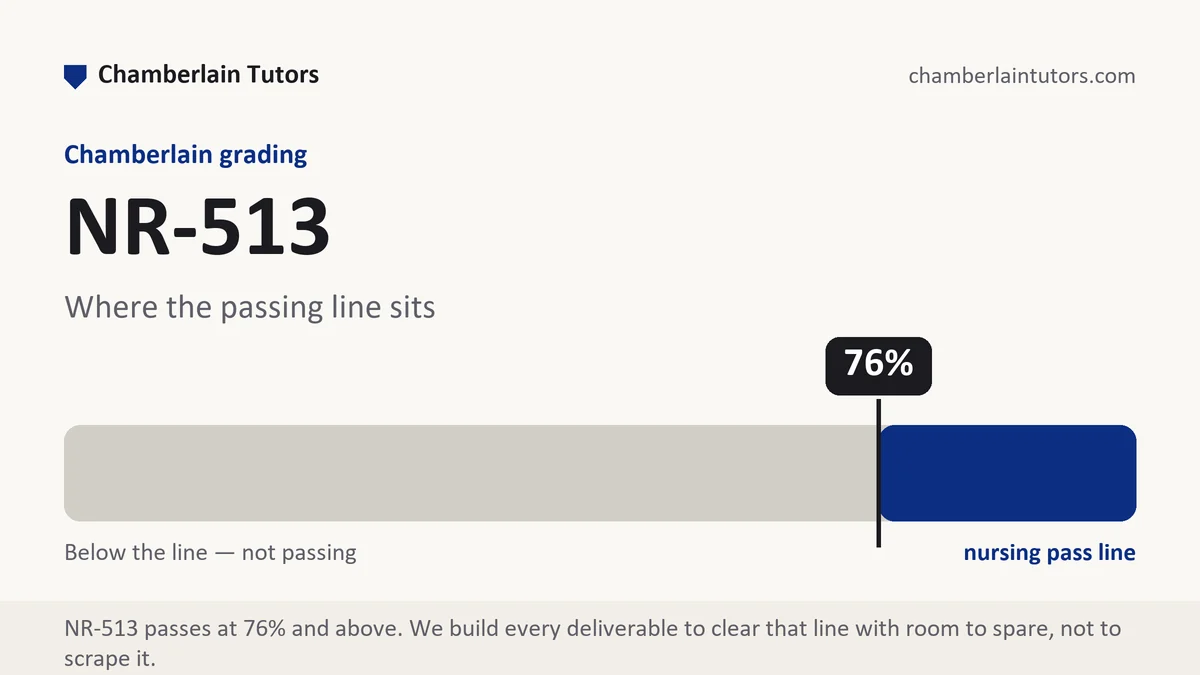
This nursing course must use the scale and any core-assignment gate printed in the live syllabus. Do not assume that a blended course percentage overrides a 76% core gate or a required satisfactory component.
Record earned and possible points by bucket and forecast the minimum needed on remaining work. Target the A band with margin rather than the minimum passing line. A forecast is useful only when it uses the registered scale, current weights, and any component-level progression rule.
Where NR-513 sits in the program network
Open the program map for the exact sequence context. Similar program names, bridge options, and clerkship pools are not interchangeable, and the student's current registration remains authoritative.
The work that remains the student's
This accelerated nursing course remains the student's work: real practice context, professional judgment, discussions, research choices, calculations, and the final submission.
Tutoring can explain concepts, build a study plan, review a de-identified draft, check evidence and calculations, rehearse a presentation, and help the student respond to feedback. It cannot invent experience, supply patient or site facts, perform a skill, contact a placement, sign a record, or submit coursework.
The weeks, one by one
Week 1
NR-513 sits in the Accelerated RN to MSN Option, and its opening week is where an experienced registered nurse begins writing as a graduate student without a bachelor's worth of academic runway: locating your professional position, naming what the accelerated path assumes about you, and producing. Read the full Week 1 manual.
Week 2
NR-513 Week 2, by the arc of a role enhancement course in the Accelerated RN to MSN Option, moves from locating yourself to analyzing yourself: professional identity as a concept with a literature behind it, applied to your own years of practice. Read the full Week 2 manual.
Week 3
NR-513 Week 3, in the arc of an accelerated bridge course, is where scholarly voice gets rebuilt deliberately: the conventions of graduate academic writing - claim and support, citation mechanics, paraphrase over quotation, hedged precision - practiced on a short piece so the habits exist before. Read the full Week 3 manual.
Week 4
NR-513 Week 4, at the midpoint of a role enhancement arc, typically brings formal role theory to bear on your own situation: concepts like role strain, role conflict, role ambiguity and role transition, defined from the literature and used to analyze the working RN who is simultaneously becoming a graduate student. Read the full Week 4 manual.
Week 5
NR-513 Week 5, in the arc of a role enhancement course, typically turns to the documents that define professional nursing from outside any one workplace: practice standards, ethical codes and specialty scope statements, read as instruments and applied to practice in writing. Read the full Week 5 manual.
Week 6
NR-513 Week 6, by the arc of a role enhancement course in the accelerated path, typically asks you to argue a direction: which master's specialty or track your record and the profession's needs point toward, written as an evidenced case rather than a preference. Read the full Week 6 manual.
Week 7
NR-513 Week 7, late in a role enhancement arc, typically turns to the contribution layer of the professional role: leadership and mentorship as documented practices - what you already do that counts, what the master's prepared role adds, and how contribution is evidenced rather than asserted. Read the full Week 7 manual.
Week 8
NR-513 Week 8 closes the bridge course, and closing weeks in role enhancement territory almost always ask for a professional development plan: the session's self-knowledge - identity, role analysis, standards, direction, contribution - converted into one forward document with goals a reader could verify. Read the full Week 8 manual.
Questions about NR-513
What is NR-513 at Chamberlain?
Where are the Week 1 through Week 8 assignments?
Can tutoring complete clinical or practicum work?
Working on NR-513 now?
Send the current week, directions, and rubric. Support starts from the real instrument and keeps protected information out.