NR-441, Community Health Nursing - Global, runs two theory credits against two clinical credits and 96 clinical hours. What separates it from the other community health codes is the word global: the writing asks you to look at a health problem across settings, explain why the same condition produces different results in different systems, and describe the nurse partnering with a community through assessment, planning and delivery rather than arriving to fix it. This page is the manual for that writing.
What NR-441 actually grades
The catalog puts community, public and global health at all levels of prevention at the center, with the nurse partnering with the community through assessment, planning and delivery. The graded consequence is that comparison becomes the main analytical move. A paper here is usually holding two things side by side, a condition in one setting and the same condition in another, or a local pattern against a regional or global benchmark, and the scoring rows are watching whether the comparison is fair. The second thing the rows watch is your posture. Partnership language and delivery language read very differently to a grader, and this course is built to reward the first.
How we help in this course
The written half is ours: global issue analyses, comparison papers, partnership and planning documents, reflective pieces. Your clinical side is yours and stays that way. We do not complete clinical hours, approach a site or a preceptor, sign placement paperwork, or fill an hour log. Send the setting you are working with and your scoring guide, and the draft arrives built on that setting rather than on a generic country.
Every order runs the full pipeline: the guide decoded row by row, core work separated from supplemental, a writer matched to global and population health, a rubric pass then an independent APA and originality pass, the scale check, and delivery inside 24 to 48 hours.
How to write this course's deliverables
Because course materials stay inside Canvas, a manual promising to tell you what your week six assignment is would be making it up. The craft, though, is stable, and it is what this page carries: pricing your scoring guide in words, the parts a global analysis needs, and the discipline that lets numbers from two different places sit honestly side by side.
In NR-441 right now?
Send the week and the rubric from Canvas. First premium sample free, floor-checked, back in 24 to 48 hours.
Two tracks, one eight week session
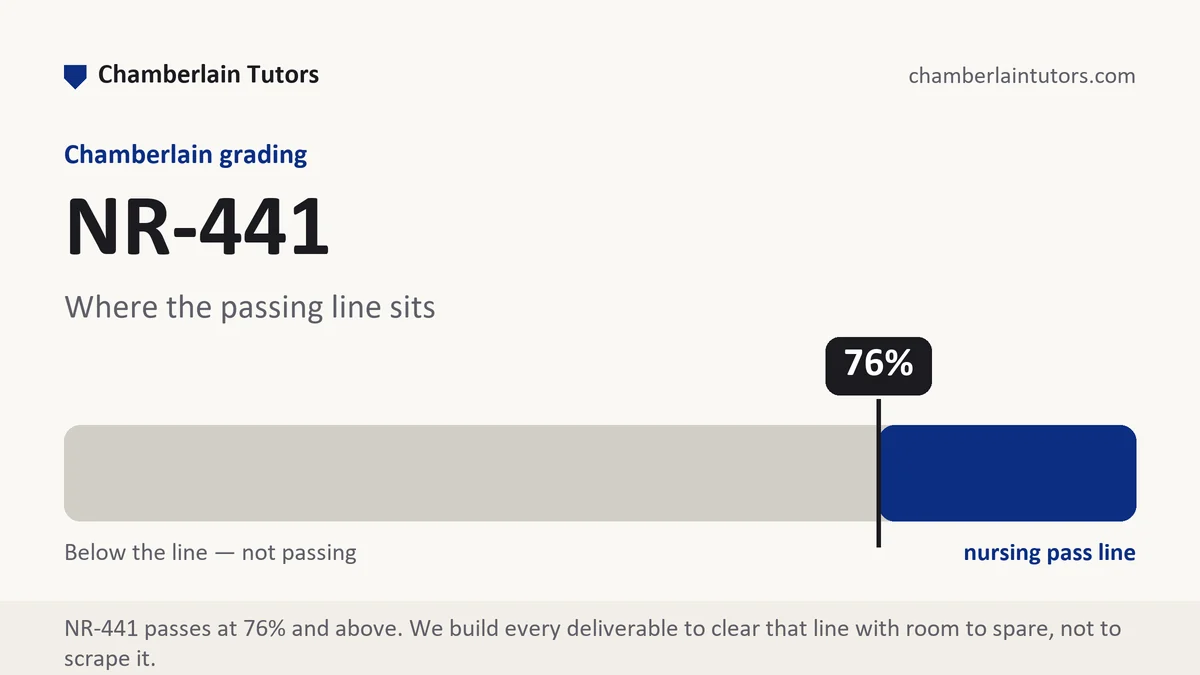
Ninety six clinical hours and weekly written deliverables share the same eight weeks, and they compete for the same evenings. The desk runs them as separate tracks so neither stalls the other: the written work moves through the pipeline on a 24 to 48 hour clock while the hours stay entirely on your side. The 76 percent floor applies here as in every nursing course, so core work is averaged apart from everything else and has to reach 76 on its own before supplemental scores are added in. No volume of later submissions rebuilds an average that has already dropped. Boards do not reopen once posted. Deadlines run Mountain Time whatever your own clock says.
Read the rubric before the prompt, then set the budget
Read the scoring guide first. The prompt sets the subject. The guide sets the payouts, and the order in which a grader will hunt for them. Copy every criterion row into an empty document as a heading, hold the guide's sequence, and draft underneath. Then price the headings before writing a sentence, because comparison papers overspend on description more reliably than any other assignment type in the program.
Take a 1,500 word cap with a guide carrying four rows in raw points: the issue and its burden, 40; the system and determinants producing it, 30; the partnership and plan, 20; APA and scholarly writing, 10. Set aside a flat ten percent, 150 words, for an introduction and conclusion that carry no scored content. That leaves 1,350 words against the 90 points of scored content, once the writing row is lifted out because it is judged across the whole document. Fifteen words per point gives 600 words to the issue and its burden, 450 to the system, 300 to the partnership and plan.
Substitute your own guide's weights and run the same arithmetic, then look hard at what it produced. The system section has earned 450 words. In most drafts it gets one paragraph of context before the writer hurries on to what should be done, and that hurry is where the analysis row goes. If your budget says 450 and your draft says 140, the paper is describing a problem it has not explained.
The shape of a global health analysis
Whatever your section calls it, the dominant deliverable here compares a health problem across settings and ends in a plan. Each part is there to carry one job, and the thin version of it is what graders meet most often.
| Part | What it has to prove | The weak version |
|---|---|---|
| The issue, scoped | One condition or exposure, in a named population, in named places, over a stated period | A disease discussed everywhere at once, which no dataset can support |
| Burden, expressed comparably | Figures put on the same footing before being set beside each other, with the basis stated | Two raw counts from countries of wildly different size, compared as if the numbers meant the same thing |
| The system behind it | How care is paid for, who is licensed to deliver it, how far people travel, what the health workforce actually looks like | Poverty, named once as an explanation and never opened |
| What has been tried | A named program or approach, where it ran, over what period, and what it changed or failed to change | Interventions described in the abstract with no site and no result |
| The local owner | Which ministry, clinic, community organization or cadre of workers holds this work where it happens | Outside agencies as the only actors, with local people appearing solely as recipients |
| The nurse's part | What assessment, planning and delivery look like in this partnership, in verbs somebody performs | Raising awareness, offered with no audience, venue or content |
| The measure | An indicator that is already collected where the work happens, with its baseline and a review window | A measure requiring data infrastructure the setting does not have |
| Transfer limits | What would and would not carry across to another setting, said plainly | A conclusion implying the approach would obviously work anywhere |
Comparing numbers across settings without breaking them
Cross-setting comparison is where this course separates careful writers from confident ones. Four habits carry it.
Never compare raw counts across populations of different sizes. A country of 200 million reporting more cases than a country of 5 million has told you nothing. Put both on a common base, per 100,000 people or per 1,000 live births, and say which base you used in the sentence. Where age structures differ sharply, note whether the figures are crude or age standardized, because a young population and an old one will differ on almost any condition for reasons that have nothing to do with the system you are analysing.
Check that both numbers mean the same thing. Case definitions, reporting requirements and the year of collection vary between countries, and a difference in surveillance can look exactly like a difference in disease. If one figure comes from a national registry and the other from a household survey, say so and let the reader weigh it. That single sentence often earns more than the comparison itself.
Frame each study by what it was and who was in it. State the kind of study, the population and the number of people, before the result appears. Then match the verb to the design: was associated with, occurred more often among, and predicted belong to observational work, while caused, reduced and prevented belong only to studies where something was deliberately changed and measured. Program evaluations frequently report before-and-after change with no comparison group, and that design supports followed by, not caused by.
No rate travels without its base and its period. A bare percentage is decoration wherever in the world it was collected. Write 62 per 100,000 population in 2022 rather than a high rate, and name the year the data were collected rather than the year the report was published. Those two dates can sit five years apart, and in global data the collection date is the one that decides whether your comparison is honest.
What lifts a global analysis above passing
A passing NR-441 paper picks a serious global problem, reports that it is worse in poorer countries, cites agency figures, and recommends education and access. It clears the floor and it could have been written without the course.
Three moves lift a paper out of that pile. It explains a difference rather than reporting one, so the paper spends its longest section on the financing, workforce, distance and licensing arrangements that produce the gap. It credits the people already doing the work by name, whether that is a ministry program, a network of community health workers or a local charity, because the partnership row is scoring your posture as much as your plan. And it states what would not transfer, since an approach resting on a cadre of paid community workers cannot be lifted into a system with no such role, and saying so is the mark of someone who understood the system section they just wrote.
Six mistakes that cost points here
- Comparing counts instead of rates. The single fastest way to lose an analysis row, and the easiest to fix.
- Treating a continent as a country. Health systems, income levels and disease patterns differ enormously inside any region, and a paper that flattens that has not done the assessment the course is named for.
- The rescue frame. Writing where outsiders act and local people only receive contradicts the partnership language the rubric is built on.
- Figures with no data year. Publication year is not collection year, and in global datasets the gap is often large enough to change the argument.
- A plan with no local owner. If no named organization or role would still be there after you left, the plan row has nothing to score.
- Board posts written live. Discussion contributions cannot be edited after submission, so draft outside Canvas and paste the version you want graded.
Questions NR-441 students ask
Can I write a global paper when my clinical placement is in the United States?
How do I compare two countries fairly when their data are not collected the same way?
The approach I found ran overseas. Can I recommend it for my own setting?
Where NR-441 sits in Chamberlain's programs
Open the exact program map for sequence, credit, and option context. The current student schedule and syllabus remain authoritative after transfer evaluation, electives, state rules, and approved plan changes.
The weeks, one by one
Week 1
NR-441 Week 1 is the stage where a bedside nursing student widens the lens from one patient to a whole community, and then widens it again to communities the student will never physically enter. Read the full Week 1 manual.
Week 2
NR-441 Week 2 typically moves from definitions to explanation: why health outcomes differ so sharply between populations, and what forces beyond biology produce those differences. Read the full Week 2 manual.
Week 3
NR-441 Week 3 usually turns the course toward its central skill: assessing a community as a client, in partnership with the people who live there. Read the full Week 3 manual.
Week 4
NR-441 Week 4 is where the course usually hands you the measurement toolkit: incidence and prevalence, rates and ratios, the epidemiologic triangle, chains of transmission, surveillance systems and the outbreak investigation sequence, all read with a cross-border lens because disease does not respect borders. Read the full Week 4 manual.
Week 5
NR-441 Week 5 usually narrows the lens onto populations whose health is shaped by exclusion: people who are unhoused, migrant and seasonal workers, refugees and asylum seekers, people who are uninsured or undocumented, rural residents cut off by distance, and elders isolated by both. Read the full Week 5 manual.
Week 6
NR-441 Week 6 commonly takes the course into emergency territory: the disaster management cycle of mitigation, preparedness, response and recovery; triage and surge in community settings; and the international dimension of outbreak detection and response. Read the full Week 6 manual.
Week 7
NR-441 Week 7 is usually where assessment turns into action on paper: a community diagnosis drawn from the data you gathered, measurable objectives written for a population, an intervention or teaching plan built to fit the community you assessed, and a plan for how it would be delivered in partnership. Read the full Week 7 manual.
Week 8
The written work at the final stage tends to combine evaluation of the intervention you planned, with process and outcome measures separated, and a reflective account of what the whole course, including your 96 clinical hours, changed about how you understand nursing at a population and global level. Read the full Week 8 manual.