NR-435, Community, Public, and Population Health Nursing, carries three theory credits and two clinical credits against 96 clinical hours. It grades your ability to write about an aggregate rather than a patient: who the group is, which social conditions are producing its health pattern, which level of prevention you are working at, and what a community health nurse actually does at that level. This page is the writing manual for that, plus how the desk carries the written half.
What NR-435 actually grades
The catalog frames this course around community, public and global health at all levels of prevention, the role of the community health nurse, social determinants of health, and the needs of community aggregates. Each of those phrases is a scoring row waiting to happen. The graded writing keeps asking one underlying question in different costumes: can you hold a group of people in view as the unit of care, explain their health as a product of conditions rather than choices, and place your own nursing action at a named point on the prevention scale. NR-435 is the state-specific alternative to NR-436, so your paperwork and project rules come from your state while the writing standard stays the same.
How we help in this course
We draft the written layer only: the aggregate analyses, the project documents, the prevention plans, the reflective pieces your scoring guide asks for. The clinical side stays entirely yours. Completing clinical hours, approaching a site or a preceptor, signing placement paperwork and filling an hour log are all outside what we do, and no draft we send will ever claim you did something you did not do. Send the population you have been assigned and the guide from Canvas, and the draft comes back built on your real aggregate.
Orders run the full machinery: your scoring guide decoded row by row, core work tagged separately from supplemental, a writer matched to community and public health, a rubric pass followed by an independent APA and originality pass, the scale check against your section's floor, and delivery inside 24 to 48 hours.
How to write this course's deliverables
Nothing outside Canvas tells you what week five of your own section contains, so a manual built on week numbers would be invention. This one is built on the three things that decide an aggregate paper whatever week produced it: whether your scoring guide became a plan before you drafted, whether one level of prevention stays in focus from first page to last, and whether your population figures are handled well enough to carry an argument. The rest of this page works through all three.
In NR-435 right now?
Send the week and the rubric from Canvas. First premium sample free, floor-checked, back in 24 to 48 hours.
The floor under a five credit course
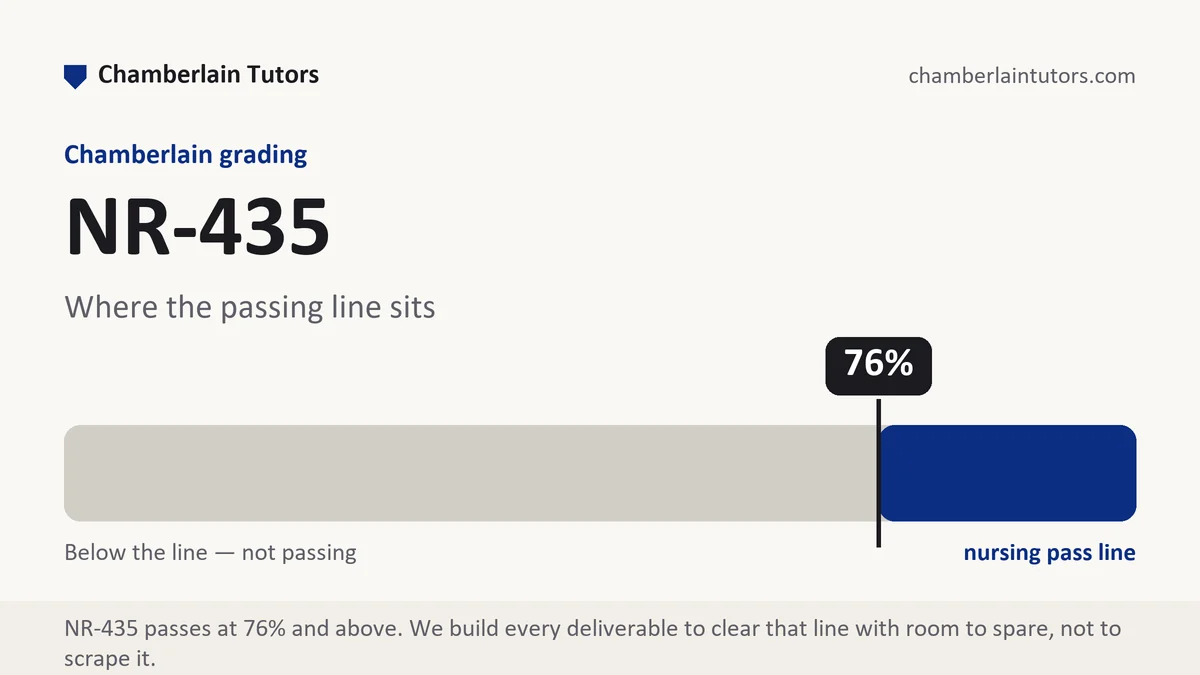
NR-435 is a nursing course, so the 76 percent floor is live on it. Your core assignments form an average of their own, and that average has to reach 76 before any supplemental points are counted at all. Nothing added later lifts a weighted average that has already gone soft. That is why every order gets tagged core or supplemental at intake. Sixteen week semesters run as two eight week sessions, which means a five credit course delivers something graded most weeks and leaves little room to recover from a bad one. Discussion posts do not reopen after submission, so treat the board as final copy.
Read the rubric before the prompt, then build the plan
Read the scoring guide first and the prompt second. The prompt describes the assignment in the voice of someone explaining it to a colleague. The guide describes it in the voice of the person entering your grade, and only one of those documents has points attached. Copy each criterion row into an empty file as its own heading, keep the guide's order, and write under it. That single move stops the most common silent loss here, a paper that answers every row but scatters the answers so widely the grader cannot find them.
Now price the headings. Say your section caps the paper at 2,000 words and your guide carries four scored rows: the aggregate and its determinants at 35 percent, the prevention level and rationale at 25, the nursing role and partners at 25, and scholarly writing with APA at 15. The writing row is judged across the whole document rather than in a section of its own, so lift it out before you divide. Hold back 200 words for an opening and a close that do no analytical work, and 1,800 words remain to spread across 85 points of content. That is roughly 21 words per point: 735 words for the aggregate and determinants, 525 for the prevention level, 525 for the nursing role and partners. Round to the nearest 25 and write the target in brackets beside each heading.
The arithmetic exposes something immediately. The determinants section has earned more than a third of the paper and the nursing role section has earned as much as the prevention section, which is far more than either usually gets. Delete a bracket only when its section reaches the number. A heading sitting 200 words short is not concision, it is a row you have half answered.
The shape of an aggregate paper
Whatever your section calls the deliverable, an aggregate-focused paper keeps one skeleton. Each part exists to prove one thing, and the thin version of each part is where the points quietly leave.
| Part | What it has to prove | The thin version |
|---|---|---|
| The aggregate, named | A group defined by something you can count: an age band, a diagnosis group, an occupation, a residency status, within a stated geographic boundary | The community, which names no group and attaches to no dataset |
| The health pattern | What is happening to this group, stated with a figure, a source and the year the data were collected | A condition described as common or rising with nothing behind the adjective |
| The determinant chain | The specific conditions producing the pattern, traced in order: what the group lacks, what that forces, what health outcome follows | A list of the standard determinant headings with no line drawn from any of them to the outcome |
| The prevention level, declared | One level chosen and named in a sentence, with the reason it is the right one for this group right now | Prevention discussed generally, sliding between screening and treatment without noticing |
| The nurse's role at that level | What a community health nurse does, in verbs a person could perform on a Tuesday, at the level you declared | Educate and advocate, offered without a venue, an audience or a subject |
| The partners | The agencies, employers, schools or faith organizations already touching this group, with what each brings | The community, treated as a single willing partner with no name |
| The measure | One indicator that exists, its baseline value and the window over which change would be checked | Outcomes will improve, which no one can verify and no grader can credit |
| Access and ethics | Who gets left out of the plan you just wrote, and what you would do about that | Silence, which reads as not having thought about it |
Handling determinant data so it holds
Population evidence is graded on discipline more than on volume. Four habits carry most of the difference in this course.
Separate the publication year from the data year. An article released last spring can be reporting a survey fielded five years earlier, and for an aggregate profile the collection date is the one that decides whether your description is current. Name it in the sentence. Writing that a 2022 survey of the county found something is a stronger evidence sentence than a citation alone will ever be.
Introduce a study before you use its result. A finding arriving with no setup is an assertion wearing a citation. Name the kind of study, in whom, and how many, then report what it found. A cross-sectional survey of 412 adults in one clinic and a national cohort followed for a decade cannot support the same sentence.
Match the verb to the design. Determinant research is almost entirely observational. Housing instability was associated with more emergency visits. Uninsured status predicted later presentation. Keep caused, reduced and prevented for designs where something was changed on purpose and measured. A single overreaching verb undoes an evidence row the surrounding sentences had already secured.
Give every rate a denominator and a window. A percentage with no base and no period is decoration. Write 31 per 100,000 residents in 2023, or one in six of the 890 households surveyed over the preceding twelve months, and say whether a rate is crude or age adjusted before you compare it to anything. Then respect what kind of number it is. Area-level figures describe areas: a tract with high uninsurance tells you nothing about whether the particular family in your case is insured, and reasoning downward from the group to the person is the one inferential move the analysis row is built to penalize.
What lifts an aggregate paper above passing
A passing NR-435 paper picks a plausible group, lists social determinants under their usual headings, proposes education, and cites sources that exist. It clears the floor and reads like every other paper submitted that week.
Four things separate that from a paper in the top band. The group is narrow enough to be actionable, because older adults in the county is not a plan and adults over 75 living alone in one housing complex is. The determinants are chained rather than listed, so the reader can follow one condition into one consequence into one outcome without guessing. The prevention level is declared and then held, so screening language does not wander into treatment language on page three. And the nursing role is written in performable verbs attached to a real venue, with a partner who already exists and a measure someone already collects.
Six mistakes that cost points here
- Writing about a disease instead of an aggregate. The unit of care in this course is a group of people, and a paper organized around a condition quietly answers a different assignment.
- Determinants listed but never linked. Naming the standard categories earns nothing on its own. The points sit in the line you draw from a condition to an outcome.
- Sliding between prevention levels. Declaring primary prevention and then spending the plan on case management reads as not knowing the difference, which is precisely what the row is testing.
- Reading an area statistic onto a person. County and tract figures describe places. Using one to assert something about an individual is the error the analysis row was built to find.
- Board posts drafted in the box. Discussion contributions are permanent once submitted, so compose elsewhere, read it cold once, then paste the version you are willing to be graded on.
- Writing past what your hours covered. A document claiming an intervention your clinical time never reached leaves the same instructor holding two accounts of your semester that do not match.
Questions NR-435 students ask
What actually counts as an aggregate, and how narrow should it be?
I am registered in NR-435 rather than NR-436. Does the writing standard change?
My site only lets me observe. How do I write a paper about a project I did not run?
Where NR-435 sits in Chamberlain's programs
Open the exact program map for sequence, credit, and option context. The current student schedule and syllabus remain authoritative after transfer evaluation, electives, state rules, and approved plan changes.
The weeks, one by one
Week 1
NR-435 opens by reversing the direction every prior clinical course pointed you: the patient is no longer one person in one bed but a population with a health status, and the opening written work usually asks you to define community health nursing, distinguish the three levels of prevention, and. Read the full Week 1 manual.
Week 2
Once the population lens is in place, this course typically hands you its most consequential concept: the social determinants of health, the conditions of living, earning, learning and aging that shape outcomes more powerfully than most clinical care does. Read the full Week 2 manual.
Week 3
The assessment stage is where this course's writing gets its clinical shape: a community assessment paper, often anchored by a windshield survey your own eyes perform, that gathers observational and published data about one defined community and ends in a prioritized community health diagnosis. Read the full Week 3 manual.
Week 4
Somewhere near the middle of this course the numbers take over: an epidemiology stage that asks you to read and use rates, incidence, prevalence and the epidemiologic triangle the way earlier clinical courses asked you to read lab values. Read the full Week 4 manual.
Week 5
After assessment and data, the course's arc bends toward intervention: a planning stage that asks you to take one aggregate, a subgroup sharing a characteristic and a risk, and build a written plan for improving a specific health outcome across all three levels of prevention. Read the full Week 5 manual.
Week 6
Health promotion is where this course puts teaching at the center, and the written work of this stage is usually a teaching plan: a structured document specifying who will be taught, what they will be able to do afterward, through which activities, verified how. Read the full Week 6 manual.
Week 7
Near the end of the arc, the course widens to its largest frames: what communities face when hazards strike, what environments do to health continuously, and how local nursing connects to global patterns. Read the full Week 7 manual.
Week 8
Final weeks in a clinical community course carry two closing motions at once: evaluating the population-level work the session produced, what moved, what did not, how anyone can tell, and synthesizing the Community Health Nurse role into your own forward practice as the clinical hours wind down. Read the full Week 8 manual.