NR-361 is the RN-to-BSN version of Chamberlain's informatics course, three theory credits with no clinical component. It does not grade how skillfully you click through your employer's system. It grades two things in writing: whether you can manage data, information, knowledge and technology ethically, and whether you can search a database well enough to bring back evidence that answers a real practice question. Every point in the course is earned in text.
What NR-361 actually grades
The catalog describes NR-361 as a lecture-only course on ethically managing data, information, knowledge and technology, and on searching databases for evidence that informs practice decisions. Those two halves explain almost every scoring row you will meet. The first half asks you to think about information as an object with a lifecycle: it gets captured, stored, transmitted, interpreted and eventually acted on, and a nurse is accountable at each of those moments. The second half asks you to demonstrate retrieval as a skill, which means a graded submission usually has to show the search itself, not only what the search happened to find.
That second demand catches experienced nurses off guard. You may have twenty years of practice knowledge and still lose points because the paper reports a conclusion without showing where it came from. In this course, the path to the evidence is part of the evidence. A grader wants to see the question you asked, the database you asked it in, the terms and limiters you used, how many results came back, how you narrowed them, and why the handful you kept deserved to be kept.
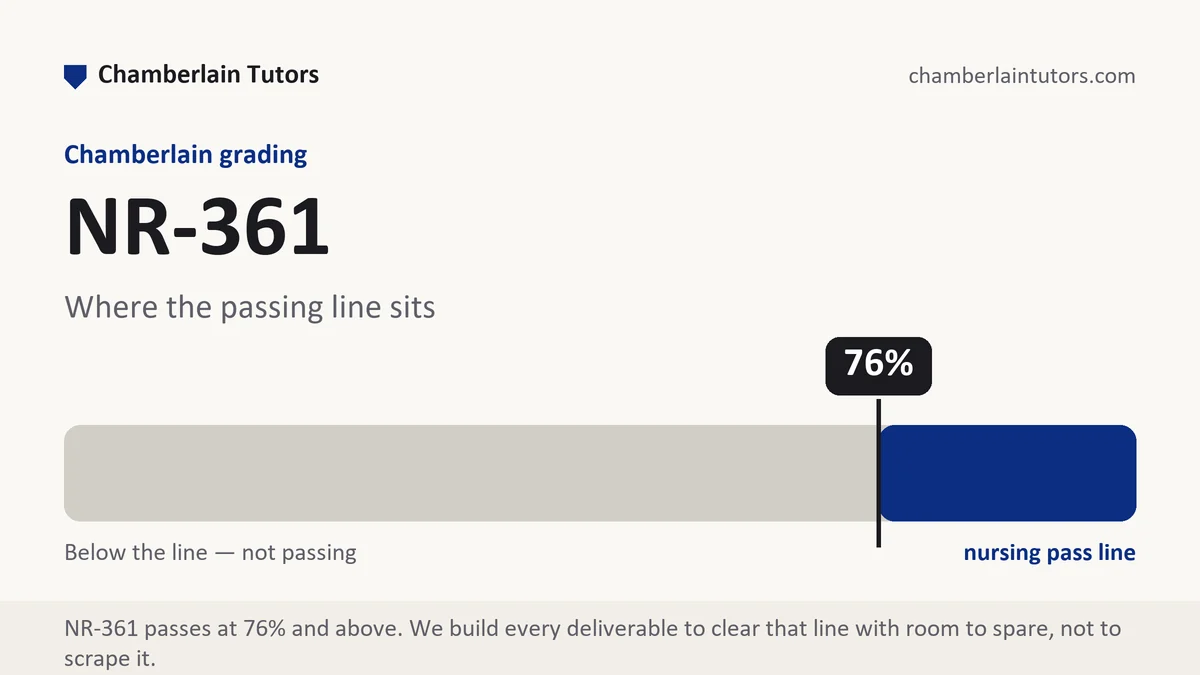
The course sits in an eight-week session, half of Chamberlain's sixteen-week semester, with new starts running up to six times a year. Work is due weekly, the LMS is Canvas, and discussion posts cannot be edited once they are submitted. Seventy-six is the number that matters in core nursing coursework, and since nothing supplementary raises an average that has already sagged, the room you need gets won inside the graded pieces themselves, starting in the first week.
How we help in this course
Drafts for NR-361 treat the search trail as a section rather than an afterthought, and they keep information ethics concrete instead of ceremonial: who may see this record, under what authority, for what purpose, and what a nurse does when the answer is unclear. If your grades sag when a paper has to prove its own method, this is the course where a worked model changes the pattern quickly.
Terms are the same across the site: a premium original draft in 24 to 48 hours, targeted at the A band of your course's actual scale, through the full pipeline with both quality passes and the floor check, revised free until it lands.
Start with the scoring guide, not the prompt
A prompt names the topic. The scoring guide says where the points actually sit, and in an informatics course those two documents often stress different things. A prompt might invite you to discuss a technology you use; the scoring guide underneath it may spend most of its weight on evidence retrieval and ethical handling, with the technology itself worth comparatively little. Students who write to the prompt alone produce an enthusiastic paper about a system they like and score in the seventies.
Pull the criterion rows out of Canvas into an empty file and underline the working verb inside each one: identify, search, appraise, apply, evaluate, protect. Build the outline from those verbs, keeping the sequence the guide uses, so whoever is scoring row three is reading your third section when they get there.
Next, price each row in words, since a weighting is really an instruction about depth. Take a week that limits the paper to 1,200 words across four rows carrying 35, 25, 25 and 15 percent. Multiply through and you get about 420 words for the heaviest row, 300 apiece for the pair in the middle, and 180 for the lightest. Then look at what that buys. When the 35 percent row is the retrieval and appraisal row, 420 words go to describing and defending the search, roughly four times the two-sentence mention a first draft usually gives it. Find out whether your guide counts the title page and references inside the limit before you shorten any analysis to make space for them.
Leave the word target visible in brackets by every heading and clear it only once that section has earned it. A section sitting far below its share is not brevity. It is a signal that you skipped the part the course is measuring.
The shape of a search and apply paper
Most graded writing in NR-361 is a variation on one form: a practice question, a documented search, an appraisal of what came back, and a decision that follows from it. It arrives as a paper one week and as an extended board post another, but the parts hold, and every one of them is either visible to a grader or missing.
| Section | What it must demonstrate | The version that loses points |
|---|---|---|
| The practice question | That you narrowed a clinical concern into something answerable, with the population, the intervention or exposure, and the outcome all named. | A topic rather than a question, such as "falls in older adults". |
| Search strategy | Which database, which terms, which Boolean combinations, which limiters and date span, and how many results the search returned. | "I searched the library databases and found several articles." |
| Screening decisions | Why the set shrank from dozens to a few: the inclusion rule you applied and the reason articles were dropped. | A jump straight from the search to the chosen sources with nothing in between. |
| Appraisal of what you kept | What kind of study each source is, how many participants it involved, and how much confidence its design supports. | Author and year listed as if publication alone were quality. |
| Application to the decision | What a nurse on a unit would actually do differently, stated with enough specificity that a colleague could follow it. | A recommendation to "increase awareness" or "provide education". |
| Ethical and information handling | How the data behind the decision is protected in transit and at rest, who has legitimate access, and what the limits of that access are. | A closing sentence naming privacy without describing a single safeguard. |
In NR-361 right now?
Send the week and the rubric from Canvas. First premium sample free, floor-checked, back in 24 to 48 hours.
Evidence craft when the evidence is the assignment
In most nursing courses citations support the argument. Here they largely are the argument, so the handling has to be visibly careful.
Currency you check rather than assume. Anything older than five years should have to justify its presence in the sentence where it appears. A course built on retrieval adds a second date to watch: a review published last year may have closed its own search two or three years before it went to print, so the evidence inside it is older than the publication year suggests. Say which date you mean whenever recency is part of the argument, and check the search window reported inside any review you lean on.
The design and the sample come first. A finding should never arrive bare. Name what produced it and how large it was before you report what it showed. "In a two-site interrupted time series covering 41,000 medication orders" costs a dozen words and gives the finding a size the reader can judge it by.
Verbs that match the design. Observational and before-and-after implementation work carries phrases such as "was associated with", "rose after" and "occurred more often among". Only a controlled comparison earns "reduced", "caused" or "produced". Informatics writing is full of implementation studies with no control group, and attaching a causal verb to one is the fastest way to lose an appraisal row.
Denominator and window before any rate. A bare percentage with no count behind it and no period attached is ornamentation. Write "roughly one in fourteen of the 3,600 alerts issued during the six-month period were overridden" rather than "7 percent of alerts were overridden". The longer sentence is the one that scores, and it also prevents you from repeating a number whose meaning you never checked.
Accurate versus auditable in NR-361
A passing NR-361 paper is accurate and tidy. It names a real technology, cites real articles, mentions privacy, and recommends education. It reads like a capable summary of things that are true, and it lands in the high seventies or low eighties without the writer understanding why.
Three differences separate a strong paper from that one. First, it is auditable: a reader could repeat your search from your own description and arrive at a similar set, which is the informatics version of showing your work. Second, it stays inside one decision. Weak papers survey a whole domain politely; strong ones take a single practice question and follow it from search to appraisal to what changes on Monday. Third, its ethics section describes mechanisms rather than values. Anyone can write that patient information deserves protection. A strong answer says which safeguard applies at which point in the information lifecycle, and what a nurse does when a workaround starts to feel normal on the unit.
Six mistakes that cost real points in NR-361
- Reporting results without reporting the search. The retrieval process carries scoring weight of its own. A paper with excellent sources and no visible method has thrown away a row it could have written in twenty minutes.
- Searching the open web and calling it a database. A general search engine is not a bibliographic database, and a graded strategy that names one usually loses the appraisal row alongside the search row.
- Treating a discussion post as a draft. Chamberlain boards do not reopen once you submit, so every post is one attempt. Compose it somewhere else, check it against the prompt, and paste only when it is finished.
- Confusing data with information. The course distinguishes raw data, interpreted information, applied knowledge and the judgment built on top. Using the words interchangeably reads as not having understood the framework the rest of the course is built on.
- Ethics by adjective. Sentences that call a practice secure, appropriate or compliant without naming what makes it so are the most common filler in this course, and graders read them as space taken from analysis.
- Recommending something the search never examined. When the retrieved evidence is about discharge instructions and the recommendation is about staffing ratios, the paper has two halves that never touch, and the application row is exactly where that shows.
Questions NR-361 students send
How much of the paper should describe the search itself?
My topic returns thousands of articles. How do I narrow it without losing the point?
Can I write about the system my employer uses?
Where NR-361 sits in Chamberlain's programs
Open the exact program map for sequence, credit, and option context. The current student schedule and syllabus remain authoritative after transfer evaluation, electives, state rules, and approved plan changes.
The weeks, one by one
Week 1
NR-361 Week 1 opens the RN-to-BSN informatics course by asking a working nurse to look again at the systems she already uses every shift and to write about them analytically instead of operating them automatically. Read the full Week 1 manual.
Week 2
NR-361 Week 2, in the arc we teach the course by, turns to the electronic health record from the only chair a working RN has ever occupied: the user's. Read the full Week 2 manual.
Week 3
NR-361 Week 3, in the arc we teach the course by, examines how the words a nurse charts become data that can travel, or fail to. Read the full Week 3 manual.
Week 4
NR-361 Week 4 takes up the second pillar of this course's catalog description: searching databases for evidence to inform practice decisions. Read the full Week 4 manual.
Week 5
NR-361 Week 5, in the arc we teach the course by, asks what the sources you retrieved are actually worth to the practice decision that started the hunt. Read the full Week 5 manual.
Week 6
NR-361 Week 6, in the arc we teach the course by, takes up the word the catalog puts first: ethically managing data, information and technology. Read the full Week 6 manual.
Week 7
NR-361 Week 7, in the arc we teach the course by, turns the record around to face the patient: portals that release results the moment they post, notes patients now read, messages that arrive in nursing queues, and the home-generated readings from cuffs, scales and wearables that patients bring to their care. Read the full Week 7 manual.
Week 8
NR-361 Week 8, in the arc we teach the course by, closes the session by pointing the course's tools at what is arriving next: decision support that grows more assertive, analytics that try to see deterioration coming, documentation that listens instead of waiting to be typed. Read the full Week 8 manual.