In the RN to BSN sequence, NR-360 is Technology in nursing course. Students search the code mid-panic more than any title, so this page answers the code: here is the honest read and the service behind it.
What NR-360 actually grades
The RN-to-BSN's technology-in-nursing territory: informatics writing where the EHR you use every shift becomes analytical subject matter, impacts on outcomes and workflow argued rather than described.
How we help in this course
Our drafts translate shift-floor experience into informatics register with the regulatory layer named precisely. If acronym-dense writing is where your grades sag, this course is where a model fixes it.
The service terms match the whole site: 24 to 48 hour delivery, A-band targeting on your scale with the floor math shown, two independent QA passes, free revisions until the target is met.
How to write this course's papers
You will not find an NR-360 syllabus published outside Canvas, so this manual works from the rubric instead of from a week grid. What the course does is turn the systems you already use into subject matter: clinical information systems, patient care technologies, telehealth, and the privacy and regulatory layer wrapped around all of them. That shift is where the grades move, because knowing a system and analyzing one are different skills, and the rubric only pays for the second.
In NR-360 right now?
Send the week and the rubric from Canvas. First premium sample free, floor-checked, back in 24 to 48 hours.
Turning shift-floor fluency into informatics prose
The gap NR-360 exposes is rarely knowledge. Working nurses know their EHR intimately; what the course grades is arguing about it, impacts on outcomes and workflow analyzed rather than described, the regulatory layer named precisely, acronyms deployed as analysis instead of decoration. Our drafts do that translation: your everyday system experience recast in informatics register with the argument structure the rubric rows actually pay for. Regulatory names are written precisely, because precision is what separates analysis from familiarity in this genre and the evidence rows check for it.
A week of this course against the desk's clock
The weekly shape is familiar RN-to-BSN territory, boards plus written work, and the desk's rhythm covers both ends: posts drafted to final quality for the one permanent submission Chamberlain boards allow, papers through the eight-person pipeline inside 24 to 48 hours, everything cleared ahead of the 11:59 p.m. Mountain-Time line. Drafts are pre-scored on your course's actual ladder before delivery, and revisions stay free until the target letter posts.
Seeing the register before you commit
If acronym-dense writing is where your grades sag, the free first sample is the fix demonstrated rather than promised: one informatics deliverable, premium standard, no charge. Send the week's prompt and rubric in chat and read the difference between describing a system and analyzing one; the walkthrough annotates every move so the method transfers to the weeks you write yourself. Informatics is the course where clients most often report the method sticking.
Read the bands, not just the rows
Read the scoring guide sideways, and read it before the prompt. Most students go down the criterion column and stop there. The information you actually need sits across the row, in the gap between the top band and the one immediately beneath it.
Take a row worth 20 percent of a 1,200-word paper. That is 240 words. Now read its bands: the top says analyzes the impact on outcomes, the level below says describes the impact on outcomes. Same subject, different job, and that two-word difference tells you how to spend the 240. It is not 240 words of description. It is roughly a third setup and two thirds argument, so about 80 words establishing the system and what it does, then 160 on impact with evidence attached.
Turn that into a rule you can apply while drafting: every descriptive sentence has to be followed by a consequence. The system flags duplicate orders. Therefore the pharmacist stopped fielding repeat calls from the floor, and therefore verification time on that unit dropped. Description that never reaches a therefore is the most common reason a paper that felt thorough to write scores in the middle.
Run that comparison on every row before you draft. One or two will look descriptive and turn out not to be, and those are the rows to protect when the week compresses.
What the informatics analysis paper has to contain
Prompts here vary, but the graded paper is nearly always the same object: one technology, in one setting, argued rather than toured. These are the parts that carry it.
| Part of the paper | What it has to demonstrate |
|---|---|
| Purpose and the system named exactly | Which system, which module, in which care setting. "The EHR" is not a subject; a named system on a named type of unit is |
| The workflow before | What the task looked like without the technology, in enough operational detail that a reader outside your unit can follow it |
| The workflow after | What changed, step by step, including the steps that got longer rather than shorter |
| Regulatory and privacy layer | The specific rule that applies, named. HIPAA is a statute with distinct rules under it, and the Privacy Rule and the Security Rule govern different things |
| Data integrity and quality | Whether the data is accurate, complete, consistent, and timely, which is a separate question from whether it is protected |
| Outcome claim with its measure | One claim about quality, safety, or delivery, tied to a number carrying a denominator and a period |
| Barriers and unintended consequences | Alert fatigue, workarounds, training burden, access gaps. A paper with no downside in it reads as marketing |
| Nursing role and professional identity | Where the nurse sits inside the system, what judgment stays human, and what the technology cannot do |
| Conclusion with a usable recommendation | Something specific enough for a manager to act on, and it names who would own it |
The two rows students consistently underspend are barriers and the nursing role. They are also the two where a working nurse has the most to say that no general source could supply, which makes them the cheapest points on the page.
Evidence and citation craft for informatics
This evidence ages faster than almost anything else you will cite. A source on clinical information systems written ten years ago is describing products that have since been replaced outright, so unless you are citing a regulation or a genuine landmark, work inside roughly the last five years and let your reference list show it.
Separate vendor material from evidence. A product sheet, a marketing page, or an implementation summary published by the company selling the system is a claim, not a finding. You may use it, and sometimes you should, but label it inside the sentence: the vendor reports, or according to the manufacturer's own summary. What you cannot do is let it sit in a paragraph beside peer-reviewed work as though the two were the same kind of thing.
Put design and setting in front of findings. A pre-post comparison at one 300-bed community hospital and a multi-site study support very different claims, and go-live comparisons are confounded by training, staffing changes, and simple elapsed time. That is why the honest verb for most implementation results is "was associated with" rather than "reduced." Keep causal language for designs built to carry it and your evidence rows stop leaking.
Then hold every rate to its denominator and its window. "Medication errors fell 30 percent" is unusable standing alone. Errors per thousand doses or per hundred admissions, measured across which months, compared against what baseline: those details turn a slogan into support. Expand each acronym once at first use and then use it, because a reader should never have to decode a sentence in order to grade it.
Description versus analysis, in grade terms
The safe version of this paper describes a technology accurately and lists its benefits. Nothing in it is inaccurate, and it still lands mid-band, because the guide asked for analysis and received a tour.
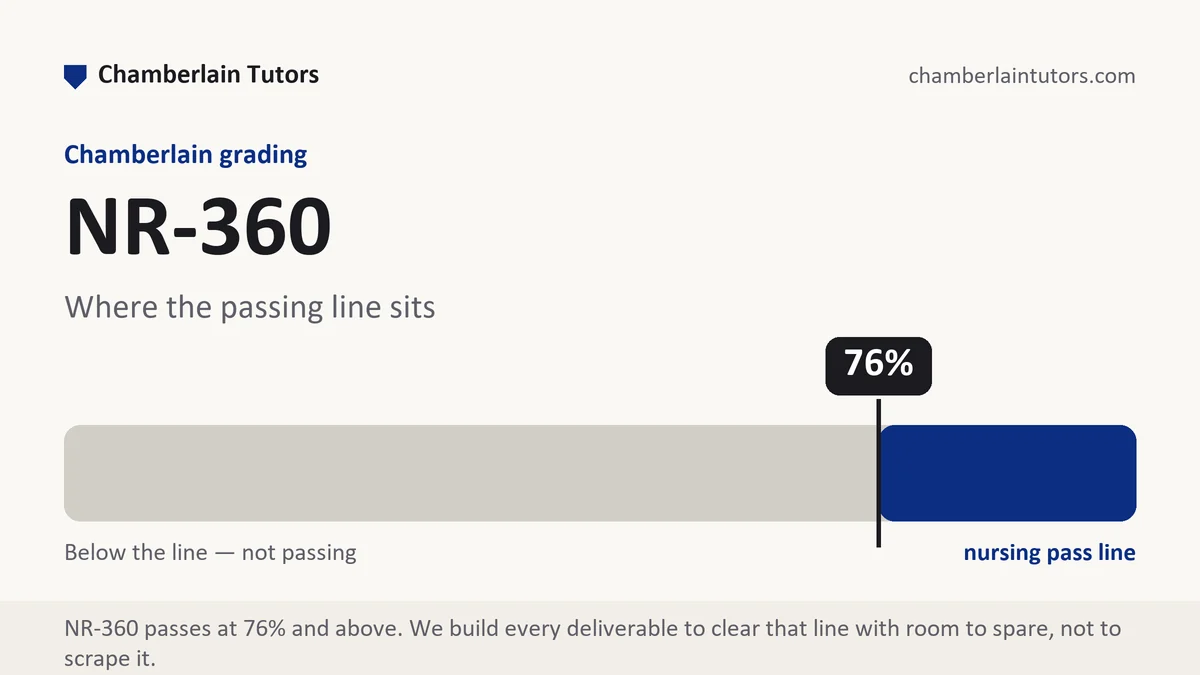
A strong one is narrower and harder. It names one system in one setting instead of surveying the field. It traces a single workflow change to a single measured outcome, denominator and period visible, so the claim can actually be checked. It names the specific regulation rather than gesturing at HIPAA, and treats data integrity and data security as the two different problems they are. It reports what the technology cost the unit in alerts, workarounds, or training hours, because a paper with no downside is not analysis. And it puts the nurse back at the center, saying which judgment the system supports and which it cannot replace, which is the row the course was designed around. In a core nursing course sitting on a 76 percent floor, the distance between touring and arguing is several letter grades rather than a rounding error.
Six habits that quietly cost you points
Vendor material used as evidence
Cite it as a claim and attribute it in the sentence. Presented as a finding, it costs the evidence row and quietly undermines the rest of the paragraph.
"HIPAA requires" with no rule named
Say which rule and what it governs. The Privacy Rule and the Security Rule cover different ground, and the precision is exactly what the regulatory row is checking for.
An acronym that never gets expanded
Expand once, at first use, then use the short form. Undefined initials read as borrowed language even when the understanding behind them is real.
A benefit claimed with no measure behind it
Improves efficiency, enhances safety, and streamlines care are unscoreable. Attach a number with a denominator or drop the claim.
Treating data integrity as data security
Integrity is whether the data is accurate, complete, and consistent. Security is whether it is protected. Papers that merge them leave a whole row unpaid.
A section about your own unit with no source anywhere in it
Your observation is legitimate material, but it needs published evidence beside it. Experience supplies the example; the citation supplies the warrant.
Three questions students send about 360
Can I write about the electronic health record my employer uses?
I know this system inside out. Why does my feedback say the analysis is thin?
How recent do sources have to be, and can I cite the vendor?
Where NR-360 sits in Chamberlain's programs
Open the exact program map for sequence, credit, and option context. The current student schedule and syllabus remain authoritative after transfer evaluation, electives, state rules, and approved plan changes.
The weeks, one by one
Week 1
NR-360 Week 1 is where the informatics course teaches you to see the difference between a number on a monitor and a decision at a bedside. Read the full Week 1 manual.
Week 2
NR-360 Week 2, by our read of the course's arc, moves from concepts to the system nurses live inside: the electronic health record. Read the full Week 2 manual.
Week 3
NR-360 Week 3, in our teaching arc for the course, examines the machinery that thinks alongside the nurse: clinical decision support, from drug interaction checks and dosing alerts to order sets and documentation prompts. Read the full Week 3 manual.
Week 4
NR-360 Week 4, as we stage the course, turns to the hardware that touches patients: infusion pumps with dose-limit libraries, barcode medication administration, continuous monitoring, and the growing family of devices that feed the record automatically. Read the full Week 4 manual.
Week 5
NR-360 Week 5, in the arc we teach the course by, leaves the building: telehealth visits, remote monitoring, tele-ICU coverage, and the question of what nursing looks like when the patient and the nurse are not in the same room. Read the full Week 5 manual.
Week 6
NR-360 Week 6, as we stage the course, turns to trust in the data itself: integrity, meaning the record says what actually happened; security, meaning only the right people can read or change it; and downtime, meaning what nursing does when the system is gone. Read the full Week 6 manual.
Week 7
NR-360 Week 7, in our staging of the course, is the law and ethics week: federal privacy protection, the minimum necessary idea, the audit trail that watches every chart access, social media hazards, and the ethical reasoning that starts where the regulations stop. Read the full Week 7 manual.
Week 8
NR-360 Week 8, as we stage the arc, closes the course by looking forward and pulling together: an emerging patient care technology examined with the analytic tools the past seven weeks built, and a synthesis of what informatics now means for the nurse you are about to become. Read the full Week 8 manual.