NR-329 Adult Health I is the expanded clinical version of adult health one: three theory credits and three clinical credits across 144 clinical hours, with the same content, adult patients and families in health promotion and in the management of acute and chronic conditions using the nursing process. The extra clinical time does not add extra pages, but it changes what the writing is made of. With three days of patient contact behind each submission, the graded work leans on reflective and reasoning pieces that ask you to account for decisions you actually watched being made.
What NR-329 actually grades
Transfer, mostly. The theory arrives in one place and the patients arrive in another, and the written work asks whether you can connect them in a specific direction: from a cue you noticed on the unit back to the concept that explains it, then forward to what you did or would do. Reflective journals, reasoning write-ups and case analyses all test that loop. A submission that narrates a shift chronologically has described the day rather than analyzed it, and chronology is the default mode students fall into when they write tired.
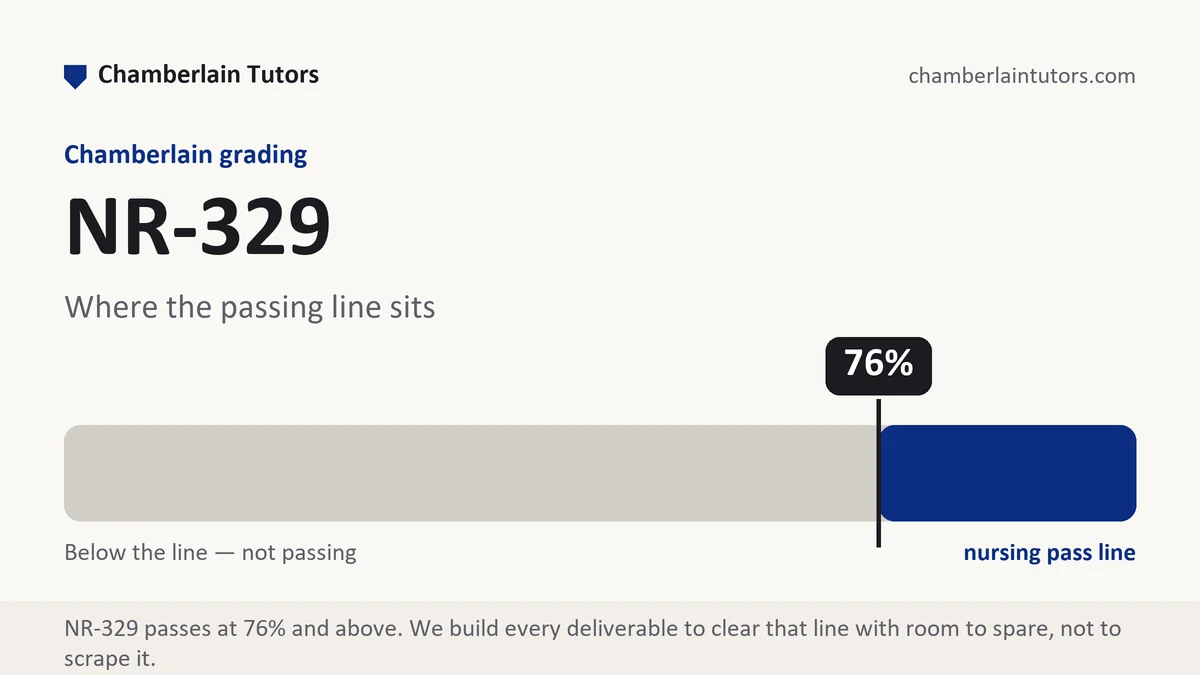
Core nursing courses pass at 76 percent, and a six-credit course is not a place to test that line. What makes a six-credit course dangerous is arithmetic rather than difficulty: it is the largest single contributor to the term average most students will have carried so far, and the writing is due on the days when the clinical load is heaviest.
How we help in this course
We write the reflective and analytic pieces, clinical reasoning journals, case analyses, care plans, concept maps, pathophysiology and medication write-ups, board responses. The move our drafts model is turning a shift into an argument: one decision point identified, the cues that surrounded it named, the alternatives considered, the reasoning made visible.
The 144 clinical hours are entirely yours. We do not attend, contact your site or instructor, complete or sign placement paperwork, or record time. Nothing we send is meant to represent hours you did not work.
In NR-329 right now?
Send the week and the rubric from Canvas. First premium sample free, floor-checked, back in 24 to 48 hours.
Read the rubric before the prompt
Reflective assignments carry the loosest prompts and the tightest scoring guides in the program, which is a bad combination for a tired student. Open the guide first. List its criterion rows, reduce each to a verb, describe, connect, analyze, evaluate, plan, and note how few of them reward description.
Then price them. A 900 word journal with rows at 40, 25, 20 and 15 percent gives roughly 360, 225, 180 and 135 words. If the 40 percent row is analysis and the 15 percent row is the account of what happened, then the narrative you want to write, the story of the shift, is the smallest section in the assignment. Most students invert this completely, spending 600 words on the story because it writes itself and 100 on the analysis because it does not. That single inversion explains most middling reflective grades in this course.
Bracket the targets and hold the narrative down. If the analysis section will not fill, you have chosen an event where nothing was decided; pick the moment where you were unsure instead of the moment where things went well.
One practice makes the writing manageable at this clinical volume. Before leaving the unit, write four lines in a notebook: what happened, what I noticed, what I thought at the time, what I still do not understand. It takes ninety seconds and it preserves the material the analysis rows need, especially your own uncertainty, which is the first thing memory edits out. Journals written from those four lines have a decision point ready-made; journals written from a blank page hours later default to chronology because chronology is the only thing still available to you.
The shape of a clinical reasoning journal
Whatever your assignment calls it, the reflective deliverable here works best in this order, and graders read for these pieces rather than for the chronology.
| Piece | What it delivers | What the tired version does |
|---|---|---|
| The situation, compressed | Three sentences of context: who, what changed, what was being decided. | A full chronological account of the shift from arrival onward. |
| The cues | The specific findings, values or statements that pointed somewhere. | A general sense that the patient seemed unwell. |
| The hypothesis | What you thought was happening, said plainly, including if you were wrong. | The correct answer written in retrospect as though it was obvious. |
| The alternatives | What else the cues could have meant and which finding would have told them apart. | One explanation presented with no competition. |
| The action and its rationale | What was done, by whom, and the physiology or evidence behind it. | The nurse handled it, with no reasoning recovered. |
| The theory link | The concept from class that explains the case, applied rather than named. | A citation appended to the end of a story. |
| The forward step | What you would do differently or watch for earlier next time, stated concretely. | A promise to keep learning. |
Evidence and citation craft at this level
Reflective writing still carries a support row, and students routinely treat reflection as the one place citations are optional. Four habits keep the analysis credible.
Currency, with older sources justified. Management of the acute and chronic conditions you will meet on an adult unit changes with guideline cycles, so anything past five years needs its reason stated. A classic account of a physiological mechanism is fine; a dated target value quoted into a reflection is a correction waiting to happen.
Design and sample before the finding. Even in a journal, put the study ahead of the number: "in a trial of 640 hospitalized adults" earns the sentence that follows. One properly framed source in a reflection is worth more than three references listed at the end with nothing attached to them.
Association verbs when explaining an outcome. Reflections are where causal overstatement hides, because you watched the sequence yourself. The patient improved after the intervention is an observation; the intervention improved the patient is a claim your single case cannot support. Write what you saw and what the evidence associates, and keep the two clauses separate.
Denominator and window before any rate you import. If you bring an incidence figure into a journal to argue that a complication is common, carry its base and its period: "roughly 1 in 12 of the 1,500 patients studied developed it within 72 hours of admission". Bare percentages in reflective writing look borrowed, because they usually are.
What separates a passing journal from a strong one
A passing NR-329 reflection is sincere and chronological. It reports a day, it says the student learned, it usually ends with a resolution to be more confident. It scores in the high seventies because nothing in it is analyzable, and the analysis rows have to be scored on something.
Strong journals share three features. They isolate one decision point rather than covering a shift, which is what makes depth possible in 900 words. They admit an alternative that was ruled out and say what ruled it out, because reasoning is visible only when something was rejected. And they link forward with a specific behavior, naming the cue they will check earlier or the question they will ask sooner, rather than a general intention. One decision, a rejected alternative, a concrete next behavior.
Mistakes that cost points here
- Narrating the shift. Chronology eats the word budget and satisfies the lightest weighted row in the guide. Compress the story to three sentences and spend the rest on the reasoning.
- Choosing the comfortable moment. Events where everything went well produce no analysis. Write the one where you hesitated, which is also the one you will remember.
- Reflection with no sources. The support row does not disappear because the genre is personal. One well-framed citation attached to the theory link is usually enough.
- Retrospective certainty. Writing your hypothesis as though you knew all along removes the reasoning the assignment is scoring. Say what you thought at the time.
- Identifiers from the unit. No initials, room numbers, dates, staff names or facility. Describe by age band and clinical picture only.
- Writing at the end of a 12 hour clinical day. With 144 hours of placement in this course the temptation is constant, and board posts cannot be edited after submission at Chamberlain. Capture two lines of notes before you leave and draft with a clear head.
Questions NR-329 students ask
How is NR-329 different from the standard adult health one course?
What do I write about if nothing dramatic happened on my clinical days?
Can you write my reflection when you were not there?
Where NR-329 sits in Chamberlain's programs
Open the exact program map for sequence, credit, and option context. The current student schedule and syllabus remain authoritative after transfer evaluation, electives, state rules, and approved plan changes.
The weeks, one by one
Week 1
NR-329 is Adult Health I in its expanded clinical form: the catalog pairs the adult health promotion and acute and chronic condition arc with 144 clinical hours, and that number is the fact that shapes your written life in this course. Read the full Week 1 manual.
Week 2
Early in an adult health arc the coverage typically moves to the perioperative patient: the assessment and teaching before surgery, the handoff through the operative phase, and the first post-operative days where most of the nursing, and most of the danger, lives. Read the full Week 2 manual.
Week 3
The oxygenation weeks of an adult health arc usually gather the respiratory alterations that fill medical floors, chronic obstructive disease, asthma, pneumonia and their neighbors, and ask you to write care that distinguishes chronic compensation from acute deterioration. Read the full Week 3 manual.
Week 4
The middle of an adult health arc usually belongs to perfusion: hypertension, coronary disease, heart failure and the peripheral vascular alterations, with chest pain assessment as the acute centerpiece. Read the full Week 4 manual.
Week 5
Past the midpoint, adult health arcs usually take up the endocrine alterations with diabetes at the center: glucose regulation and its failures, the acute swings in both directions, and the self-management education that is the actual long-term treatment. Read the full Week 5 manual.
Week 6
Late-middle adult health stages commonly cover the digestive territory: the upper and lower gastrointestinal alterations, the liver in its failing forms, and nutrition as both assessment domain and intervention. Read the full Week 6 manual.
Week 7
Closing in on the end of an adult health arc, the coverage usually reaches the renal and urinary alterations and the musculoskeletal territory, kidneys as the body's accountants, and mobility as the function whose loss cascades into everything else. Read the full Week 7 manual.
Week 8
The final stage of an adult health course typically asks for integration: a multi-system case or final assessment that crosses everything the session covered, the reflective writing that closes the clinical component, and the last submissions of the paper trail a 144-clinical-hour course generates. Read the full Week 8 manual.